No products in the cart.
Choosing the Right Rust Converter: The Best Rust Converter and Rust Remover Guide (2026 Guide)
March 30, 2026
By Xion Lab
Free Shipping
easy returns
secure paymentS
FAQ | MY ACCOUNT | SUPPORT
March 30, 2026
By Xion Lab
From surface rust to heavy scale — a practical decision guide for homeowners, mechanics, and contractors on when to convert, when to remove, and which product actually holds up.
Quick Answer — A rust converter chemically transforms existing iron oxide into a stable, paintable compound — no bare metal required. A rust remover strips rust away entirely, leaving clean metal behind. Use a converter for large structural surfaces, vehicles, and equipment with scale or pitting rust. Use a remover when precision metal restoration demands a completely bare surface. For most jobs, a 2-in-1 rust converter and metal primer handles conversion and priming in a single pass.
Rust never sleeps. That much is true in the salt belt states — Ohio, Michigan, Pennsylvania — where road-salt spray attacks undercarriages all winter. But it’s just as true along the Gulf Coast, where high humidity and marine air eat through untreated steel in months rather than years. Left alone, corrosion compromises structural integrity, destroys resale value, and eventually renders the metal useless.
The financial scale is staggering. According to AMPP (formerly NACE International), the estimated annual cost of corrosion in the United States alone exceeds $450 billion. For vehicles specifically, FHWA data puts automotive corrosion repair at $6.45 billion per year — and conservative estimates suggest rust reduces a vehicle’s resale value by anywhere from 10% to 40% depending on severity and location.
Good news — the right rust converter, applied correctly, stops active corrosion dead and primes the surface for paint in a single step. But the wrong choice — or a misapplied product — wastes time and money. This guide settles the debate for good.
Annual cost of corrosion in the United States — every dollar preventable with proper surface treatment and protective coatings (AMPP Corrosion Cost Study)
Most people use these terms interchangeably. They shouldn’t. The products work through completely different mechanisms — and choosing the wrong one means redoing the job from scratch.
A rust remover is an acid-based solution — typically phosphoric acid, oxalic acid, or a citric acid blend — that dissolves iron oxide and lifts it off the surface. Apply it, wait, rinse, and you end up with bare metal. Clean. But that exposed steel starts re-oxidizing within hours in humid environments if you don’t prime it immediately.
A rust converter takes the opposite approach. It reacts chemically with the rust itself, transforming ferrous oxide (Fe₂O₃) into ferric tannate — a dark, stable polymer matrix. That converted layer stays bonded to the metal and becomes the primer layer. Salt wins every time against bare steel, but ferric tannate resists moisture penetration far more effectively. And you get there in one step, not two.
| Factor | Rust Converter | Rust Remover |
|---|---|---|
| Mechanism | Chemically transforms rust into stable compound | Dissolves and strips rust away |
| End result | Dark, paintable primer layer remains | Bare or near-bare metal exposed |
| Best for | Large surfaces, undercarriages, structural steel, marine | Small hardware, bolts, precision restoration |
| Prep required | Remove loose flakes — no need to reach bare metal | Full surface access needed for immersion |
| Time to topcoat | 24–48 hours after conversion | Immediately after rinse and dry |
| Risk of re-rusting | Low — converted layer is protective | High if not primed immediately |
For a deeper look at the chemistry, see our guide on the science of rust converters and primers — it walks through the tannic acid reaction step by step.
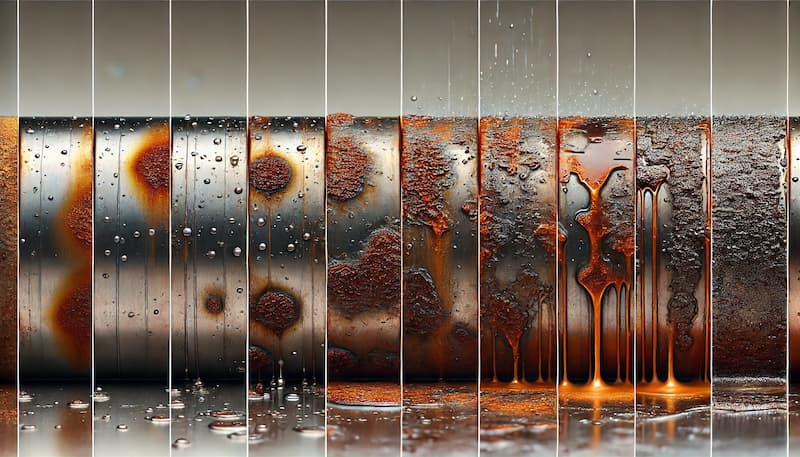
Rust is the product of an electrochemical reaction. When iron or steel meets oxygen and moisture, the iron atoms lose electrons — oxidizing into iron oxide. Not all rust looks the same, and the type you’re dealing with determines which product actually works.
One thing most guides skip: rust accelerates. A pinhole of corrosion grows exponentially once it breaches the factory primer or galvanized coating. Pacific Northwest boat owners know this firsthand — salt fog in coastal Washington does in six months what takes three years inland. The faster you intervene, the less metal you lose.
Vehicle resale value lost to visible rust damage — treating scale rust early costs under $50 in product versus thousands lost at trade-in (FHWA / Zerust corrosion data)
Not all converters use the same formula, and not all formulas suit all jobs. Here’s how to read the label.
Tannic acid in a water carrier. Gentler, lower odor, easier cleanup. Good for light-to-moderate surface rust on garden tools, railings, fences, or indoor structural steel. Not suited for heavy scale or marine environments where deep penetration is critical.
Phosphoric acid as the active agent. More aggressive conversion, better penetration into pitting. Creates iron phosphate rather than ferric tannate — a slightly different chemistry, equally stable. Requires more careful handling and adequate ventilation. Better for automotive, marine, and industrial applications where rust is serious.
This is where modern formulas like XionLab’s 2-in-1 Rust Converter and Metal Primer change the calculation. One coat converts the rust AND leaves a primer-ready surface — eliminating the separate priming step entirely. On a trailer frame or boat hull, cutting out that step saves hours of labor. One coat. Done.
For automotive-specific applications, see our detailed rust converter for automotive protection guide covering undercarriages, frame rails, and body panel treatment.
Before buying anything, assess the rust. Five minutes of inspection saves a trip back to the hardware store — and prevents applying the wrong product to the wrong surface.
Run a gloved hand across the surface. If chunks break away, you have scale rust. If the rust is firm and thin, it’s surface rust. Probe pitting with a pick — deep cratering needs a heavier formula. Hold a flashlight behind thin panels: light coming through means perforation, and no converter helps structurally at that point.
Also consider the environment. Coastal exposure, road-salt zones, or marine applications call for acid-based or 2-in-1 formulas regardless of current rust severity. Salt accelerates re-oxidation of anything less than a properly converted and topcoated surface.
I learned the severity-matching lesson the hard way. A neighbor near coastal Louisiana had a bass boat trailer with scale rust about a quarter-inch thick on the tongue hardware. We grabbed a water-based converter from the hardware store. It worked on the lighter areas — but the heavily scaled sections stayed mottled and re-rusted within a few months. Applied XionLab’s 2-in-1 on the second attempt with proper wire brush prep first. Two coats held solid through two full seasons of saltwater launching and retrieval. Not all are equal.
| Rust Severity | Recommended Product | Prep Needed | Coats |
|---|---|---|---|
| Light surface rust (thin orange film) | Water-based converter | Wire brush loose debris | 1 |
| Moderate rust (scale, flaking) | Acid-based or 2-in-1 converter-primer | Remove flakes, degrease | 2 |
| Heavy pitting rust | 2-in-1 converter-primer + body filler | Scrape, wire brush, degrease | 2–3 |
| Perforated structural rust | Replacement required | No converter restores this | N/A |
XionLab has formulated rust conversion chemistry since 2015 with a single guiding principle: safer for the person applying it, safer for the environment, and more effective than products requiring multiple steps. See how the formula works across applications in our industrial rust converter guide.
Converts active rust to ferric tannate while building a primer-ready surface — one product, one application sequence, no separate priming step.
Formulated for high-humidity and salt-spray environments — Gulf Coast, Pacific Northwest, Great Lakes — where standard converters underperform.
Water-based carrier. No hazardous disposal. Safe for workshop use without heavy-duty respiratory equipment — Safer For You, Safer For The Environment.
Works on undercarriages, frame rails, quarter panels, and rocker panels — tested in salt-belt states through full winter seasons.
Covers large structural steel surfaces efficiently. Bridge steel, tank exteriors, equipment frames — designed for volume application without sacrificing conversion quality.
The ferric tannate layer resists moisture penetration and acts as a chemical barrier against future oxidation — not just a surface coating.
Application technique matters as much as product choice. The sequence is non-negotiable. Skip a step and you’ll get adhesion failure, uneven conversion, or peeling topcoat within months.
The most frequent failure. Converter applied over heavily contaminated, greasy metal won’t penetrate or bond. Five minutes with a wire brush and degreaser prevents a complete redo.
Rust converters need film thickness to react completely. Apply it like a coat of paint, not a wipe-down. Thin application leaves unconverted rust underneath.
Topcoating before full cure traps outgassing solvents and blocks the chemical reaction. 24 hours minimum before topcoat — 48 hours in humid or cold conditions. Rush this and the paint fails.
Rust converters are designed for ferrous metals — iron and steel. Aluminum, copper, and intact chrome plating don’t react. But galvanized steel with failed zinc coating? Those exposed steel areas absolutely respond to converter treatment.
Here’s the hard truth — a converter stabilizes rust, but it won’t restore structural integrity to metal eaten through. Perforated sections need to be cut out and replaced. No converter fixes that — and any product claiming otherwise is overpromising.
A note on competitors: Corroseal works well for lighter surface rust and is easy to find at hardware stores. Where XionLab pulls ahead is in its 2-in-1 formula — skip the primer step entirely — and in penetration depth for heavy scale rust on vehicles and marine equipment. For straightforward surface rust jobs, either product handles it competently. For serious corrosion, the formulation difference shows.
Can I paint over rust converter directly?
Yes — after full cure (24–48 hours). Most oil-based primers and alkyd topcoats adhere well to a converted surface. If you used a 2-in-1 formula, the converted layer IS the primer. Apply topcoat once fully cured. Latex paints are compatible but check the product label for specific guidance.
How long does rust converter protection last?
The converted ferric tannate layer is chemically stable and won’t spontaneously re-rust. With a quality oil-based topcoat over XionLab’s 2-in-1 formula, you can realistically expect 5–10 years of protection on a properly treated undercarriage in moderate conditions. Marine and road-salt environments shorten that window without annual inspection and touch-up.
Does rust converter work on really heavy rust?
Yes, but with caveats. Scale rust and moderate pitting respond well to 2–3 coats of an acid-based or 2-in-1 formula. Rust so deep the metal is perforated cannot be saved by any converter — it requires replacement. The rule: if the metal flexes or crumbles, replace it first.
Is rust converter safe to use indoors?
Water-based formulas like XionLab are significantly safer than solvent-based products. Still, work with adequate ventilation — open windows, run a fan. Gloves and safety glasses are standard practice with any converter formula.
Can I use rust converter on a car frame?
Absolutely — it’s one of the best applications. Clean and degrease the frame thoroughly, remove flaking scale, apply two coats of converter-primer, and topcoat with rubberized undercoating or chassis paint. But if the frame shows structural rust penetration near welds or load-bearing sections, have a body shop assess it before relying on surface treatment.
Do I need to remove all rust before applying a converter?
No — and this is the key advantage over removers. Remove loose, flaking, or crumbling rust so the product can reach the solid rust underneath. But you don’t need to grind to bare metal. The converter reacts with the rust remaining on the surface. That’s exactly the point of using a converter instead of a remover.
What is the difference between rust converter and rust neutralizer?
Effectively the same product — “rust neutralizer” is a marketing term often used for phosphoric acid formulas, while “rust converter” typically refers to tannic acid-based products. Both chemically neutralize iron oxide into stable compounds. The end compound differs slightly (iron phosphate vs. ferric tannate), but both are paintable and protective.
How do rust converters compare to rust-preventive primers?
Rust-preventive primers — like zinc chromate — work only on clean metal. They can’t treat existing rust. On any already-rusted surface, a converter is always step one. After full conversion and cure, a rust-preventive topcoat extends the protection timeline significantly.
XionLab’s 2-in-1 Rust Converter and Metal Primer converts active rust AND primes the surface in a single application — less labor, less mess, longer-lasting protection. Formulated for serious rust on serious surfaces since 2015.
Safer For You, Safer For The Environment