No products in the cart.
Quick Answer: Rust is the reddish-brown iron oxide produced when iron and oxygen react in the presence of water. It is one specific type of corrosion — the broader chemical process by which most metals lose mass and strength. Stop the reaction with a converter and primer like XionLab's 2-in-1 formula, and the rust cycle ends.
The Chemistry
What Rust Actually Is at the Atomic Level
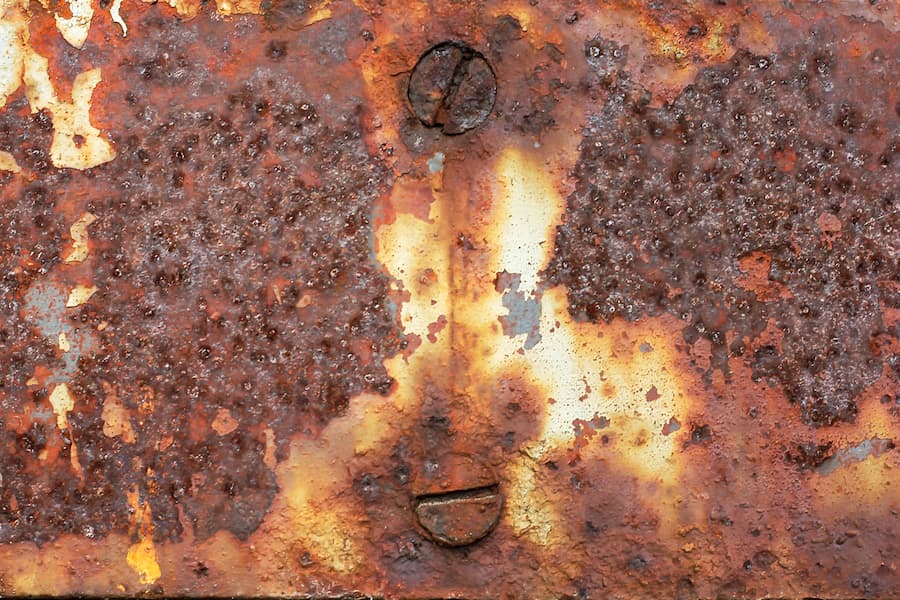
Rust forms through electrochemistry, not magic. When iron atoms sit next to water and oxygen, they give up two electrons each and become positively charged iron ions. Those ions bond with oxygen and hydroxide groups to form hydrated iron oxides — the flaky orange crust everyone recognizes.
Chemists usually write the simplified reaction as 4Fe + 3O₂ + 6H₂O → 4Fe(OH)₃. But the real story is messier. Iron can take three oxide forms: FeO (a black, divalent oxide), Fe₂O₃ (red trivalent hematite), and Fe₃O₄ (a dense magnetite mix). Most surface rust starts dark, then converts to red hematite as more oxygen reaches the crystal lattice. The result? A friable orange scale, loose and unwilling to protect.
And here lies the danger. Unlike the tight aluminum oxide film on a soda can, iron oxide cracks, lifts, and traps more moisture underneath. Each new layer drives oxygen deeper. So rust accelerates itself once it starts. No pause. No equilibrium. Salt wins every time.
The Association for Materials Protection and Performance (AMPP), formerly NACE International, has been studying this cascade for decades — and its findings shape every modern coating standard we follow at XionLab.
Rust vs Corrosion
Why the Distinction Really Matters
People use the words interchangeably, but engineers don't. Corrosion is the umbrella — any chemical breakdown of a metal due to its environment. Rust is one branch: the corrosion of iron and its alloys. Copper turns green. Aluminum dulls to gray. Zinc develops a chalky white film. None of those are rust, even though all are corrosion.
Why bother with the difference? Because the treatment changes. Rust responds to tannic-acid conversion chemistry. Aluminum oxide needs mechanical removal or chromate conversion. Treat one as the other and you waste product or worse, you damage the substrate. Sequence is everything.
Where the Confusion Comes From
Hardware stores sell “rust removers” for steel, aluminum, and even chrome on the same shelf. Each product targets a different oxide. Reading the chemistry behind a converter saves a frustrating Saturday afternoon. Our deeper write-up on the science of rust converters and primers walks through every conversion step we use in the XionLab formula.
Five Faces of Corrosion
The Forms You'll Run Into
Iron and steel rarely fail from one neat cause. Most failures stack two or three corrosion modes at once. Knowing which kind you face changes how you treat it.
| Type | How It Looks | Where It Strikes | Best First Step |
|---|---|---|---|
| Uniform Rust | Even orange film across an entire panel | Outdoor steel, fence rails, garden tools | Wire brush, then convert |
| Pitting | Tiny deep craters, often hidden | Stainless near saltwater, pump bodies | Inspect with magnification first |
| Crevice | Concentrated rust under washers, gaskets | Bolted assemblies, lap joints | Disassemble if possible, then treat |
| Galvanic | Faster rust where two metals touch | Steel rivets in aluminum boats | Isolate the dissimilar metals |
| Stress Corrosion | Hairline cracks under tension | Pressure piping, marine fasteners | Replace the part, do not patch |
Yet most homeowners and weekend mechanics deal with the first kind — uniform surface rust on tools, trailers, mowers, gates, and trailer frames. So that is what most converter products, including ours, target first.
By the Numbers
Corrosion Costs More Than People Realize
$2.5 Trillion
Estimated annual global cost of corrosion, equal to roughly 3.4% of world GDP. Source: NACE/AMPP IMPACT study.
The number sounds abstract until you scale it down. In the United States alone the figure climbs above $450 billion every year — bridges, water mains, vehicle frames, refinery vessels, all silently shedding metal. AMPP's research suggests we could recover between 15% and 35% of that loss with smarter coatings and earlier intervention.
So the math actually favors the careful homeowner too. A $25 bottle of converter applied at year three can postpone a $700 repaint at year five. Time matters more than money here.
Passivation
Why Iron Rusts but Aluminum Does Not
Look at an empty aluminum can left in the rain for a year. It dulls slightly, maybe spots, but never flakes. Now picture an iron skillet in the same yard. Different planet.
The answer is passivation. Some metals form an oxide film — dense, tightly bonded, and only a few nanometers thick — thin enough to be invisible, strong enough to seal the surface against further attack. Aluminum, titanium, stainless steel, and chromium all benefit from this trick. Iron does not. Its oxide cracks open, lifts away, and gives fresh atoms straight access to oxygen.
So when iron meets moisture, the oxidation cycle never closes. One coat. Done. The metal keeps shedding until either the moisture stops or someone converts the existing oxide into a stable protective film. A converter does the second job chemically, locking the iron into ferric tannate, which behaves more like aluminum's passive layer than open rust.
For a deeper read on how this conversion chemistry works on car bodies and frames, our piece on rust converter for automotive protection covers the full process step by step.
Real-World Drivers
What Speeds Up Rust on Your Property
Three variables drive nearly every rust problem we see at the shop: humidity, salt, and dissimilar metals. Above 60% relative humidity, a thin water film clings to bare steel long enough for the electrochemical cell to form. Below that threshold, rust slows dramatically.
Region matters too. Boat owners along the Gulf Coast watch flash rust appear overnight on transom hardware. Salt-belt states like Ohio and Pennsylvania spread tens of thousands of tons of road salt every winter, which doubles or triples corrosion rates on undercarriages compared with the Mountain West. Pacific Northwest homeowners battle rain-driven crevice rust on fence brackets. Not all regions are equal.
The Galvanic Trap
Pair a steel bolt with an aluminum panel, add a damp environment, and you create a tiny battery. Electrons flow from the less noble metal (aluminum) to the more noble one (steel), and the aluminum loses mass ten times faster than it would alone. Or flip the pair on a boat and the steel rivets rot inside an aluminum hull. Either way the dissimilar contact pays the price.
Temperature Cycles
Heating and cooling pumps moisture in and out of microscopic pores. Each cycle deposits a fresh trace of salt or acid. So a part stored in an unheated garage near a coast often rusts faster than the same part left outside year-round in a dry climate. Counter-intuitive, but real.
pH and Industrial Pollutants
Acid rain in heavy industrial corridors drops surface pH below 5, which accelerates iron loss noticeably. The same pattern shows up near agricultural operations where ammonia and fertilizer dust settle on equipment. Steel buckets at a Pennsylvania dairy farm last a third as long as identical buckets at a dry-climate ranch. Chemistry plays favorites, and acidic moisture is the worst guest. Even diesel exhaust in a closed garage adds sulfur compounds, which dissolve into condensation films and pit unprotected steel slowly over years.
How Converters Work
Stopping the Reaction Instead of Sanding It Off
Two main approaches exist for handling rust on a finished part. Mechanical removal — wire brush, sandblasting, grinding — strips the oxide back to bare metal, then a primer goes on top. Conversion chemistry takes a different path. It reacts with the iron oxide already present, turning it into a stable black ferric tannate film. That film bonds to the substrate and accepts paint directly.
| Method | Skill Required | Time per sq ft | Best Use Case |
|---|---|---|---|
| Sandblasting | High — equipment + PPE | ~3 minutes | Heavy structural pitting |
| Wire Wheel + Primer | Medium | ~6 minutes | Localized flaky rust |
| XionLab 2-in-1 Converter | Low — brush or roller | ~1 minute | Surface and moderate rust under 1/16" |
| Pure Rust Remover | Low | ~4 minutes (soak) | Small parts that fit in a bucket |
I learned this lesson on a 1998 Chevy trailer frame last spring in Tallahassee. The frame had about a quarter-inch of scaly orange rust along the spring perches after three winters of coastal driving. We knocked down the loose flakes with a stiff brush, wiped it clean, and rolled on XionLab in two thin coats. Forty-eight hours later the surface was a uniform matte black, ready for topcoat. Same trailer two years on — still locked in. Salt wins every time, except where the converter sealed it.
Prevention Playbook
Five Habits That Stop Rust Before It Costs You
Treating rust is half the battle. Preventing the next round saves real money. We have walked through hundreds of customer projects and seen the same five habits separate equipment lasting decades from equipment dying young.
1. Dry Storage Beats Outdoor Storage
Tools and trailers parked outside in coastal zones lose useful life roughly three to five times faster than indoor-stored counterparts. A simple covered structure pays for itself within a few seasons through avoided repairs. And ventilation matters even more than walls — condensation under a tight tarp is worse than honest rain.
2. Wash the Salt Off Promptly
Salt-belt drivers in Pennsylvania, Ohio, Michigan, and upstate New York should rinse undercarriages within 24 hours of road brine exposure. Gulf Coast boaters need a freshwater rinse after every saltwater trip. Plain water flushes chloride ions before they migrate into seams and threaded fasteners. One coat. Done. Same idea applies here.
3. Touch Up Scratches the Same Week
A scratch through paint exposes bare iron to oxygen instantly. Within seven days in humid air the breach develops a rust pinhole, and within a month the surrounding paint lifts. Carry a small brush bottle of XionLab in the toolbox, dab any chip the day it appears, and the problem disappears.
4. Isolate Dissimilar Metals
Bolts, brackets, and fasteners should match the substrate when possible — stainless screws into aluminum panels, galvanized fasteners into mild steel framing, and so on. When mixing is unavoidable, an insulating washer or a dab of dielectric grease breaks the galvanic cell. The cost is pennies. The savings are real.
5. Inspect Twice a Year
Set a calendar reminder for spring and fall walk-arounds on trailers, gates, mowers, and outdoor equipment. Small spots caught early take five minutes of converter and a dab of paint. Ignored, the same spots become structural problems requiring grinding, welding, and full repainting. Sequence is everything.
15–35%
Savings achievable on corrosion costs through better coatings and earlier intervention, equal to $375–$875 billion globally per year. Source: AMPP IMPACT analysis.
How XionLab Helps
What Makes the 2-in-1 Formula Different
⚡
One-Step Application
Converter and primer in a single coat. No waiting between two products, no compatibility worries.
🌿
Low-VOC Formula
Water-based chemistry safer for indoor garages and the people working in them. Cleans up with soap.
🛡
Black Protective Film
The ferric tannate layer bonds tightly to remaining iron, sealing against fresh oxygen and water.
🏠
Topcoat-Ready
Accepts most automotive, industrial, and marine paints once cured. No second primer needed.
🌡️
Brush, Roll, or Spray
Apply with whatever fits the job. Vertical surfaces, undercarriages, fence posts — all workable.
🔥
Heat Resistant
Stable through summer trailer floors and engine bays once cured. Tested on Gulf Coast equipment.
Honest Comparisons
Where XionLab Fits Against Other Options
Corroseal works well on lighter surface rust and gives a similar black-finish result. Where XionLab pulls ahead is on heavier scale and on the topcoat bond — our tannin blend grabs deeper into pitted areas, and the primer matrix accepts oil-based finishes without flash rust bleed-through. Ospho is cheaper per ounce, but it leaves a white phosphate residue and demands a separate primer step afterward. Trade-offs everywhere.
Honest caveat: XionLab will not fix perforated metal. If you can poke a screwdriver through the panel, the part needs cutting and welding, not chemistry. The product is meant to stabilize sound metal carrying scaling or surface rust — not resurrect Swiss cheese. And on already painted surfaces with no rust, a converter offers no benefit; pick a regular primer instead.
For people deciding between products, our side-by-side breakdown in rust converter vs rust remover covers the chemistry and the cost trade-offs in plain language.
Frequently Asked
Common Questions on Rust and Corrosion
Is rust the same thing as corrosion?
No. Rust is a specific corrosion product formed when iron reacts with oxygen and water. Corrosion is the broader category and covers metals like copper (green patina), aluminum (dull oxide), and zinc (white film). All rust is corrosion, but not all corrosion is rust.
Why does aluminum not rust like iron does?
Aluminum forms a tight, self-sealing oxide film only a few nanometers thick. That film passivates the surface and blocks further oxygen from reaching the metal. Iron oxide, by contrast, cracks and flakes, exposing fresh metal underneath.
How fast does rust spread once it starts?
Speed depends on humidity, temperature, salt exposure, and electrolyte concentration. In coastal salt air, visible spread can happen within days. In dry climates above 4,000 feet, the same surface might take years to show. Salt wins every time once moisture is present.
Can I paint directly over rust without a converter?
Painting over active rust traps moisture and oxygen, which feeds the reaction beneath your topcoat. Within a season, the new paint will bubble, lift, or stain through. A converter chemically stops the reaction first — then paint adheres to a stable film.
Does a rust converter work on stainless steel?
Stainless typically pits rather than rusting uniformly, and the metal already carries a chromium passive layer. Converters target ferric oxide, so they offer limited benefit on stainless. For pitted stainless, mechanical polishing and passivation chemistry from a stainless specialist work better.
How long does a converter coating last before topcoating?
XionLab's 2-in-1 cures in 24 to 48 hours under normal conditions and remains topcoat-ready for several weeks indoors. Outdoor exposure during that window is fine, but a topcoat extends UV life dramatically. One coat. Done.
What about galvanized steel? Does that ever rust?
Galvanized steel has a zinc coating, which sacrifices itself first through galvanic protection. As long as zinc remains, the steel below is safe. Once the zinc wears down to expose bare iron — common after 15 to 30 years outdoors — the steel begins to rust normally.
Is rust dangerous to handle or breathe?
Dry rust dust can irritate lungs if inhaled during heavy sanding, and tetanus risk rises with deep punctures from rusty objects. A simple dust mask, gloves, and an up-to-date tetanus shot handle the practical concerns. Per CDC guidance, the rust itself is not toxic.
Will XionLab work on something I can stick a screwdriver through?
No. The product stabilizes sound metal with scaling or moderate rust. Perforated panels need cutting and welding, not chemistry. Be straightforward about the structural condition before reaching for a converter.
Lock In Your Rust Repair Today
One bottle. Two coats. Decades of protection for your tools, trailers, fences, and frames.
Safer For You, Safer For The Environment