No products in the cart.
Quick Answer: Yes, you can paint over rust converter once the conversion film has fully cured. Use an oil-based or epoxy topcoat after a 24 to 48 hour wait. Skip latex and water-based paints — they will not bond properly to the polymer layer left behind by the converter.
The Short Version
Painting Over Rust Converter, Without Wrecking the Bond
You finished a rust converter pass on a stubborn fender, a railing, or some old shop equipment. Now you want a finished look. So the obvious next move is paint. But the chemistry under the surface decides whether your topcoat sticks for a decade or peels in a single Gulf Coast summer.
This guide walks through the answer in plain English. We will cover cure windows, paint compatibility, surface prep, and the small mistakes ruining otherwise solid jobs. And we will show where XionLab 2-in-1 Rust Converter and Metal Primer changes the math by acting as both converter and primer in one coat.
Short answer up front. Yes, you can paint over rust converter. The longer answer involves which paints to choose, how long to wait, and why surface chemistry matters more than most weekend warriors realize. According to NACE International research, corrosion costs the global economy roughly $2.5 trillion every year — about 3.4% of global GDP. Most of those losses trace back to coating failures, not the steel itself.
Foundations
What Rust Converter Actually Leaves Behind
Rust converter is a chemical product, not a paint. It uses tannic acid or phosphoric acid to react with iron oxide, the orange flaky stuff people call rust. That reaction creates iron tannate or iron phosphate — a stable, dark-colored compound bonded to the underlying steel.
Most converters also carry a polymer binder. So once the chemistry runs to completion, you are left with a thin black or dark navy film. Think of it as a sealed layer with a polymer skin on top.
That polymer skin is the surface your paint will actually touch. It changes everything about topcoat selection.
The conversion layer is not a finish coat
A common misconception: people think the converter is the final coat. It is not. UV light slowly degrades the polymer, water sneaks through micro-pores, and oxygen finds a way in eventually. So the topcoat does the heavy lifting against the elements. The converter just gives the topcoat something honest to grip.
Sequence is everything.
- Prep: Loose flaking gets wire-brushed off down to firm, well-attached rust.
- Apply: Converter goes on, reacts with the remaining iron oxide, and forms a stable polymer film.
- Cure: The film hardens fully — usually 24 to 48 hours depending on humidity.
- Seal: An oil-based or epoxy topcoat seals the conversion layer against weather.
- Build: A second topcoat goes on once the first reaches its recoat window.
Cure Time Reality
How Long to Wait Before You Pick Up a Paint Brush
Cure time is the single biggest variable. Move too soon and the topcoat lifts the half-set polymer. Wait too long without protection and dust contaminates the surface.
The honest range runs 24 to 48 hours after the final converter coat. Lab conditions sit around 70°F with 50% relative humidity. Real conditions rarely cooperate.
48 hrs
The cure window most pros wait before applying any topcoat — long enough for the polymer to fully harden, short enough to avoid surface contamination.
I learned the hard way last summer on a back-porch railing in Mobile. Air sat heavy at about 90% humidity for three days straight. So I gave the converter a full 60 hours instead of the usual 24, then wiped the polymer down with a damp cloth, dried it, and rolled on an oil-based enamel. Two seasons later, no peel, no creep, no underrun. Patience won that round.
Humidity, temperature, and the cure clock
Cold slows the chemistry. Heat speeds it. High humidity prevents the polymer from properly releasing residual moisture. Below 50°F, most converters refuse to cure cleanly at all. Above 95°F, the surface skins over before the body of the film fully reacts.
The sweet spot lives between 60°F and 85°F with relative humidity under 70%.
Paint Compatibility
Which Topcoats Bond and Which Ones Fail
Not all paints are equal. The polymer left behind by a rust converter behaves differently from bare metal or a traditional zinc primer. Some paint chemistries grab it. Others slide right off the moment moisture sneaks underneath.
Here is the breakdown most product datasheets bury in fine print:
| Topcoat Type | Bonds to Cured Converter? | Notes |
|---|---|---|
| Oil-Based Enamel | Yes — excellent | The pigment binders dissolve slightly into the polymer skin. Forms an intermolecular bond. |
| Two-Part Epoxy | Yes — excellent | Amine cure cross-links straight through the polymer. Best choice for marine and industrial. |
| Alkyd Enamel | Yes — good | Similar to oil-based. Works well, slightly slower drying. |
| Polyurethane (Solvent) | Yes — good | Solid choice for wheels and exposed steel. Apply in thin coats. |
| Latex | No — fails | Water carrier never bonds with the polymer. Peels in months. |
| Acrylic Water-Based | No — fails | Same issue as latex. Skip it entirely. |
| Spray Lacquer | Marginal | Bonds chemically but is too brittle for outdoor use. |
Why the gap between oil-based and water-based? Carrier solvents in oil paints partially soften the cured polymer. So molecules from the topcoat actually fuse with the converter film instead of just sitting on top. Water-based products cannot do that. They dry as a separate layer with no real chemical handshake.
What about spray-can primers?
An aerosol oil-based primer works fine. Aerosol latex primers, including most “bonding” rebrands, do not. Read the label. If the cleanup line says “soap and water”, walk away.
Step-By-Step
The Full Painting Sequence After Rust Converter
Below is the workflow professional refinishers use. Each step exists for a reason — skip one and the job risks lifting within the first wet season.
1. Confirm full cure
Press a fingernail into a corner of the treated area. The film should resist firmly with no tackiness. If it dents at all, wait another 12 hours.
2. Wipe down the surface
Use a damp cloth and plain water. No solvents. No degreasers. Just water removes airborne dust and any residual unreacted converter.
3. Light scuff (optional but recommended for gloss)
For a glossy showroom finish on automotive panels, a 320 to 400 grit scuff helps the topcoat key in. Rough surfaces in shop or marine contexts can skip this step.
4. Tack rag pass
A tack rag picks up the scuff dust without leaving residue.
5. First topcoat — thin and even
Lay down a thin first pass. Heavy first coats trap solvent against the polymer and cause fish-eye. Manufacturer recoat windows usually run 4 to 6 hours for oil enamel and 6 to 8 hours for two-part epoxy.
6. Second topcoat — full hide
Build full hide on the second pass. Two thin coats outperform one thick coat every single time.
7. Final cure
Finished paint reaches handling cure in 24 hours and full chemical cure around 7 days. Avoid pressure washing or harsh solvents until the week is up.
One coat. Done. That sequence repeats for every rust-converted surface, from a wheelbarrow to a barge.
XionLab Difference
How XionLab 2-in-1 Helps You Skip the Primer Step
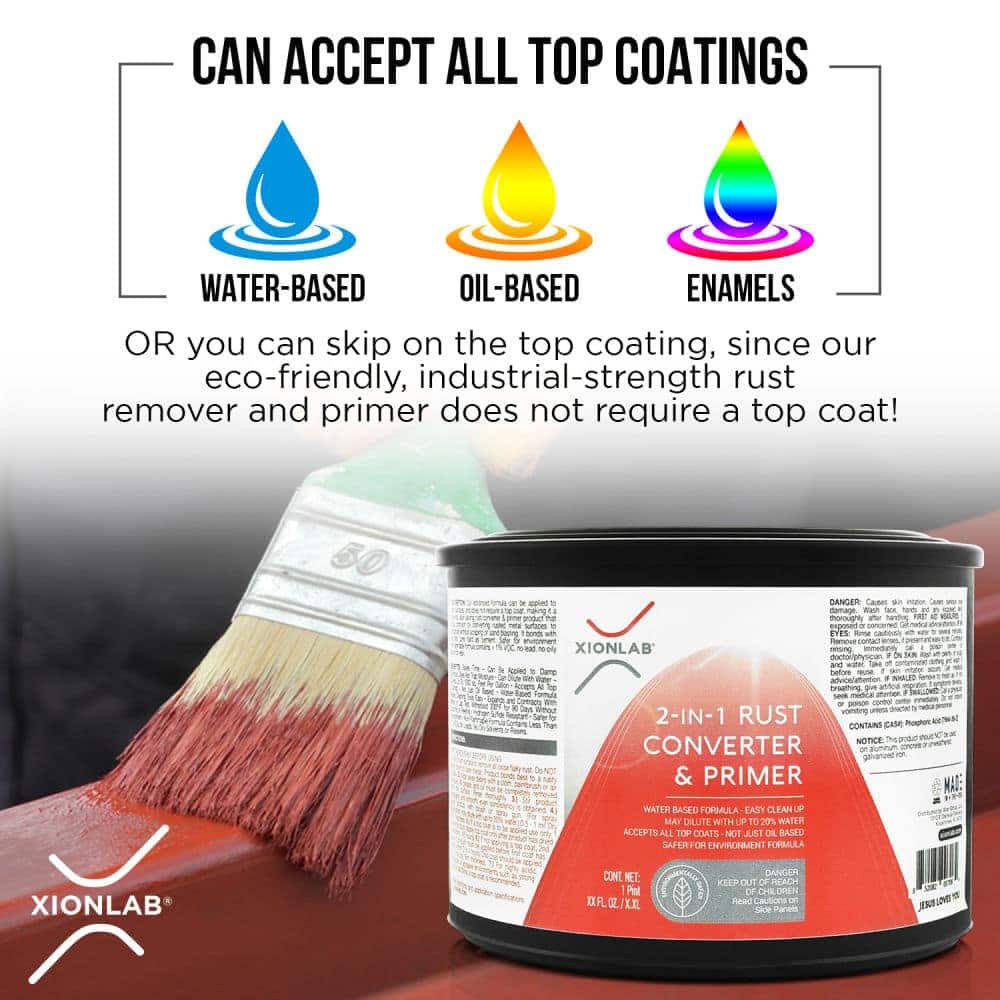
Most converters require a separate primer or rely on the topcoat itself to act as one. XionLab 2-in-1 Rust Converter and Metal Primer rolls both jobs into a single bottle. So once the polymer film cures, you can go straight to a finish coat.
●
Converter Plus Primer
Single product replaces two. Saves a full day of cure stacking and one whole product cost.
●
Eco-Friendly Chemistry
Water-cleanable, low VOC, non-flammable. Ships safe by ground. Friendly to indoor projects.
●
Topcoat-Ready Polymer
Engineered to accept oil, alkyd, epoxy, and solvent polyurethane. Skip the primer entirely.
●
Brush, Roll, or Spray
Three application methods. Same result. Use what your project geometry demands.
●
Marine-Grade Bond
Tested on Gulf Coast and Pacific Northwest steel. Holds up against salt mist and standing water.
●
USA-Made Since 2015
Formulated and bottled in the United States. Same lab tested by AMPP-certified inspectors.
That two-jobs-in-one nature is the difference. Where a traditional Corroseal pass works well on lighter surface rust, XionLab pulls ahead by skipping the primer cycle entirely and tying both chemistries into one polymer film. Less product. Less cure time. Same protection.
Common Mistakes
Mistakes Every DIY Painter Makes At Least Once
Some errors only show up after a wet winter. By the time the topcoat lifts in sheets, the underlying converter has already been compromised. Here is the short list of preventable failures.
- Painting too soon: The polymer needs its full 24 to 48 hours. Pushing the timer is the most common cause of bubbling and flaking.
- Using latex paint: Water-based topcoats simply will not bond. They peel within months even on indoor projects.
- Skipping the wipe-down: Dust on the cured polymer becomes a release layer between the converter and topcoat.
- Painting a perforated panel: Rust converter cannot rebuild metal. If the steel is holed through, weld or patch first.
- Heavy first coat: A thick layer traps solvent, fish-eyes, and shoves the polymer skin around. Lay it thin.
- Ignoring weather: Below 50°F or above 95°F sabotages cure chemistry. Wait for a workable day.
The honest limit
Rust converter has a hard ceiling. It cannot fix perforated metal. It cannot rebuild a structurally weak panel. And it will not save a panel sitting in standing water week after week. For those situations, cut the bad metal out, weld in fresh stock, and start clean. No converter on the market changes that fact.
Industry Data
Why Topcoat Choice Matters in Real Dollars
Coating failures are a major slice of corrosion costs. The numbers humble even seasoned engineers.
$2.5T
Estimated global cost of corrosion annually, per NACE International / AMPP — roughly 3.4% of global GDP.
Properly applied corrosion control could reclaim 15 to 35% of those losses. So when a topcoat fails because someone rushed the converter cure, the cost stretches well beyond a weekend afternoon. Corrosionpedia notes the conversion layer protects only as long as the topcoat above it remains intact. That cause-and-effect chain is what makes the paint choice and cure window non-negotiable.
Salt wins every time when prep gets shortcut. Saltwater accelerates cathodic disbonding under the topcoat. Salt belt states from Michigan down through Ohio see steel fail in two winters that lasted ten in Arizona. Coastal Florida and the Pacific Northwest face the same accelerated curve. Geography matters.
When the topcoat fails
Once the topcoat compromises, oxygen and moisture re-enter the conversion layer. The film slowly delaminates from the steel. And the rust returns under the paint, often invisible until the panel pops a blister. So the goal is never just “convert the rust”. The goal is convert it, seal it, and keep the seal alive.
Brand Comparison
XionLab vs Other Rust Converters: An Honest Look
No single product wins every category. Here is a fair comparison so you can pick the right tool for your scenario.
| Brand | Strength | Weakness | Best For |
|---|---|---|---|
| XionLab 2-in-1 | Converter and primer combined; topcoat-ready | Premium price point | Marine, automotive, industrial steel |
| Corroseal | Affordable; widely available | Requires separate primer in many cases | Lighter surface rust, indoor projects |
| POR-15 | Hard, glossy finish; UV-stable with topcoat | Sensitive to humidity during cure | Restoration projects with controlled conditions |
| Permatex Rust Treatment | Cheap; fast acting | Thinner film; needs more coats | Quick fixes on small parts |
| Eastwood Rust Converter | Solid bond; trusted brand | Strong odor; not low-VOC | Garage and shop work |
Where XionLab pulls ahead is the integrated primer step. So one coat covers ground that takes two products with most other systems. For a side-by-side breakdown, see our best rust converter guide and the automotive protection deep-dive.
Application Scenarios
Painting Over Rust Converter on Specific Surfaces
Different metal surfaces ask different questions of the topcoat. A garden gate sits in a different world from a boat trailer or a brake caliper. Below are the situations folks ask about most.
Automotive bodywork and chassis
Vehicle sheet panels deserve a 320 grit scuff before any topcoat lands. High-build epoxy fills micro-imperfections, basecoat lays down color, clear protects everything from UV. Solvent polyurethane finishes give a showroom shine and shrug off road salt better than acrylics. Avoid waterborne automotive paints — they perch on top instead of fusing through.
Chassis pieces and undercarriages endure a far rougher life. Two-part epoxy with a chip-resistant additive carries the brunt there. Our automotive guide walks through every step.
Marine gear and boat trailers
Saltwater is brutal. Pick a marine-grade epoxy formulated specifically for immersion service. Roll two thin films with a recoat window of 6 to 8 hours between layers. Full chemical hardening runs about seven days before the trailer dips back into seawater. Skipping that hardening window remains the leading cause of premature peel on coastal rigs.
For mixed aluminum and steel fasteners, watch for galvanic interactions. The converter neutralizes ferric oxide, but dissimilar alloys still demand careful electrical isolation.
Outdoor furniture and ironwork
Patio sets, wrought-iron railings, and garden gates accept oil-based enamel beautifully. Roll one converter pass, give it 48 hours, then build two thin enamel layers. Most installations hold for five to seven years before needing touch-up. More on outdoor furniture care.
Industrial machinery and shop tools
Heavy-duty kit inside warehouses handles oil-based industrial enamel without complaint. Solvent polyurethane behaves identically. A properly hardened conversion film mates with either. Skip waterborne products even indoors — a single humid August is enough to break that adhesion.
FAQ
Frequently Asked Questions
Can I paint over rust converter without a primer?
Yes. Modern converters with a polymer binder, including XionLab 2-in-1, double as a primer. Apply your finish coat directly once the converter has cured for 24 to 48 hours.
How long should I wait before painting over rust converter?
Wait at least 24 hours under ideal conditions and a full 48 hours in humid or cold weather. The film must be hard to a fingernail press with no tackiness.
Can I use latex paint over rust converter?
No. Latex and water-based acrylics do not bond to the cured polymer film. The topcoat will peel within months. Stick with oil-based, alkyd, epoxy, or solvent polyurethane finishes.
What happens if I paint too soon?
Premature painting traps solvent and moisture under the topcoat. Expect bubbling, fish-eye, and eventual peeling. The conversion layer underneath also suffers, leaving the steel exposed again.
Does rust converter work on heavily rusted metal?
It works on firm rust, even thick scaly rust about a quarter-inch thick. It does not work on perforated metal. Holes need welding or patching first.
Can I spray paint over rust converter?
Yes — aerosol oil-based enamels, alkyd sprays, and solvent polyurethane sprays bond well. Avoid aerosol latex and water-based spray paints.
Will rust come back through the paint?
Only if the topcoat fails or the original rust included perforations. A properly converted surface with an oil or epoxy topcoat lasts 5 to 10 years in most outdoor conditions.
Do I need to scuff the converter before painting?
Scuffing helps for high-gloss automotive finishes but is not required for general shop, marine, or outdoor use. A wipe with a damp cloth is enough for most projects.
Is XionLab better than Corroseal for outdoor projects?
Corroseal works well for lighter surface rust and indoor jobs. Where XionLab pulls ahead is heavier rust, marine exposure, and projects where you want to skip a separate primer step.
Ready to Convert and Coat Right the First Time?
XionLab 2-in-1 turns rust into a topcoat-ready surface in a single application. Safer for you. Safer for the environment.
Safer For You, Safer For The Environment