
No products in the cart.
How to prep, prime, and topcoat converted rust — so your metal stays protected for years, not months
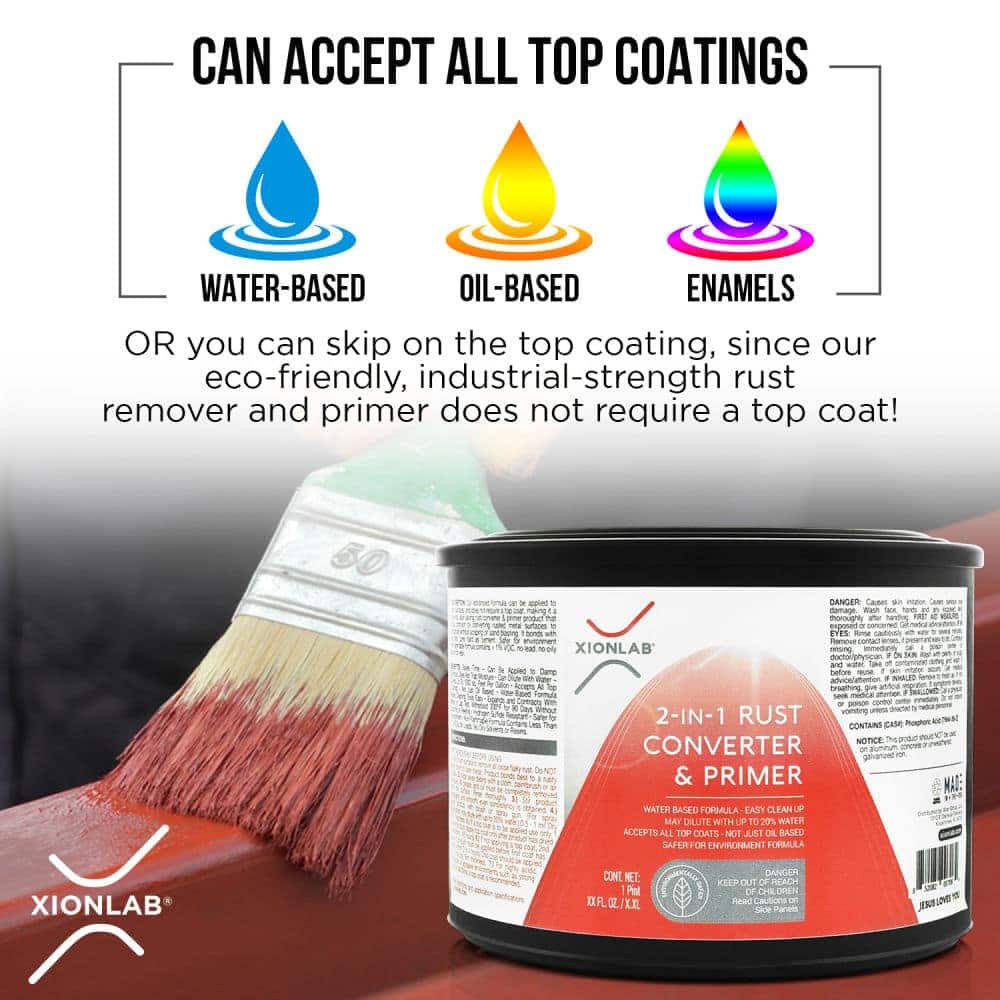
Quick Answer: Yes — you can absolutely paint over rust converter, and you should. After the converter cures for 48 hours, apply an oil-based or epoxy topcoat directly over the black polymeric layer. Skip latex and water-based paints; they won’t bond properly to the converted surface.
RUST CHEMISTRY
What Happens When Rust Converter Meets Iron Oxide
Many homeowners picture rust as a cosmetic nuisance — orange flakes on a gate hinge or bubbled paint along a truck rocker panel. But the chemistry runs deeper. Iron oxide is porous. Moisture and oxygen pass right through it, gnawing into healthy steel underneath. One square inch of heavily pitted surface can lose about a quarter of its original wall thickness in under five years along the Gulf Coast, where salt-laden breezes accelerate the degradation dramatically.
Rust converter changes the equation. The tannic acid in the formula reacts with iron oxide to produce iron tannate — a dark, stable compound with no porosity. Simultaneously, an organic polymer bonds over the tannate layer and creates a tangible shield. So the answer to “can you paint over rust converter” is baked right into the product’s design: the polymer stratum acts as a primer, ready to accept oil-based or epoxy topcoats.
And here’s the part many guides skip. Iron tannate alone is not waterproof. It resists further oxidation far better than raw iron oxide does, but leave it exposed on a coastal dock piling or a Midwest salt-belt undercarriage and moisture will eventually discover a pathway. Paint seals the deal.
$2.5 Trillion
Estimated annual global cost of corrosion — roughly 3.4% of world GDP — according to NACE International’s IMPACT study
KEY DIFFERENCES
Rust Converter vs Rust Remover — Why It Matters for Painting
Plenty of folks grab a jug of phosphoric acid stripper and assume they’re getting the same thing as a converter. They’re not. Acid removers dissolve the oxide entirely, which sounds appealing until you consider exposed bare steel begins oxidizing again within hours in humid air. You still need a separate primer before paint goes on.
Converters work differently. They transform existing rust into a stable base and leave a built-in primer behind. Fewer stages, less waste, and a substrate ready for topcoat after curing. For anyone asking “can you paint over rust converter,” the follow-up answer is simple: it’s actually simpler to paint over converter than over a chemically stripped substrate.
| Factor | Rust Converter | Rust Remover (Acid-Based) |
|---|---|---|
| How it works | Converts iron oxide to iron tannate | Dissolves oxide with acid |
| Primer included? | Yes — organic polymer layer | No — separate primer needed |
| Paint ready after cure? | Yes, 48 hours | No — prime first, then paint |
| Re-rust risk | Low if topcoated | High unless sealed quickly |
| Best paint type | Oil-based or epoxy | Varies by primer used |
| Skin safety | Mild irritant — gloves recommended | Corrosive — full PPE required |
| Environmental impact | Water-based, lower VOC | Often high VOC, acid disposal needed |
Corroseal and Ospho both get decent results on light surface rust. Where XionLab pulls ahead is the 2-in-1 formula — primer and converter in one step — which means you go from rusty surface to paintable primer faster, with one less product to buy.
STEP-BY-STEP
Painting Over Rust Converter: The Right Way
Knowing you can paint over rust converter is only half the battle. Botch the sequencing and you’ll be chiseling blistered topcoat six months from now. Here’s the process we’ve tested on everything from trailer hitches in Florida to farm gates in Iowa.
Step 1 — Prep the Surface
Knock off loose rust scale with a wire brush or stiff-bristled scraper. Don’t strip the surface to bare metal — converter needs rust to react with. Leave a thin layer of firmly attached oxide. Clean off grease, oil, and road salt with a degreaser, then let the metal dry completely. Water-soluble formulas dissolve around lingering moisture, which sabotages the chemical bonding before it even initiates.
Step 2 — Apply Rust Converter
Brush or roll the converter onto small areas like railings and brackets. Use an airless sprayer for larger surfaces — car undercarriages, sheet metal panels, equipment frames. One gallon covers roughly 500 square feet by brush. Wait at least 20 minutes between coats. Two coats is standard for moderate-to-heavy rust.
Step 3 — Let It Cure
Patience matters here. The surface turns black within 20 minutes, but the full chemical conversion takes 48 hours. High humidity slows things down; Gulf Coast and Pacific Northwest projects sometimes need an extra day. Before painting, wipe the cured surface with a damp cloth to remove any residual converter film.
Step 4 — Apply Paint
Use oil-based or epoxy paint. Period. Latex and water-based formulas don’t adhere to the polymeric primer layer. Two coats of paint are recommended for outdoor exposure — rain, UV, salt mist, and temperature swings will test a single coat quickly. Sand lightly between coats for better adhesion.
- Cure first: 48 hours minimum before any topcoat
- Wipe clean: Damp cloth to remove excess converter residue
- Choose oil or epoxy: Latex and powder coats will peel
- Two coats outdoors: Single layers fail under weather stress
- Sand between coats: Light scuffing improves topcoat grip
PAINT SELECTION
Best Paints to Use Over Rust Converter
Not every can of paint on the hardware store shelf belongs over converted rust. I learned this the hard way on a backyard smoker frame in Tampa — brushed on a leftover quart of exterior latex, and the whole thing began peeling within three weeks. The polymeric layer rejected the water-based formula completely.
Oil-based alkyd enamels deliver the strongest bond. Epoxy coatings work too, especially for high-moisture environments like boat trailers and dock hardware. Both achieve a tenacious mechanical grip on the organic polymer left behind by the converter.
Some contractors prefer a standalone oil-based primer between the converter and the finish coat. Technically unnecessary — the converter itself functions as a primer — but an additional barrier doesn’t hurt on mission-critical metalwork like structural beams or automotive frames. Just verify the primer is oil-based too.
Paints to Avoid
Latex. Water-based acrylics. Powder coatings. All three react poorly with the tannate-polymer surface. You’ll see peeling within weeks, sometimes days. Spray cans labeled “all-surface” are usually water-based underneath the marketing — read the fine print.
500 sq ft
Approximate coverage per gallon of brush-applied rust converter — enough to treat a full-size truck frame or a 20-foot iron fence run
APPLICATIONS
Where Can You Apply Rust Converter Before Painting?
Rust converter works on any ferrous surface — iron and iron alloys, including mild steel and cast iron. It won’t react with stainless steel, aluminum, copper, zinc, or galvanized metal because those materials don’t produce iron oxide.
Common targets include vehicle undercarriages, trailer frames, metal gates and fences, farm equipment, mower decks, iron railings, storage tanks, sheet metal roofing, and structural I-beams. Basically, if it’s rusting and made of iron-based metal, converter followed by paint is the play.
One honest caveat: converter won’t resurrect perforated metal. If the rust has eaten all the way through a panel, there’s nothing left for the tannic acid to bond with. Patch or replace the section first, then treat the surrounding area with converter and paint. Pretending a gaping hole will seal itself just wastes product.
- Automotive: Frames, wheel wells, rocker panels, trailer hitches
- Agricultural: Tractor bodies, plows, barn hardware, grain bins
- Marine: Dock pilings, boat trailers, anchor chains, hull fittings
- Residential: Iron railings, fence posts, mailboxes, outdoor furniture
- Industrial: Storage tanks, I-beams, pipe supports, equipment housings
PREPARATION
Surface Preparation: The Step Most People Rush Through
Skip the prep and you’ll blame the converter when the paint fails. Nine times out of ten, peeling topcoats trace back to greasy surfaces, trapped moisture, or too much loose scale blocking the chemical reaction.
Start with a hammer and scraper for thick, flaking rust. Follow up with 80-grit sandpaper or a wire wheel on a drill. The goal is to remove anything loose while leaving a uniform layer of firm oxide. This is where the tannic acid does its work.
Degrease with a solvent-based decontaminant or ordinary dish soap and water. Rubberized undercoating, road tar, and machining lubricants all impede absorption. Rinse methodically and allow several hours for the workpiece to air-dry. Using converter on damp metal dilutes the active ingredients and produces a weak, patchy conversion layer. Diligence here prevents a costly redo later.
Salt is another concealed adversary — particularly for anyone working in salt-belt states like Michigan, Ohio, or upstate New York. Sodium chloride crystals embedded in pitted metal can disrupt the tannate reaction. A vigorous freshwater flush before application handles it, but you have to look for the salt deliberately. Most DIYers don’t.
PRO TIPS
Application Tips for a Lasting Finish
Rust converter goes on straight from the bottle — no thinning required. Give it a good shake first, though. Settled formula distributes unevenly, which produces inconsistent conversion and blotchy primer coverage.
Temperature matters more than people realize. The ideal range sits between 50°F and 100°F. Below 50°F the chemical reaction crawls; above 100°F the liquid can flash-dry before bonding. Last summer we treated a flatbed trailer outside a warehouse near Pensacola. The mercury climbed past 102°F by noon and the formula dried in streaks. We switched to early-morning application — worked perfectly.
Coverage drops with spray application: about 300 square feet per gallon versus 500 for brush work. Aerosol cans are the most wasteful at roughly 24 square feet per gallon equivalent, so reserve them for tight spots only.
- Temperature window: 50–100°F for proper curing
- Between coats: Wait at least 20 minutes, no more than 24 hours
- Clean tools immediately: Soap and water while the converter is still wet
- Don’t pour unused product back: Contaminated formula spoils the whole bottle
- Wear safety glasses and chemical-resistant gloves: Mild skin and eye irritant
- Work in ventilation: Fumes are low but still present in enclosed spaces
TOPCOAT NECESSITY
Do You Actually Have to Paint After Converting Rust?
Technically, no. The converter creates a protective layer on its own. But “technically” doesn’t hold up well against a Charleston winter or a North Dakota spring thaw.
Here’s why painting matters: the converter’s polymer membrane shields metal from continued oxidation, but UV radiation degrades polymers over time. Rain seeps into micro-pores. Thermal cycling opens tiny fractures. Pile salt spray on top of all of it — the arithmetic doesn’t work in your favor.
Indoor projects get more leeway. A converted cast-iron woodstove surround in a dry basement? Probably fine unpainted for years. An exterior iron railing in the Pacific Northwest rain belt? Paint it. Two coats minimum.
The converted surface turns a flat black, which some people don’t mind. Others find it unappealing on decorative metalwork like fence finials or porch railings. Either way, adding paint costs a few dollars and extends protection by years. Hard to argue against it.
And here’s one more thing worth mentioning. According to AMPP (formerly NACE International), applying protective coatings over properly prepared surfaces can reduce corrosion-related maintenance costs by 15–35%. Paint over converter isn’t just cosmetic — it’s the financially smart move for any metal exposed to weather.
XIONLAB ADVANTAGE
How XionLab Helps You Get From Rust to Painted Finish Faster
🔬
2-in-1 Formula
Converts rust and primes in a single application — no separate primer step before painting
🌊
Water-Based & Low VOC
Safer for indoor use and easier cleanup with soap and water
🖌️
Brush, Roll, or Spray
Flexible application for any project size — from small brackets to full vehicle frames
🛡️
Long-Lasting Barrier
Organic polymer film seals out moisture and oxygen after topcoating
🌿
Eco-Conscious Design
No harsh acids — plant-derived tannic acid does the heavy lifting
⚡
Fast Visual Confirmation
Surface turns black within 20 minutes so you know the reaction is working
MISTAKES TO AVOID
Common Mistakes When Painting Over Rust Converter
We encounter the same handful of grievances on automotive forums and DIY groups. Almost every one traces back to a preventable blunder.
Painting too soon. Forty-eight hours is the minimum. Rushing the cure means the conversion reaction is incomplete beneath the paint. Moisture gets trapped, and within a few months the topcoat blisters. Just wait.
Using the wrong paint. Latex over converter peels. Every single time. We’ve watched it happen on iron deck railings, garden furniture, even a carport support column. Oil-based or epoxy — those are your only two options.
Skipping the wipe-down. Excess dried converter sitting on the surface acts as a barrier between the primer layer and your paint. A quick pass with a damp rag lifts the residue and gives the topcoat a clean bonding surface.
Applying on wet or greasy metal. Converter is water-soluble. So moisture dilutes it on contact and prevents the tannic acid from reaching iron oxide at full strength. Grease deposits a slick barrier the converter can’t penetrate. Clean and dry first. No shortcuts.
Storing converter past its shelf life. Most formulas stay viable for about nine months, opened or not. Expired product applies fine but reacts poorly — you end up with a weak layer under your paint. Check the date before you start.
FAQ
Frequently Asked Questions About Painting Over Rust Converter
Can you paint over rust converter with any type of paint?
No. Use oil-based alkyd enamels or epoxy coatings only. Latex, acrylic, water-based, and powder-coat paints do not bond with the polymeric primer layer and will peel.
How long should rust converter dry before painting?
Allow a full 48-hour cure time. The surface looks dry much sooner, but the chemical conversion underneath continues working. Painting before the reaction finishes leads to blistering and delamination.
Do I need a separate primer over rust converter?
Generally no — rust converter doubles as a primer. Some professionals add an oil-based primer for structural or marine applications where maximum protection matters, but it isn’t strictly required.
What surfaces work with rust converter?
Any ferrous metal — iron, steel, and cast iron. It won’t react with aluminum, copper, stainless steel, zinc, or galvanized surfaces because those materials don’t form iron oxide.
Can you paint over rust converter on a car frame?
Yes. Automotive frames are one of the most common applications. Apply two converter coats, wait 48 hours, then topcoat with oil-based or epoxy paint. This is standard practice in salt-belt states where road chemicals attack exposed steel.
Will paint over rust converter stop future rusting?
It dramatically slows it down. The converter neutralizes existing oxide while the paint layer blocks moisture and oxygen. No system lasts forever — inspect painted metal annually and touch up chips or scratches promptly.
Is rust converter safe to use at home?
Water-based formulas like XionLab’s 2-in-1 use plant-derived tannic acid and contain no harsh acids. Wear gloves and safety glasses as a precaution, and work in a ventilated area. Keep the product away from children and pets.
Can I use spray paint over rust converter?
Only if the spray paint is oil-based or epoxy. Many aerosol “rust paints” are actually water-based acrylic underneath the branding — read the label before spraying over converted metal.
How much rust converter do I need for a typical project?
One gallon covers about 500 square feet by brush or roller. Spray application reduces coverage to around 300 square feet per gallon. A mid-size truck frame usually takes about half a gallon for two coats.
SAFETY
Safety and Storage Reminders
Rust converter is far milder than acid-based removers, but basic precautions still apply. Wear chemical-resistant gloves and splash-proof goggles during application. Old clothes are a smart call — converter stains fabric permanently.
Store the product between 50°F and 85°F. Freezing ruins the formula. So does prolonged heat above 100°F. Keep the cap sealed tightly and never pour used product back into the original container — cross-contamination spoils the remaining inventory faster than calendar aging.
Dispose of leftover converter according to your state or local hazardous-materials guidelines. Most water-based formulas qualify for standard household chemical disposal, but check the label and your municipality’s rules. XionLab’s formula is eco-friendly by design — lower VOC content and no phosphoric acid means less environmental impact at every stage.
One more note: converter is not food-grade once cured. Don’t use it inside water tanks, cooking equipment, or anything in contact with food or drinking water. Industrial containment? Fine. Your kitchen smoker grate? Hard no.
Ready to Convert Rust and Paint With Confidence?
XionLab’s 2-in-1 Rust Converter & Metal Primer gives you a paintable surface in one step. Safer for you, safer for the environment.
Safer For You, Safer For The Environment • Since 2015