No products in the cart.
Can You Prime Over Rust Converter? (2026 Guide)
A field-tested look at when a primer coat earns its keep on top of cured tannate — and when it just slows the job down.
Quick Answer: Yes, you can prime over rust converter — once the tannate film has cured for 24 to 48 hours. Stick with oil-based alkyd or two-part epoxy. Avoid latex and waterborne acrylic completely.
Decision Framework
Prime Over Rust Converter, or Paint Straight On?
The shortest honest answer goes like this. Many converter products already act as a primer on their own, making a second underlayer optional. But “optional” is hardly equivalent to “useless.” Where the workpiece sees salt, UV, abrasion, or a thin topcoat color, an extra pass carries genuine weight.
So the real question isn’t can you prime — you can. It becomes when priming pays back additional labor, plus which underlayer chemistry plays nicely with cured iron tannate.
Converter first. Then primer. Then finish. Done. Most projects live or die on how those layers communicate. Get one chemistry mismatch and the entire stack peels.
$2.5T
Annual global cost of corrosion, per NACE International — about 3.4% of global GDP, much traceable to coating failures.
Picking the wrong primer is one of those small mistakes with outsized cost. Painting straight over converter works fine for many situations. Adding underlayer adds insurance — when the finish runs thin, glossy, or holds light color, insurance pays.
The Chemistry
What Happens Chemically When You Prime Over Rust Converter
Rust converter handles two jobs at once. Tannic acid reacts with iron oxide and forms iron tannate, a stable dark complex. A polymer carrier — typically styrene-acrylic or modified PVA emulsion — leaves behind a thin barrier once water flashes off. That barrier locks tannate in place.
Apply compatible primer on top and three things happen sequentially. Resin wets the polymer barrier. Solvents inside oil and epoxy products soften the upper few microns just enough to interlock molecularly. Once fully cured, you get a continuous system.
Apply latex instead and water reactivates the underlying polymer. Adhesion plummets. Sometimes converter lifts in sheets. We’ve watched careful preparation ruined by one wrong product choice.
The role of the polymer carrier
Not every converter uses identical polymer. Budget formulations skimp on binder content. Tannate forms regardless, but the protective film stays thin and porous — moisture migrates through within months. Better chemistry uses denser binder plus higher tannin loading, making the cured film function as a genuine barrier independently.
This matters when priming. A weak film barely holds anything above. A strong film carries the next layer cleanly without delamination risk.
Timing
How Long Before You Can Prime
Cure timing is where most rookie projects fall apart. The converter looks dry within twenty minutes. Chemistry isn’t finished. Iron tannate keeps forming for hours after the surface goes flat to touch.
- Touch dry: 20 to 30 minutes at 70°F and 50% relative humidity.
- Recoat ready (second converter pass): 24 hours.
- Prime ready (oil or epoxy): 24 to 48 hours. Closer to 48 during cold or humid weather.
- Full chemical cure: 5 to 7 days. Some products quote longer windows for marine service.
Humidity is the variable people forget. At 80% RH and 60°F, double the window. Polymer cannot flash off water with nowhere to release.
Timing is everything here. Rush it and the bond fails.
Primer Compatibility
Which Primers Play Nice, Which Ones Don’t
The chemistry rule is simple. Solvent-based goes on top. Water-based does not.
Oil-based alkyd primers
Default safe pick. Alkyd products flash solvent, bond tight against cured tannate, and accept any oil or epoxy finish. Rust-Oleum, Sherwin-Williams Pro-Cryl alkyd, and PPG Pitt-Tech all qualify.
Two-part epoxy primers
Heavy-duty industrial jobs love amine-cured epoxy. Trailer frames. Structural beams. Marine hulls. Amine systems build a genuinely waterproof barrier above tannate. Boatyards along the Gulf and Pacific Northwest specify these formulas precisely because chloride permeability stays remarkably low — see the AMPP coating performance standards for the technical specs.
Etch primers and zinc-rich primers
Skip both. Acid etch needs bare substrate. Zinc-rich formulas need direct galvanic contact — the tannate barrier blocks that contact. Use only after grinding down to bright steel.
Latex, water-based acrylic, and rattle-can primers
Avoid. Water carrier softens the polymer skin, dropping adhesion to whatever survives by friction alone. Latex over fresh tannate has peeled in long strips inside ninety days during our field tests.
Compatibility Matrix
| Primer Type | Bond on Cured Tannate | Cure Before Topcoat | Best Use | Avoid When |
|---|---|---|---|---|
| Oil-based alkyd | Excellent | 8 to 24 hr | General DIY, fences, trailers | Sub-50°F application |
| Two-part epoxy | Excellent | 16 to 24 hr | Marine, structural, salt-belt vehicles | Indoor furniture, light service |
| Direct-to-metal (DTM) acrylic | Marginal | 4 to 8 hr | Mild interior only | Outdoor exposure |
| Latex / waterborne | Poor | — | Not recommended | Any service over tannate |
| Etch primer | Won’t bond | — | Bare bright steel only | Anywhere a converter has been used |
| Zinc-rich primer | Won’t function | — | Bare steel, galvanic protection | Tannate present — no metal contact |
Practical Decisions
Scenarios Where Priming Pays Off
Scenario 1 — You Want a Light Topcoat Color
Cured tannate looks almost black. Cover it with a single pass of pale yellow or pearl white and dark substrate shadows through visibly. A white or gray underlayer hides the contrast in one step. On a patio set we treated last spring, the underlayer cut topcoat consumption by roughly a third.
Scenario 2 — Salt, Spray, or Marine Exposure
Coastal homeowners and salt-belt drivers should think in barrier terms. Bare tannate film alone offers decent protection. Add an epoxy underlayer and moisture resistance climbs dramatically. Marine corrosion work almost always specs separate underlayer between converter and finish.
Scenario 3 — Epoxy Topcoat Systems
If the final layer happens to be two-part epoxy, primer doubles as a tie layer. The epoxy underlayer cures alongside finish and forms a chemically cross-linked stack. You lose almost nothing in flexibility while gaining substantial chemical resistance.
Scenario 4 — Mixed Rusted and Bare Metal
Real-world surfaces are rarely uniform. You’ll often discover rusty patches next to grinding marks straight down to bright steel. Converter handles rusted spots. Bare zones need underlayer. An alkyd applied over both unifies the system.
When to Skip the Primer
When You Don’t Need a Separate Primer
Plenty of projects run fine without separate underlayer. Skip the extra pass when these three conditions line up:
- Finish is oil-based and thick. Two coats of quality alkyd above cured tannate carry their own priming load.
- Exposure stays mild. Indoor furniture. A shed door. A garage tool rack.
- Color hides the substrate. Black, dark gray, hunter green, deep red — anything which doesn’t ghost through.
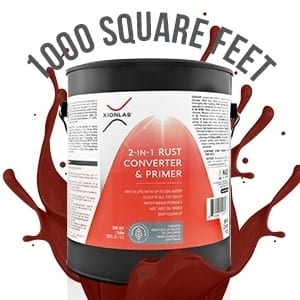
Some converter chemistries already build in primer-grade adhesion. XionLab’s 2-in-1 Rust Converter & Metal Primer handles both jobs within a single bottle.
Step-by-Step
How to Apply Rust Converter and Prime Correctly
Step 1 — Clean and De-Scale
Knock loose flaking scale away with a wire wheel. Degrease. Rinse. Dry. Oil and silicone are silent killers — invisible, lethal to adhesion. Two minutes of solvent wipe saves two hours of rework.
Step 2 — Apply the Rust Converter
Brush, roller, or HVLP at the spec rate. Most products cover 250 to 500 square feet per gallon. Two thin passes beat one heavy flood. Wait twenty-four hours between applications. First pass does chemistry. Second seals.
Step 3 — Cure the Tannate
Walk away. Twenty-four to forty-eight hours minimum. Longer when temperatures dip below 60°F or humidity climbs above 70%. Polymer needs to flash water off completely.
Step 4 — Prime (If You’re Priming)
Apply alkyd or two-part epoxy. Roller or brush for trim. Spray gun for panels. Aim two to three wet mils per pass.
Step 5 — Topcoat Within the Recoat Window
Most products cite a recoat window of 24 to 72 hours. Miss it and you’ll need scuff-sanding for adhesion. Apply finish inside the window and you get chemical bonding rather than purely mechanical grip.
Product Path
Rust Converter Plus Primer vs. 2-in-1 Product
You have two basic paths. Either use a converter plus a separate underlayer (three layers, three cure cycles). Or use a 2-in-1 like XionLab’s formulation and skip the middle stage.
| Approach | Layers | Active Working Time | Total Cycle | Best For |
|---|---|---|---|---|
| Converter + Separate Primer + Topcoat | 3 | ~3 hours work | 3 to 5 days | Marine, structural, salt-belt critical service |
| 2-in-1 Converter-Primer + Topcoat | 2 | ~2 hours work | 1 to 2 days | DIY, automotive panels, garden gear, weekend rescues |
| Converter Only (no topcoat) | 1 | ~1 hour work | 1 day | Hidden interior structure, undersides, garage racks |
48 hr
Typical full cure window before finish — the single most-skipped checkpoint among DIY rust treatments.
Field Story
A Real Project — Patio Table Rescue on the Gulf Coast
Last March we tackled a 1990s wrought iron bistro set sitting outside Pensacola. Salt air had eaten the underside of the tabletop plus chair stretchers. Pitting about a quarter-inch deep in spots. The owner tried rattle-can rust paint two summers earlier — it lasted four months before peeling away.
Our workflow ran like this. Wire-brushed loose scale. Wiped using mineral spirits. Brushed on two passes of converter (24 hours apart). Waited 48 hours for cure — Gulf humidity hovered around 75%. Then a layer of alkyd in pale gray. Two coats of satin finish above.
The set is in its second summer now showing zero bleed-through, no edge lifting, no chalking. Not bad for what looked like a junkyard candidate. One small detail mattered most. We brushed converter into the pitting first, then rolled the flats afterward. Pulling product into deep spots made the difference.
Common Mistakes
What Goes Wrong When Priming Over a Converter
Mistake 1 — Priming too early
Most common error. Tannate looks dry, feels dry, yet polymer keeps flashing moisture underneath. Lay primer atop wet underlayer and you trap moisture beneath. Bubbles. Lifting. Sometimes weeks later.
Mistake 2 — Wrong primer chemistry
Latex or waterborne product over fresh tannate reactivates the polymer skin. Adhesion plummets immediately. Fix? Sand back and reprime using oil or epoxy.
Mistake 3 — Treating perforated metal
Honest limit. Converter and primer cannot restore metal already rusted clear through. If you can poke a screwdriver through the panel, you need patch plates. Converter buys time on thinning steel — never on missing steel.
Where XionLab Fits
Why XionLab’s 2-in-1 Makes Priming Simpler
Most converters do one job well — convert. They form tannate. Then they hand off to a separate underlayer plus a finish coat. That means three products. Plus three cure intervals. And three openings for chemistry mistakes.
XionLab’s 2-in-1 Rust Converter & Metal Primer combines tannate-forming chemistry with primer-grade resin in one application. The film cures harder, sands smoother, accepts most oil plus epoxy finishes directly. For roughly 80% of common projects — automotive panels, fence rails, garden tools, trailer frames, outdoor furniture — that single product eliminates the separate prime stage altogether.
Corroseal works well against lighter surface rust. Ospho delivers phosphoric-acid passivation quickly. Where XionLab pulls ahead is integrated underlayer — meaning the cured film already does what a separate alkyd would handle.
How XionLab Helps
⚙
One Product, Two Jobs
Converter chemistry plus primer adhesion in a single application — no separate prime step on most projects.
⏱
Faster Cycle Time
Saves a full day on most weekend rescues. Two coats. Topcoat. Done.
🌍
Low-VOC Chemistry
Water-based formulation meets stricter state air-quality rules without sacrificing barrier performance.
🛡
Salt-Belt Tested
Field-proven on Gulf Coast humidity and Northeast road-salt exposure. Holds where lesser formulas chalk.
🔫
Topcoat Friendly
Accepts oil-based alkyd, two-part epoxy, and most rust-grade aerosols without sanding between coats.
💰
Lower Total Cost
One product replaces two — converter plus primer — for most residential and automotive use cases.
Pro Details
Three Pro Details Beginners Miss
Detail 1 — Temperature Matters During Application
Most spec sheets quote a cure temperature. Almost none mention application temperature. Brush converter at 45°F and the polymer never properly films — that 70°F number becomes meaningless if application failed upfront. Manufacturers like Rust-Oleum specify 50°F minimum. Trust the label, ignore the optimistic forecast.
Detail 2 — Edges and Welds Need Extra Attention
Edges fail first. Welds fail second. Sharp corners shed coatings faster than flat panels because tension pulls wet liquid away from the lip during drying. Brush an extra band along every weld bead. Then brush a matching band of underlayer through the same path. Edge thickness matters more than panel thickness across real-world life.
Detail 3 — Document Batch Codes
Professional shops photograph every batch code. Casual DIYers rarely bother. Snap a quick phone image of the label code on every container before opening. When a system fails years later, that lot number tells the manufacturer if the issue traces back to a defective production run — or human error during installation. Cheap insurance against future warranty arguments. Salt-belt mechanics in Buffalo, Cleveland, and Detroit swear by this habit alone.
Quick Answers
FAQ — Priming Over Rust Converter
Can I apply primer the same day I apply rust converter?
No. Wait at least 24 hours, ideally 48 during humid or cool weather. The tannate reaction continues for hours after the surface goes dry to touch. Priming too early traps moisture beneath and the new layer bubbles.
What primer is safest for a beginner?
Oil-based alkyd. Brush-on or aerosol. Forgiving when application errors happen. Available at every hardware store nationwide. Rust-Oleum Clean Metal Primer makes a common starting point.
Can I use rust converter and primer on aluminum or galvanized?
No. Converter chemistry requires iron oxide to function. Aluminum, copper, stainless, and galvanized steel don’t form iron oxide — nothing for the chemistry to bind against. Use a self-etching product designed for those metals instead.
Does priming over rust converter change paint color?
Yes, helpfully. A white or gray underlayer hides the near-black tannate and lets a light finish reach proper color within one application. Skip primer and a yellow or pearl finish takes three passes before the dark substrate stops shadowing through.
What if I missed the primer recoat window?
Scuff-sand using 220 grit, wipe with a clean rag plus mineral spirits, then apply the finish. The bond becomes mechanical rather than chemical. Slightly weaker, still durable for most service.
How do I know if my old converter coat is still good?
Press a strip of masking tape firmly onto the cured surface. Pull it off fast. Black flakes or fibers of tannate stuck to the tape mean the bond has weakened — sand off and restart. A clean tape lift means you’re good to recoat.
Is XionLab’s 2-in-1 product a primer, a converter, or both?
Both. The formula converts rust into iron tannate and leaves a primer-grade film during a single pass. Most jobs don’t require a separate primer between the XionLab product and the finish. Marine and structural service may still benefit from an added epoxy underlayer.
Edge Cases
Unusual Jobs Where Primer Choice Matters Most
Most rust projects forgive mistakes. A few never do. Knowing where chemistry gets unforgiving keeps your effort alive.
- Restored cast iron stoves and grills. Rust converter isn’t heat-resistant — neither is most primer. Skip both. Use a high-temp ceramic-bonded enamel instead.
- Drinking water tanks. Not approved for potable contact. Use NSF/ANSI 61 certified linings only.
- Heavy chemical exposure (chlorine, sulfuric, acetic). Choose chemical-resistant epoxy rated for that environment. Standard alkyd dissolves.
- Surfaces being welded later. Sand back to bright metal at the weld zone. Welding through converter creates toxic fumes and contaminates the bead.
And regional notes. Salt-belt cars want epoxy plus a quality oil finish. Pacific Northwest moisture demands the same approach. Desert Southwest is friendlier — alkyd alone usually holds. Read climate before reading spec sheets.
Bottom Line
Bottom Line on Priming Over Rust Converter
Can you prime over rust converter? Yes — after tannate has fully cured and primer chemistry matches. Alkyd handles the safe default. Two-part epoxy carries heavy-duty work. Latex and waterborne acrylic products will not bond, full stop.
Should you? Sometimes. Marine and salt-belt jobs, light finish colors, mixed bare-and-rusted substrates, and high-flexure panels all benefit from an added underlayer. Indoor furniture beneath a thick dark finish usually does not.
To skip the whole question, a 2-in-1 like XionLab’s formulation does both jobs at once for most residential and automotive use. Faster timeline, fewer bottles, same protection. Respect the cure interval. Match the chemistry. Treat the edges. Get those right and the system lasts.
Ready to Stop Rust the Right Way?
Skip the guessing on primer compatibility. XionLab’s 2-in-1 Rust Converter & Metal Primer does the converter job and the primer job in a single coat — so your topcoat goes straight on top.
XionLab — Safer For You, Safer For The Environment