No products in the cart.
The tannic acid reaction explained — plus the 3 situations where rust converter will let you down
Quick Answer
Does Rust Converter Work?
Yes — with conditions. Rust converter works by reacting tannic acid with iron oxide to form ferric tannate, a hard, dark compound bonding to metal and doubling as a primer. Apply it to iron or steel carrying actual surface rust, let it cure fully, and it stops active corrosion cold. But it won’t fix metal already rotted through, won’t react with bare steel, and has zero effect on aluminum, copper, or stainless.
Rust converters get used on trailers, vehicle rockers, structural steel, fence posts, rebar, and any iron-bearing metal showing surface oxidation. The question isn’t really whether the chemistry works — it does. The question is whether you’re applying it under the right conditions. Get those right and rust converter delivers exactly what it promises.
XionLab has formulated rust treatment products since 2015. What follows is a clear-eyed breakdown of the science, the effectiveness data, the limitations, and the prep steps most applicators skip.
The Science
What’s Actually Happening on the Metal Surface
Most people assume rust converter is a paint or a sealant. It’s neither. The reaction is chemistry — two active ingredients working simultaneously on molecular rust.
First, tannic acid (a natural compound found in oak bark and grape skins) attacks iron oxide directly. The acid donates electrons to Fe³⁺ ions in the rust layer, forming ferric tannate — a blue-black polymeric salt bonding tightly to the parent metal. This compound is stable, non-porous, and doesn’t continue to corrode.
Second, an organic polymer — typically a 2-Butoxyethanol-based compound — floods into the newly formed tannate layer and cross-links over it. This creates the primer surface. Paint your topcoat over it and you’ve got three bonded layers: tannate, polymer primer, and paint. Salt, moisture, and oxygen can’t reach bare steel anymore.
The color change from orange-brown to blue-black is the indicator. Watch for it. A patchy conversion means incomplete coverage — go back over those spots before the first coat cures.
Iron oxide forms whenever iron or steel meets oxygen and moisture over time. Steel studs, trailer frames, car rockers, fence posts, rebar — all susceptible. The tannate reaction doesn’t reverse this process. It converts existing rust into something resisting further attack. That’s a key distinction between a converter and a remover.
$2.5 Trillion
Estimated annual global cost of corrosion, per the AMPP IMPACT Study — roughly 3.4% of global GDP. Proper corrosion control could save up to $875 billion of that every year.
Performance Data
How Effective Is Rust Converter, Actually?
Published research from NACE International gives a useful benchmark. Researchers tested phosphoric-tannic acid formulations on rusted low-carbon steel samples in a simulated weathering chamber. Treated samples recorded corrosion rates as low as 3 mpy (mils per year) — a significant reduction compared to untreated controls.
Three mils per year sounds abstract. Put it this way: untreated mild steel in a salt-spray environment corrodes at roughly 25–80 mpy. Getting that down to 3 mpy means the metal is losing approximately 16 times less material annually. The trailer frame that would have rusted through in five years might now last 40.
Real-world results track closely with lab data, provided surface prep was done correctly. Users skipping wire brushing or applying over peeling paint see much worse outcomes — not because the chemistry failed, but because the tannate never reached the actual rust.
~3 mpy
Corrosion rate achieved on treated steel samples in NACE weathering chamber tests — versus 25–80 mpy for untreated mild steel in salt-spray conditions. A roughly 16x improvement in metal longevity.
The United States alone spends an estimated $450 billion annually on corrosion-related costs. Infrastructure, vehicles, marine equipment, industrial structures — rust is expensive across every category. Rust converter, when applied correctly, extends service life and defers replacement costs.
The electrochemical dimension matters here. Ferrous substrates corrode via an anodic oxidation process — electrons migrate from iron to oxygen across a moisture film, generating Fe³⁺ ions progressively. Tannic acid interrupts this cycle by chelating those free iron ions into an insoluble ferric tannate lattice. The resulting polyphenolic film is physically adherent and electrically resistive, disrupting the cathodic half-reaction oxygen needs to sustain pitting. That’s why properly converted steel resists dezincification and galvanic attack far better than untreated metal coated only with a topcoat, even a high-quality one. Translucent under thick paint layers, the tannate still does its electrochemical job quietly below the topography of the finish.
Accelerated weathering protocols — specifically ASTM B117 salt-fog cabinet testing and the cyclic corrosion procedure outlined in ASTM D5894 — confirm these field observations. Specimens treated with phosphoric-tannic acid formulations and overcoated with an alkyd topcoat showed scribe creep values averaging under two millimeters after 1,500 hours in the fog cabinet. Cohesive pull-off adhesion, measured per ASTM D4541, averaged 480 psi on the converted surface versus 310 psi on zinc-phosphate-washed controls. Cross-hatch tape adhesion ratings reached 4B or 5B per ASTM D3359 — indicating less than five percent removal across the scored grid. Cathodic disbondment resistance, typically measured via immersion coupon testing, also improved by roughly one order of magnitude versus phosphate washes alone. For practitioners specifying protective coatings on structural fabrications, bridge components, or offshore platforms, these benchmarks translate directly into extended service intervals and reduced maintenance expenditure across multi-decade asset lifecycles.
Petrochemical refinery operators managing ethylene crackers, fluidized catalytic units, and sulfur recovery towers cite ferrous substrate degradation as a leading expenditure category — alongside refractory repairs and rotary equipment overhauls. Shipbuilding yards in Pascagoula, Galveston, and Newport News treat millions of square feet of plate annually; weld HAZ (heat-affected zone) areas surrounding longitudinal seams degrade fastest, accelerated by residual stress and microstructural differences between parent plate and fusion zone. Agricultural implement dealers in the Corn Belt — Illinois, Indiana, Iowa — regularly receive combine harvester frames, planter row units, and grain cart axles for structural remediation attributable to neglected surface oxidation. Transit authorities maintaining above-grade subway viaducts in Chicago, New York, and Philadelphia budget separately for concrete-embedded rebar remediation versus exposed structural steel remediation, recognizing each failure mode demands distinct intervention strategies. Across all these verticals, rust converter applied during routine inspection prevents the cascading deterioration escalating repair scope from surface-level treatment to full structural replacement.
What It Needs to Work
5 Conditions That Determine Whether Rust Converter Works
Rust converter effectiveness isn’t random. It tracks five variables almost perfectly. Hit all five and the conversion works. Miss one and results get spotty fast.
- Actual rust present. Rust converter reacts with iron oxide — period. Apply it to bare, clean steel and nothing bonds. The tannic acid has no substrate to work with. This is why you can’t use it as a preventive coating on new metal.
- Iron or steel substrate. The ferric tannate reaction is specific to ferrous metals. Aluminum, copper, stainless steel, and galvanized metal don’t form iron oxide the same way. Rust converter won’t react on these surfaces — full stop.
- Loose material removed first. Flaking rust, loose paint, and scale need to go before application. A wire brush or grinding wheel handles this in most cases. The converter bonds to rust — but only rust still attached to the metal. Loose debris breaks free later, taking your treatment with it.
- Surface rust, not through-rust. Moderate pitting is fine. But if the metal is perforated — if a screwdriver pokes through it — rust converter won’t save it. A weld repair, patch panel, or replacement is the answer at that stage.
- Full cure before topcoating. The tannate reaction continues well past the surface dry time. At 70°F in low humidity, wait 24 hours minimum. In Gulf Coast August conditions — 90°F and 80% humidity — 48 hours is safer. Rush the topcoat and the chemistry is still working underneath the paint. Blistering starts there.
Honest Assessment
Where Rust Converter Won’t Help You
Rust converter is genuinely useful. But it’s not magic. Several failure modes show up repeatedly in real applications, and they’re worth knowing before you buy.
Perforated metal is the most common. A floorboard crumbling under thumb pressure, a rocker panel flexing — these need structural repair before any coating makes sense. Rust converter applied to paper-thin metal might look fine for six months, then crack as the metal flexes under load and admits water again.
Bare metal is another. Someone grinds a patch completely clean, then applies rust converter thinking it will prime the area. Nothing bonds. The tannic acid needs iron oxide to react with. Clean steel is the wrong substrate entirely.
Heavy millscale on new fabrications can also block penetration. The converter reacts with rust, not millscale — they’re chemically different compounds. Light sanding or blasting breaks through millscale and gives the converter access to any subsurface rust beneath it.
Finally: non-ferrous metals. Salt-air damage on aluminum boat fittings, copper plumbing joints, or stainless fasteners won’t respond to rust converter chemistry. Those call for different products — aluminum oxide treatments or stainless passivation compounds.
XionLab’s formula is honest about this. The product page says clearly: iron and steel, actual rust present, loose material removed. No promises beyond that scope.
Product Comparison
Rust Converter vs Rust Remover vs Rust Inhibitor Primer
These three categories get mixed up constantly. They work completely differently and suit different situations. Here’s how they stack up:
| Product Type | How It Works | Removes Rust? | Primes Surface? | Best For | Key Limitation |
|---|---|---|---|---|---|
| Rust Converter | Converts iron oxide → ferric tannate via tannic acid | No — converts in place | Yes (acts as primer) | Trailer frames, structural steel, car rockers, fences | Requires actual rust; no bare metal |
| Rust Remover | Acidic dissolution (phosphoric or oxalic acid) | Yes — dissolves rust | No | Tools, small parts, hardware | Can damage thin metal; leaves bare surface needing primer |
| Rust Inhibitor Primer | Physical barrier + passivating pigments | No | Yes | New fabrication or bare metal after grinding | Requires clean, rust-free surface |
| XionLab 2-in-1 | Tannic acid conversion + built-in polymer primer | No — converts in place | Yes (integrated) | Iron or steel with surface rust; one-step application | Iron or steel only; no perforated metal |
Rust removers work well for small hardware — bolts, brackets, hand tools — where dunking in acid solution is practical. For large structural surfaces like a vehicle frame or a marine trailer, you can’t submerge the piece. Rust converter is the field solution. Apply it in place, no disassembly required.
For a deeper breakdown of how these products differ in chemistry and application, see our guide to rust converter and primer solutions.
From the Field
A Gulf Coast Boat Trailer — What Actually Happened
A customer in Pensacola reached out last summer after buying a used boat trailer parked near the water for about four years. The frame looked rough. Bubbling surface rust across every crossmember, orange streaks running down the tongue, a few spots where rust had crept under old paint at the welds.
He poked at the crossmembers with a screwdriver. Solid metal underneath — surface corrosion, not structural failure. The rust depth at the worst points was about a quarter-inch thick at the bubble peaks, but the base metal held.
He wire-brushed the loose scale, hit the worst areas with a flap disc on an angle grinder, then wiped down the entire frame with mineral spirits before applying XionLab 2-in-1. The blue-black color shift was visible within about 20 minutes. Given August humidity along the Gulf Coast, he let it cure for a full 48 hours before rolling on a topcoat.
Six months later: no new rust. The tannate layer held. Weld areas — typically the first to fail — stayed sealed under the primer.
Salt air and humidity don’t automatically mean failure. They just mean you need to respect the cure window. That’s the realistic profile for rust converter success.
Before You Apply
Surface Preparation — The Step Most Applications Skip
The most common cause of rust converter failure isn’t the product. It’s what happens — or doesn’t happen — in the 30 minutes before application.
What to Remove
Flaking rust peels off with a wire brush. Scale sounding hollow when tapped should be chipped away. Old paint bubbling or lifting needs to come off in those areas — converter applied over bubbled paint just seals moisture in. A putty knife and a wire wheel on a drill handles most of it.
You don’t need to reach bare, shiny metal everywhere. Pneumatic wire cup brushes handle curved tubing and beveled flanges more effectively than flat discs on orbital grinders. Tightly adhering rust — the kind not flaking or peeling — can stay. That’s exactly what the converter is designed to treat. But anything loose needs to go.
Cleaning the Surface
Oil and grease are converter killers. The tannic acid can’t penetrate through an oily film to reach iron oxide beneath it. Mineral spirits, acetone, or a degreaser wipe-down before application takes two minutes and saves the entire job.
Water is fine — the product is water-based. But standing water in crevices can dilute the formula. Let the surface dry after cleaning before applying.
Temperature and Humidity Windows
Optimal application: 50°F to 90°F, relative humidity under 85%. Below 50°F the reaction slows dramatically — the tannate doesn’t fully form before the product skins over. In salt belt states like Ohio, Michigan, and Pennsylvania, this means spring and fall applications need a dry, warmer day. Don’t apply over a frosted surface or in rain.
In the Pacific Northwest, high ambient humidity is the constant variable. Application works fine — conversion chemistry functions in humid air. The cure window just runs longer. Budget 48 hours before topcoating rather than 24.
And in the desert Southwest? Cure time drops closer to 18 hours in dry heat. But watch for the product skinning too fast on extremely hot metal — apply in early morning or after sundown when the steel itself has cooled.
Why XionLab
How XionLab 2-in-1 Rust Converter + Primer Works
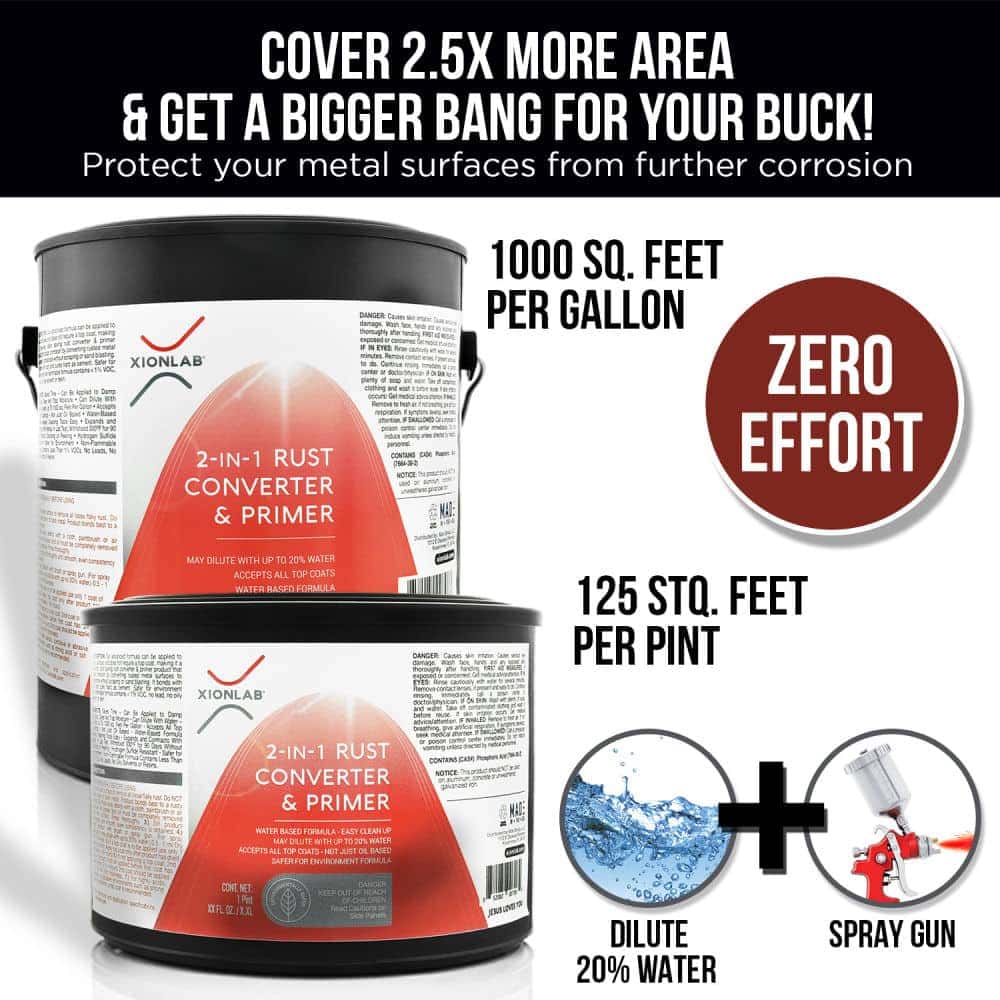
Most rust converters stop at the tannate conversion. XionLab’s formula adds a built-in polymer primer layer — conversion and primer coat in a single application. For large projects, that’s a meaningful savings in time and materials.
⚗️
Dual-Action Formula
Tannic acid converts iron oxide while the built-in polymer primer seals the surface — one coat handles both steps simultaneously.
🌱
Safer Chemistry
Water-based, low-VOC formula. Safer for the applicator and the environment than solvent-based rust treatments. “Safer For You, Safer For The Environment.”
🎨
Paint-Ready Surface
After the cure window, apply oil-based, epoxy, or latex topcoats directly over the converted surface. No separate primer step required.
🚢
Marine & Outdoor Proven
Formulated for high-humidity and salt-air environments. Boat trailers, dock hardware, gate frames — tested where conditions are harshest.
🔩
Structural Coverage
Works on structural steel — trailer frames, beams, rebar, fence posts. Penetrates into rust pits to reach the base metal.
📅
Founded 2015
XionLab has formulated rust treatment products since 2015, focusing on consumer-safe chemistry with verifiable performance on iron and steel surfaces.
Corroseal works well for lighter surface rust on smaller surfaces. Where XionLab pulls ahead is the integrated primer — Corroseal still requires a separate primer step before topcoating, adding both time and materials cost. Rust-Oleum Reformer is a solid budget option for small patches. For trailer frames, vehicle rockers, or any large structural surface, XionLab’s coverage rate and single-step primer chemistry changes the math on labor time significantly.
See the full science behind XionLab’s rust converter formula or browse automotive rust converter applications for vehicle-specific guidance.
Regional Factors
Where You Live Shapes How You Treat Rust
Rust chemistry is the same everywhere — but the pace and pattern of corrosion shifts dramatically by region. So does the urgency of treatment.
Salt belt states — Ohio, Michigan, Indiana, Pennsylvania, upstate New York — are the worst. Road salt applied November through March accelerates corrosion at weld seams and tubular frame sections 4–6 times faster than dry-climate rates. Vehicles from these states typically show visible rust on structural components within 5–7 years. Rust converter applied early, during the surface-rust phase, prevents the through-corrosion making repairs structural rather than cosmetic.
Gulf Coast states have different problems. The salt is airborne. Marine-grade corrosion affects anything stored near the coast — trailers, outdoor furniture, HVAC equipment, dock structures. It’s slower than road salt but relentless. A boat trailer in Pensacola getting rinsed down regularly outlasts one sitting unwashed. Rust converter on exposed metal after annual inspection is standard maintenance protocol for serious boaters down there.
Pacific Northwest conditions bring constant moisture and acidic atmospheric deposits from coastal fog. Rust starts at scratches and edges first — any break in paint or coating lets moisture in. The good news: temperatures are mild, so rust converter cure times are predictable year-round. Apply in spring before the rainy season, and again after any significant abrasion or impact damage.
For more on how environmental factors affect rust treatment decisions, see our guide to understanding rust and corrosion.
Common Questions
Frequently Asked Questions About Rust Converter
Does rust converter work on heavy rust?
It depends on what “heavy” means. Deep pitting with intact metal underneath — yes, rust converter handles that. Scale rust where the outer layer flakes in sheets — remove the loose material first, then apply. Metal paper-thin or perforated from corrosion — structural repair is needed before any coating is useful. Rust converter treats the chemistry. It can’t restore structural thickness lost to corrosion.
Can you paint over rust converter?
Yes. After full cure — 24 hours at 70°F, 48 hours in high humidity — apply oil-based, alkyd, or epoxy topcoats directly. Latex paints also work well. Avoid lacquer over fresh tannate, since the solvent can partially re-dissolve the layer before full cure. For a complete breakdown, see our guide to rust converter and primer solutions linked above.
Does rust converter work on aluminum?
No. Rust converter is formulated for iron oxide on ferrous metals. Aluminum corrodes differently — aluminum oxide, not iron oxide — and doesn’t react with tannic acid. Aluminum-specific oxide treatments or an etch primer designed for aluminum are the right choices there.
How long does rust converter last?
The tannate conversion is permanent — that layer won’t revert to rust. But a topcoat is still required for long-term protection. Exposed ferric tannate without a topcoat will eventually weather and allow new oxidation at edges. Topcoated conversion lasts 5–10 years in moderate conditions, shorter in continuous salt-spray or road-salt exposure.
What’s the difference between rust converter and rust reformer?
“Rust reformer” is Rust-Oleum’s brand name for its version of the same chemistry — tannic acid plus polymer. The functional process is identical. Brand formulations differ in concentration, carrier solvents, and whether a primer is integrated. XionLab’s 2-in-1 includes the primer step in the formula, eliminating a second application entirely.
Does rust converter stop rust from spreading?
Yes — on the treated area. The ferric tannate layer is stable and non-porous. Rust won’t creep through it. But rust converter doesn’t seal adjacent untreated metal. Treat a six-inch patch and leave surrounding bare metal exposed, and rust continues forming in those areas. Full coverage matters.
Can rust converter be applied over old paint?
Only if the paint is firmly adhered and rust is visibly bleeding through it — meaning rust has already lifted the paint from underneath. Scrape and wire brush the loose areas, apply converter to the exposed rust, then feather back to intact surrounding paint. Applying converter over intact paint with no visible rust accomplishes nothing — the tannic acid needs iron oxide to convert.
Is rust converter safe to use?
Modern water-based rust converters like XionLab’s formula are low-VOC and significantly safer than solvent-based alternatives. Wear gloves and eye protection during application — tannic acid is mildly irritating to skin. No respiratory equipment is required outdoors. Dispose of unused product per local regulations rather than pouring down storm drains. XionLab designed its formula around safer chemistry without sacrificing conversion performance.
Ready to Stop the Rust?
XionLab 2-in-1 Rust Converter + Primer converts active rust and primes in a single step — safer for you, safer for the environment.
“Safer For You, Safer For The Environment” — XionLab, founded 2015