No products in the cart.
Rust Converter vs Rust Remover: Which One Actually Works for Your Project? (2026 Guide)
May 8, 2026
By Xion Lab
Free Shipping
easy returns
secure paymentS
FAQ | MY ACCOUNT | SUPPORT
May 8, 2026
By Xion Lab
QUICK ANSWER: A rust converter chemically transforms existing rust into a stable, paint-ready ferric tannate layer. A rust remover strips rust off entirely and leaves bare metal behind. Pick a converter for large structures, painted projects, and embedded surface oxidation. Pick a remover for small hand tools, antiques, or any job where you want raw steel back.
Choosing between a rust converter vs rust remover comes down to one practical question. Do you want to keep the rusted layer and lock it down, or strip it off and start fresh? Both products fight iron oxide. But each takes a wildly different chemical path to get there. And the path you pick shapes the cost, the time, the mess, and how long the metal will last.
This guide walks through the chemistry, the trade-offs, and the real-world use cases where each product wins. We will cover how a rust converter pulls double duty as a primer, why rust removers leave you with extra prep work, and which option XionLab recommends for trailers, farm gates, marine hardware, and weathered patio sets. Some of it will challenge what hardware-store shelf labels promise.
Rust is iron oxide (Fe₂O₃). It forms when iron meets oxygen and moisture. The flaky orange layer keeps growing because rust is porous, so water and oxygen bleed through and corrode the steel underneath. Stopping the spread means dealing with the layer one way or the other.
A converter relies mostly on tannic acid plus a polymer binder, often a 2-Butoxyethanol carrier. Tannic acid reacts with iron oxide and produces ferric tannate, a stable blue-black compound. The polymer dries on top and seals the converted layer in a tough film primed for paint. So the rust does not vanish — it gets locked into a different molecule and capped.
Some older formulas use phosphoric acid and create iron phosphate instead. Those work, but they smell harsh and leave a chalky surface. Modern tannic-based products like the XionLab 2-in-1 give a smoother finish and skip the acid burn risk.
Rust removers come in three main flavors. Strong acid blends use phosphoric, hydrochloric, or sulfuric acid to dissolve the oxide. Chelating agents like EDTA grab the iron ions and pull them off. Organic-acid soaks rely on citric or oxalic acid for a slower, gentler bite.
All three return the metal to its bare, shiny state. The trade-off? Bare steel will flash-rust in hours unless you prime it fast. So a remover is rarely the last step. It is just the demolition crew before the real coating crew shows up.
Global annual cost of corrosion, per the NACE IMPACT study — about 3.4% of global GDP. Proper rust treatment trims the bill by 15–35%.
The labels make these products sound similar. They are not. One adds a layer. The other takes one off. Here is the cleanest comparison we can give you, drawn from a decade of XionLab field data and shop floor testing.
| Attribute | Rust Converter | Rust Remover |
|---|---|---|
| Active chemistry | Tannic acid + polymer | Phosphoric, citric, or oxalic acid |
| End result | Stable black ferric tannate film | Clean bare metal |
| Doubles as primer | Yes | No, you still need to prime |
| Works on heavy rust | Yes, up to roughly a quarter-inch thick | Best for thin or moderate rust |
| Best for large surfaces | Excellent — brush, roll, or spray | Slow and impractical |
| Re-rust risk after use | Low if topcoated within 7 days | High — flash rust in hours |
| Typical dry time | 20–40 minutes to touch | Rinse, dry, prime same day |
| Dimensional change | None — metal is preserved | Removes some surface metal |
| VOC profile | Low (XionLab is water-based) | Often acidic, ventilation needed |
Notice the dimensional-change row. Big deal. Strip a heavily pitted brake bracket with a strong remover and the metal often loses thickness it cannot afford. Convert it instead, and the structural cross-section stays intact while corrosion stops cold. Engineers call the practice section preservation. We call it the difference between fixing a fender and replacing it.
A converter shines on jobs where stripping is unrealistic, the metal will eventually be painted, or the rust is too embedded to scrub out. We see the same handful of scenarios over and over:
One owner of a Florida charter-boat outfit told us he was about to junk a 22-foot trailer because the cross-members were cratered orange. He brushed two coats of XionLab on a Saturday afternoon, hit it with topcoat the next morning, and the trailer rolled three more salt-soaked seasons before showing any new bloom. Such is the converter promise, and the same logic explains why the automotive protection guide on our site keeps getting bookmarked by RV owners.
Converters bond best to surfaces with light to moderate scale. Loose, flaky rust still needs a wire wheel pass first — not for chemistry reasons but for mechanical grip. Think of it the way painters scuff glossy trim before a recoat. The chemistry will work either way. The film will only stick if it has texture to grab.
Removers earn their keep on jobs where bare metal is the goal. Restoration work, plating prep, welding, and decorative finishes all need clean steel. So do small parts fitting in a soak tub.
For these jobs, a citric-acid soak is usually the friendliest option. It is slow but safe. Phosphoric blends move faster but raise ventilation flags. Either way, prime within hours or you will be doing the job twice. Flash rust is real and ruthless.
FIELD TIP: If you are switching from remover to converter mid-project (say, you stripped a hood but cannot strip the inner fenders), let the bare metal flash a light orange first. Then convert it. The converter needs some oxide to react with.
Money matters, but labor matters more. A gallon of rust converter and a gallon of rust remover often hit similar shelf prices. The hidden cost lives in the prep and the cleanup. Here is what the math usually looks like on a 50-square-foot panel of moderate rust:
| Cost Bucket | Converter Path | Remover Path |
|---|---|---|
| Product (1 gal) | $30–$45 | $25–$60 |
| Surface prep time | 30–60 min | 2–3 hr |
| Treatment time | 30 min apply + dry | 1–12 hr soak/dwell |
| Rinse and dry | None | 30–60 min |
| Primer needed | No (built-in) | Yes ($25–$50) |
| Total labor | 1–2 hr | 4–7 hr |
For shop owners running customer jobs, the delta adds up. Three or four big trailers a month with the converter route can free a full work day. The savings show up in margin, not in the receipt drawer. And on big infrastructure jobs, the gap widens further. Bridge crews and pipeline operators moved toward conversion-first protocols years ago for exactly the same reason.
No product fixes everything. Salt wins every time on metal already perforated. Honest limitations beat overpromising any day, so here are the lines we hold:
Brand-honest take: Corroseal works well for lighter surface rust in clean shop conditions. Where XionLab pulls ahead is on weathered field metal — the kind of moss-streaked, pit-pocked steel you see on Gulf Coast trailers and Pacific Northwest gates. Our 2-in-1 was tuned for the mess. So if your project lives outside, the math usually points one way.
Not all are equal. Picking the right product is half the battle, and we built our resources to make the pick faster. The icon grid below is the short version. Need the long version? Our deep dive on rust converter and primer science walks through the full chemistry tree.
Converts rust and primes the surface in a single pass. One coat. Done.
Water-based, low VOC, no harsh acids. Safer for you, safer for the environment.
Trusted on trailers, farm gear, fleet trucks, and marine docks across all 50 states.
We tell you what works and what does not. No miracle claims, no fine-print catches.
Formulated, mixed, and shipped from our facility. Quality you can trace.
Talk to a technician, not a script reader. Call us before you buy.
Annual road-salt damage to U.S. fleet trucks alone, per recent industry estimates. The right rust strategy keeps a working truck out of the statistic.
Last fall a fence-installer in coastal Mississippi sent us photos of a 200-foot run of wrought iron behind a beach house. Sequence is everything. He had tried a rust remover gel first and only got halfway down the run before the bare sections flashed orange overnight in the salt humidity. Frustrating, but predictable.
We told him to switch tactics. Convert what was left of the rust, then topcoat. He picked up two gallons of XionLab 2-in-1, brushed it across the entire run in one Saturday, and topcoated with oil enamel the following Tuesday. Eighteen months later the fence is holding the line against Gulf spray. So which option won? Neither alone. The combo did. But the converter saved the project.
The same pattern shows up in our reader mail every week. Someone tries to strip first, gets ambushed by humidity, and ends up running back for a converter. Save yourself the round trip if you live where the air carries chloride.
Still on the fence? Run through these five questions and your path becomes obvious. Each one is binary on purpose. Vague answers mean a vague outcome.
Three or more “converter” answers usually means the chemistry race is decided. And honestly, for most home and shop projects, the verdict lands on the converter side. Corrosionpedia notes the same trend in industrial maintenance — converters are dominating large-asset workflows for exactly these reasons.
Yes, and it works well. Strip the easy areas with a remover, prime them fast, and use a converter on the embedded or hard-to-reach rust. Just keep the two products separated by a few inches and let each finish before bridging.
It stops the existing oxide layer permanently when topcoated. New rust can form anywhere paint cracks or fails. So yes, it ends current rust, but the topcoat is the real long-term moisture barrier.
Anywhere from 20 minutes for light surface rust with a phosphoric blend to 12 hours overnight for heavy scale in a citric-acid bath. Read the product label and check progress every 30 minutes.
Yes. The dried film is paint-ready and acts as a primer. Oil-based, latex, or alkyd topcoats all bond well within 7 days of application. Sooner is better.
They are two names for nearly the same thing. Some brands use “reformer” for products including a sealing topcoat, while “converter” can refer to the chemistry-only version. Read the data sheet, not the front label.
Generally no. Most removers contain stronger acids and need ventilation, gloves, and eye protection. Modern water-based converters like XionLab carry a far gentler safety profile.
It works very well on moderately rusted car frames if the metal is still solid. Holes and structural perforation are jobs for a welder, not a chemist. Treat surface rust early and you will skip the welding bill.
Our formula handles both the conversion chemistry and the primer film in a single application. So you skip the extra primer step. Apply, wait, topcoat. The whole workflow, beginning to end.
Roughly 2 years if stored above freezing and out of direct sun. Once opened, plan to use it within 12 months. The polymer carrier slowly cures even in a sealed can.
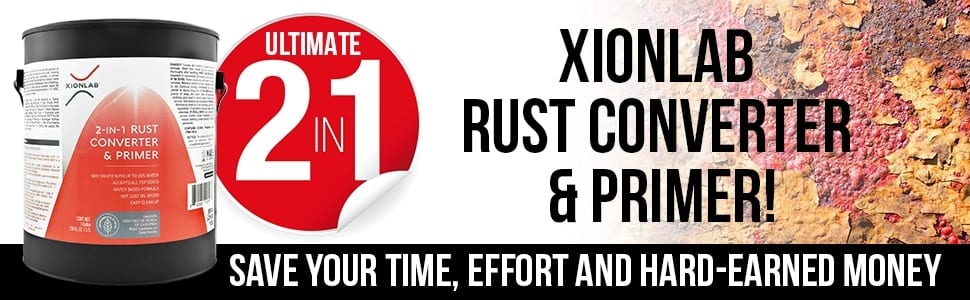
One product. Two jobs. Less time, less mess, less guessing. The XionLab 2-in-1 Rust Converter and Metal Primer keeps trailers, fences, hardware, and fleet vehicles in service across the country.