No products in the cart.
Water-Based Rust Converter (2026 Guide) — Low-VOC Chemistry, Field Workflow, and Salt-Belt Results
May 11, 2026
By Xion Lab
Free Shipping
easy returns
secure paymentS
FAQ | MY ACCOUNT | SUPPORT
May 11, 2026
By Xion Lab
Tannic and phosphoric acid carried in water — the science behind low-VOC rust treatment, plus how to apply it on automotive, marine, and industrial steel.
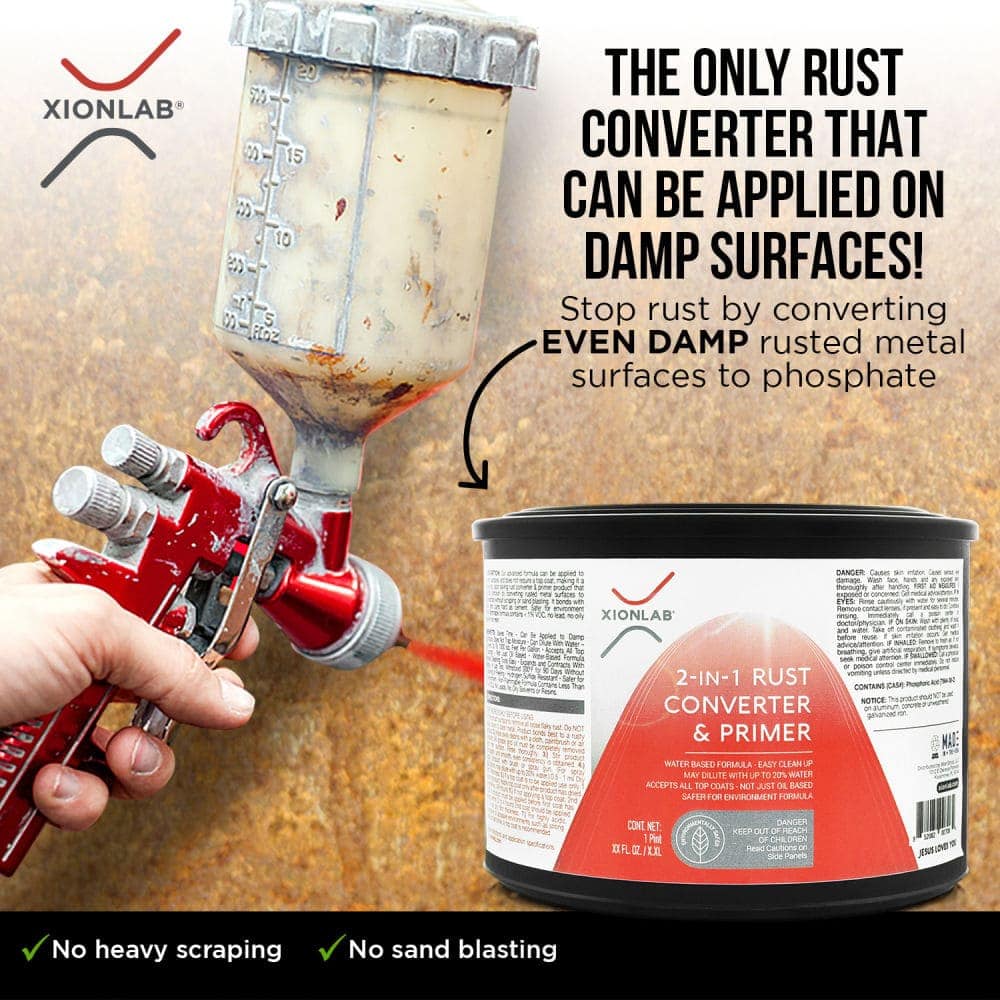
Quick Answer. A water-based rust converter uses tannic and phosphoric acids dissolved in water to chemically transform iron oxide into a stable, paintable surface. The water carrier keeps fumes low, meets the EPA’s new 1.10 O₃/g rust converter VOC limit, and works on light-to-moderate rust without sandblasting. Cure time runs roughly 24 hours at room temperature.
Rust is iron oxide. A water-based rust converter pulls iron out of the oxide lattice and locks it inside a new, inert compound — usually ferric tannate or iron phosphate — using acids carried in plain water rather than petroleum solvent. The result is a dark, paintable film bonded to the steel beneath.
And the water carrier matters more than people think. Solvent-based converters off-gas xylene and toluene as they cure. Water-based formulas release water vapor, mild acid traces, and very little else. Lower VOC. Lower flash risk. Safer indoors.
So when you spray XionLab 2-in-1 Rust Converter & Metal Primer on a rusted bracket, three things happen in sequence: the acids attack the oxide layer, the iron gets chelated into a stable salt, and the polymer carrier dries into a primer film. One product. Two jobs. Done.
Want the deeper chemistry? Our Science of Rust Converters and Primers guide walks through the molecular reactions step by step.
Two acids do almost all the work. Tannic acid — pulled from oak galls and chestnut bark — chelates ferric ions into ferric tannate, a hard blue-black film. Phosphoric acid takes a different path, attacking iron oxide directly and forming iron phosphate (FePO₄), a gray-black passivating crust. Both lock down active corrosion. Both leave a primable surface.
The difference matters in real conditions. Phosphoric is fast and shallow. Tannic is slow and deep. Tool handles with light flash rust respond well to phosphoric; pitted, scaly rust on a Gulf Coast trailer fender wants the deeper chelation tannic offers. A dual-chemistry formula gives you both, plus an acrylic polymer carrier sealing the conversion under a built-in primer film.
Water replaces solvent as the carrier. Sounds small. The implications run deep. According to peer-reviewed work on water-based rust converters and polymer composites, the polymer carrier in modern aqueous formulas does double duty — it transports acid to the oxide layer, then cross-links into a protective film as the water evaporates.
And there’s a regulatory side too. The EPA’s January 2025 aerosol coatings amendments created a standalone “Rust Converter” emissions category for the first time. The VOC limit landed at 1.10 O₃/g. High-solvent aerosol converters are getting reformulated, withdrawn, or relabeled. Water-based products already comply.
Global annual cost of corrosion per the NACE IMPACT study — about 3.4% of global GDP. Modern rust converters help recover an estimated 15–35% of that loss.
Not every job wants water-based. But most do. Here is where the formula earns its place.
So where doesn’t it work? Heavily oily surfaces. Galvanized substrates. Stainless. Anywhere the steel is already perforated through. We cover the honest limitations further down.
A reader sent me photos last February. His 2009 Tacoma frame had picked up about a quarter-inch of scaly rust along the rear cross-member after a brutal Cleveland winter. The local body shop wanted $1,800 to sandblast and prime. He degreased the area with a citrus solvent, wire-brushed the loose flakes — about ten minutes of work per square foot — then brushed two coats of water-based 2-in-1 converter on with a chip brush. Twenty-four hours later the surface had turned a deep matte black. Eighteen months later, after another full Ohio winter and a wet spring, the treated zone showed no bleed-through. Total cost: roughly $40 in product. Sequence is everything.
Application looks simple. Skipping steps wrecks results. Here is the sequence that works in the field, broken into six clear stages.
Knock loose flakes off with a wire brush, an angle grinder with a wire cup, or 80-grit sandpaper. You are not trying to reach bare metal — you only need to remove the powdery, non-adherent layer. Sound rust stays. Loose rust goes. A clean rag wipe afterward catches the dust.
Oil contamination is the number-one cause of converter failure. A quick wipe with a citrus degreaser, mineral spirits, or even dish soap and water clears the surface. Let it flash off completely. Acid plus oil equals a weak bond.
Brush, roll, or spray. One thin wet coat reaches more oxide than a thick puddle. The film should look like wet ink on the surface — not pooled, not running. A standard chip brush works for tight spots. A foam roller covers panels fast.
Within 20 minutes you’ll see the surface darken. Rust orange shifts to brown, brown to deep black-blue. The visual cue tells you the chelation reaction is running. If a patch stays orange, the converter never made acid-to-oxide contact — usually an oil residue. Spot-clean and reapply.
Two coats outperform one. The second coat fills micro-voids the first coat missed and reinforces the polymer film. Wait two hours between coats at 70°F. Longer if the shop is cold.
The polymer film needs a full day to harden. Topcoat with an alkyd enamel, an automotive urethane, or a moisture-cure single-stage paint. Need the full treatment workflow? Our how to use rust converter to treat rust guide breaks down the full sequence for heavier corrosion.
Pro tip. Cure time stretches in cold or humid conditions. Below 50°F or above 80% humidity, give it 48 hours before topcoat. Salt wins every time when you rush the cure.
Solvent-based converters still ship. Some marine applications still call for them. But for 90% of jobs, water-based now wins on safety, cost, and finish.
| Factor | Water-Based | Solvent-Based |
|---|---|---|
| VOC Output | Low (often <50 g/L) | High (250–500 g/L) |
| Fume Profile | Mild acid vapor | Xylene, toluene, ketones |
| Flash Risk | None | Significant near pilot lights |
| Indoor Use | Safe with normal ventilation | Requires industrial extraction |
| EPA 2025 Aerosol Rule | Compliant | Often non-compliant |
| Cleanup | Soap and water | Mineral spirits |
| Cure Speed | 24 hours at 70°F | 2–6 hours |
| Cost Per Gallon | $25–$80 | $40–$120 |
| Best Use Case | Most general restoration | Fast turnaround, outdoor only |
The honest take? Solvent-based cures faster. But the speed advantage rarely justifies the fume tradeoff, especially given the EPA’s tightened reactivity rules now require manufacturers to either reformulate, reclassify the product into a different specialty coating category, or pull the SKU entirely from store shelves before the compliance deadline lands. And modern water-based polymer films cure hard enough to topcoat the next morning on most jobs.
One more thing worth noting before you grab a gallon off the shelf. The bottle date matters. An open container of water-based converter loses potency after about twelve months because the acid slowly reacts with dissolved oxygen and the polymer carrier begins to thicken in the can, both of which weaken the chemistry and the eventual film. Buy what you’ll use in a season. Fresh product gives the best conversion.
The same product behaves differently in different ZIP codes. Humidity, temperature swings, and how often metal sees liquid water all shift how a converter performs. Worth knowing before you buy a five-gallon pail.
Salt-laden coastal air drives constant flash rust. Marine fittings, dock hardware, and even car bodies park within a few miles of the ocean see chronic corrosion. Water-based converter works here, but the cure window matters. Apply on a low-humidity morning, get two coats down by noon, and topcoat the next day before the next moist sea breeze rolls in. The polymer needs dry air to film properly.
Road salt during winter pummels truck frames, brake lines, and undercarriage mounts. Pit depth is the issue here, not surface area. A wire brush won’t reach the bottom of a quarter-inch pit. Two thinned coats of tannic-heavy converter, applied with a small detail brush forced into the pit, gives the chemistry time to crawl deeper before the polymer sets up. Skip the dunking method some shops swear by — it wastes product and creates runs.
Constant drizzle from October through May means metal rarely fully dries. Tools left in the bed of a pickup grow rust overnight. The trick here is finding a four-hour weather window — uncommon but real. Apply in a heated garage if possible. Move the project indoors. The converter itself tolerates damp, but the cure cycle wants dry air.
Phoenix, Tucson, Vegas. Bone-dry air, intense UV, wild temperature swings between day and night. Rust appears slowly here because liquid water is rare. But when it shows up — on a swamp cooler housing, a rooftop AC unit — the dry air actually helps the converter cure fast. Watch out for hot panels under direct sun though. Surface temperatures above 100°F flash off the water carrier before the acid finishes chelating. Apply early morning or in shade.
UV intensity climbs with altitude. The cured polymer film is rated for normal UV exposure but degrades faster at 8,000 feet than at sea level. Always topcoat outdoor work with a UV-stable enamel or urethane up here. The conversion underneath stays sound; the polymer carrier just needs sun protection.
I have to be straight here. Water-based rust converter is not a miracle. A few situations where you should reach for something else.
Be skeptical of any product claiming to fix all of these. Here’s a brand-honest comparison. Corroseal works well for lighter surface rust on automotive metal. Where XionLab pulls ahead is on heavier pitted rust where the deeper-penetrating tannic-plus-polymer blend has more time to chelate iron before the film dries.
Does rust converter work? Yes — within its limits. Our does rust converter work deep dive shows where the chemistry succeeds and where it falls short.
Estimated savings on corrosion damage achievable with proper conversion treatment, according to the AMPP Cost of Corrosion Study.
XionLab has built rust treatment products since 2015 with one principle behind every formula: safer for you, safer for the environment. Our 2-in-1 Rust Converter & Metal Primer combines tannic acid chemistry, phosphoric acid attack, and an acrylic polymer carrier in one water-based bottle. Here is how it stacks up in practice:
The polymer carrier dries into a primer film. No separate primer coat needed before paint.
Compliant with the EPA’s 2025 aerosol coatings standard. Safe for indoor garage work.
Tannic for deep pit penetration. Phosphoric for fast surface oxide conversion. Both in one bottle.
Same product, three application methods. Pick whatever fits the job.
No mineral spirits. No solvent disposal. Brushes rinse clean in the utility sink.
Formulated, blended, and bottled domestically. Tested on real automotive, marine, and structural steel.
Surface dry in about 30 minutes at 70°F. Recoat window opens at 2 hours. Full cure takes 24 hours before topcoat. Cold or humid conditions stretch that to 48 hours.
Yes, once the polymer film fully cures. The dark cured surface accepts alkyd enamel, oil-based paint, automotive urethane, or moisture-cure single-stage finish. Water-based latex topcoats work too, though a tie-coat primer helps for outdoor exposure.
Yes. The water carrier will freeze below 32°F and the formula breaks once thawed. Store between 50°F and 80°F. A heated utility closet works fine for winter storage in northern climates.
No, the chemistry is the same. Tannic and phosphoric acids react with iron oxide regardless of the carrier. The only real difference is cure speed — solvent flashes off faster. The acid reaction itself runs identically.
Apply only when you can guarantee 4 hours of dry weather. Rain during the conversion window washes the acid film off before it fully chelates. Once cured 24 hours, the polymer is rain-tolerant.
It works on aged rust, with one caveat — really old, deeply pitted rust often holds moisture inside the pit. Scrape the worst flakes off first, hit it with two thinned coats, then evaluate. Sometimes a third coat helps for heavy historic corrosion.
Roughly 200 to 250 square feet per gallon for two coats on moderately rusted steel. Smooth light rust stretches further. Heavily pitted surfaces drink more product because the topology has more actual surface area.
Some water-based 2-in-1 formulas are rated for bare metal priming because the acid etches the steel slightly and the polymer adheres. Single-acid converters with no polymer carrier are not — use a dedicated primer instead.
The dark film is the conversion product — ferric tannate or iron phosphate. It stays dark unless you topcoat over it. Most users paint over the cured film to match the surrounding finish.
XionLab 2-in-1 Rust Converter & Metal Primer turns iron oxide into a paintable surface with low-VOC, water-based chemistry. Safer for you. Safer for the environment.