No products in the cart.
Water-Based Rust Converter (2026 Guide) — Low-VOC Chemistry, Field Workflow, and Salt-Belt Results
June 1, 2026
By Xion Lab
Free Shipping
easy returns
secure paymentS
FAQ | MY ACCOUNT | SUPPORT
June 1, 2026
By Xion Lab
How a water-carried tannic and phosphoric blend turns iron oxide into paintable steel, why low fumes matter, and where this chemistry pulls ahead on automotive, marine, and industrial jobs.
Quick Answer. A water-based rust converter carries tannic and phosphoric acids in water rather than solvent, and the acids react with iron oxide to form a stable, paintable film. Fumes stay low. The job needs no sandblasting on light-to-moderate corrosion, and a typical coat cures in about 24 hours before topcoat.
Rust is iron giving up. Oxygen and moisture pull electrons out of the steel, and the metal flakes into a soft orange crust. Left alone, the crust keeps eating inward. A water-based rust converter stops the slide by reacting with the oxide directly, swapping the crumbly layer for a dense, dark, paint-ready surface.
The trick lives in the carrier. Solvent versions flood the rust with the same active acids, but they ride in xylene or ketones, so they reek and they flash near a pilot light. Water skips the drama. It wets the surface, delivers the acids into every pit, then evaporates clean. And the polymer left behind dries into a primer film you can paint over the next day.
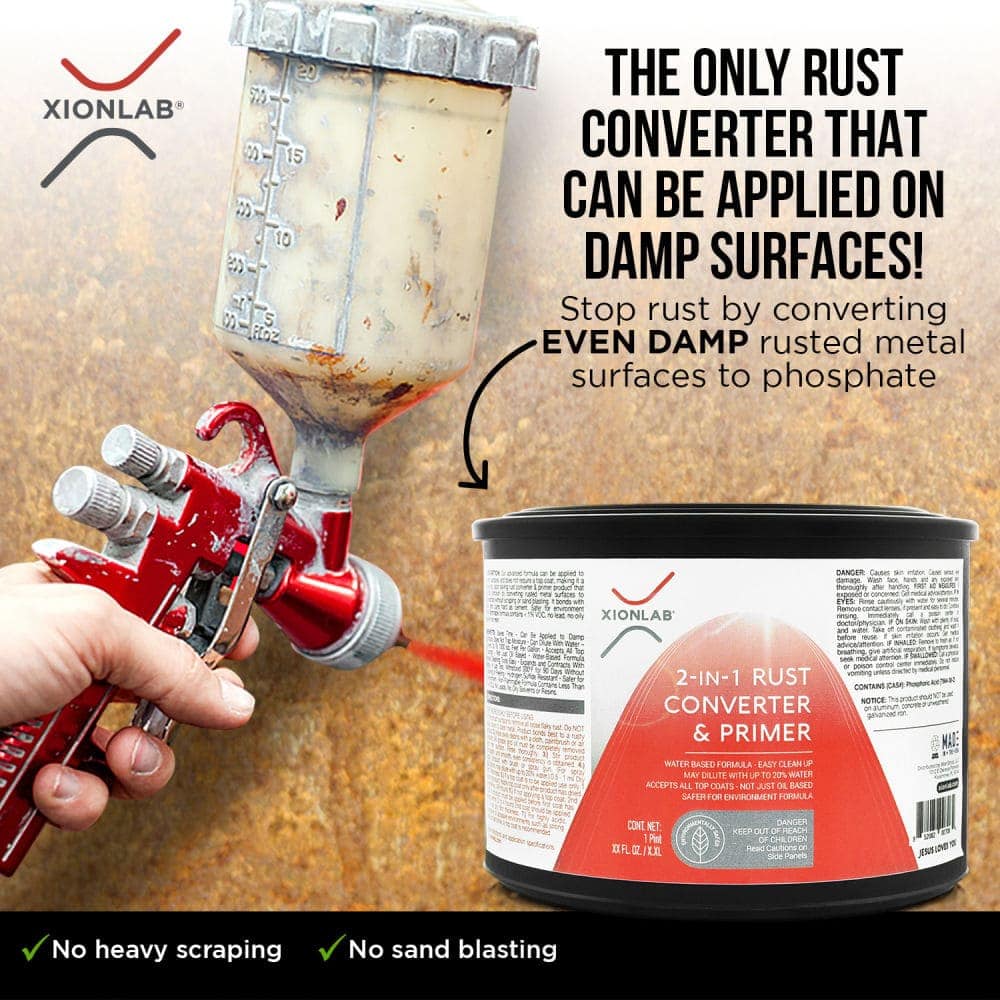
XionLab built its 2-in-1 Rust Converter & Metal Primer around water for exactly these reasons. One pass converts. The same pass primes. For a deeper teardown of the reaction itself, the science of rust converters and primers walks through it step by step.
Think of the difference in plain terms. Sanding rust off only removes the symptom, and the bare steel left behind starts rusting again the moment air touches it. Conversion plays a longer game. It changes the rust into something chemically inert, so the very layer attacking your metal becomes the layer protecting it. That flip is the whole appeal, and it is why a thin brushed coat can outlast hours of grinding.
Two acids do the heavy lifting. Tannic acid comes from oak bark, chestnut hulls, and grape skins — natural polyphenols loaded with hydroxyl groups. Each phenol works like a tiny claw. It grabs an Fe³⁺ ion inside the rust lattice and locks it into a fresh molecule called ferric tannate, a blue-black complex that no longer reacts with air.
Phosphoric acid plays the faster role. It attacks loose surface oxide and lays down iron phosphate, a thin protective scale. Tannic goes deep. Phosphoric goes wide. Together they cover both the pitted valleys and the broad flats of a corroded panel. Research on phosphoric and tannic acid converters in the journal Corrosion Science backs the dual-acid approach with measured adhesion and barrier data.
Why does the finished tannate matter so much? Because it is hydrophobic. Water beads on it. Oxygen crawls through it at a fraction of the rate it crosses bare oxide. So once a complete tannate layer forms, the steel underneath sits behind a moisture shield nature never gave it.
Carrier choice is not a footnote. It decides who can use the product, where, and how safely. A water carrier keeps volatile organic compound output low — often under 50 g/L, versus 250 to 500 g/L for solvent rivals. The EPA aerosol coatings VOC rules keep tightening, and water-based chemistry already clears the bar. Cleanup drops to soap and water. No flash hazard. No respirator dance in a closed garage.
Global annual cost of corrosion, per the NACE IMPACT study — roughly 3.4% of world GDP. Effective corrosion control recovers an estimated 15 to 35% of that loss, and the AMPP cost of corrosion study puts the U.S. share alone above $450 billion a year.
Not every rust job wants the same tool. Water-based converter shines on light-to-moderate surface rust — the orange film and shallow pitting you find on frames, fenders, fences, trailers, tools, and boat hardware. It needs no sandblaster and no solvent permit. Brush it, roll it, or spray it.
It is the natural pick for indoor work. A hobbyist restoring a fender in an attached garage cannot run industrial extraction, and water-based chemistry removes the need. The same logic helps shops chasing cleaner air reports. For automotive use specifically, our notes on rust converter for automotive protection cover undercarriage and frame work in detail.
How do you know if your rust qualifies? Run the screwdriver test. Press a flat-blade into the worst spot and lean. Solid steel pushes back. Treatable rust crumbles a little at the surface but holds firm underneath. Rust you can poke straight through has gone past chemistry — flag it for a patch instead. Most fences, fenders, trailers, and tool decks fall squarely in the treatable middle, which is exactly where water-based converter does its best work.
Here is one from the field. A buddy outside Cleveland had a 2009 Tacoma with a frame the salt belt had been chewing for a decade. The rear crossmember wore scale about a quarter-inch thick in spots, flaking off in sheets when you poked it. We wire-wheeled the loose stuff, hit it with a degreaser, and brushed on two thin coats of water-based converter over a cold Saturday.
By Sunday the frame had gone from rust-orange to a deep gunmetal black. Two years on, that section still holds. No bubbling under the topcoat, no fresh bloom. Salt wins every time you ignore it. Treated early, though, the steel keeps its fight.
Sequence is everything. Skip a step and the film fails early. Follow the order and a weekend coat outlasts the panel.
Knock off the loose scale first. A wire wheel, a stiff brush, or coarse sandpaper does the job. You want the flaking crust gone and the tight, adhered rust left in place. The converter feeds on the adhered oxide.
Oil blocks the reaction. Wipe the surface with a degreaser or denatured alcohol and let it dry. A clean panel lets the acids reach iron instead of grease.
Thin beats thick. Two light coats convert deeper and dry truer than one heavy pour, which can skin over and trap moisture. A foam brush or a low-pressure sprayer spreads it evenly.
Watch the surface shift. Orange darkens to black or deep purple as ferric tannate forms. That color is your receipt. Pale or patchy spots mean missed oxide, so dab those again.
Once the first coat surface-dries, around two hours at room temperature, lay the second. It catches what the first missed and thickens the barrier.
Give the polymer a full day. After cure, the dark film accepts oil enamel, automotive urethane, or epoxy primer. Cold, damp air stretches the window toward 48 hours. Our guide on how to use rust converter to treat rust adds photos for each stage.
Both chemistries convert rust. The split shows up in fumes, safety, and where you can legally work. Here is the breakdown.
| Factor | Water-Based | Solvent-Based |
|---|---|---|
| VOC Output | Low, often under 50 g/L | High, 250 to 500 g/L |
| Fume Profile | Mild acid vapor | Xylene, toluene, ketones |
| Flash Risk | None | Real near pilot lights |
| Indoor Use | Fine with normal airflow | Needs industrial extraction |
| EPA VOC Rule | Compliant | Often non-compliant |
| Cleanup | Soap and water | Mineral spirits |
| Cure Speed | About 24 hours | Often faster in cold |
Solvent versions do hold one edge. They cure quicker in freezing weather, which matters for outdoor crews in January. For most garage and shop work, though, the low-fume trade lands in water’s favor. The honest look at whether rust converter works digs into the limits of both.
Where you live decides how hard rust hits. The U.S. spreads roughly 20 million tons of road salt every winter — about 123 pounds for every American — and the EPA pegs the damage near $5 billion a year to cars, trucks, bridges, and roads. Salt is the accelerant. Geography sets the dose.
Michigan, Ohio, New York, Pennsylvania, and their neighbors brine the roads from November to March. New Hampshire alone dumps around 18.4 tons of salt per lane-mile each year, while Minnesota spreads closer to 3.8. Frames, brake lines, and rockers pay the price. Convert early and reconvert as new spots bloom.
Down south the enemy is humid salt air, not road brine. Boat trailers, dock hardware, and patio steel corrode from constant moisture. Water-based converter handles it well, and the marine corrosion protection notes cover saltwater hardware specifically.
Rain is the story here. Steady wet without much road salt means slow, even surface rust rather than aggressive pitting. Treated early, most projects need only one round.
Dry air slows corrosion to a crawl. When rust does appear, it tends to be light and superficial. One coat usually finishes the fight.
Road salt spread across U.S. roads each winter. The AAA Foundation has estimated corrosion damage to fleet vehicles at $70 or more per ton of salt encountered, and ten-year-old cars in salt-belt states can lose roughly 20% of resale value to rust versus the dry Southwest.
Honest limits matter. A converter treats rust. It cannot rebuild metal already gone. If corrosion has eaten clean through a panel — perforated holes, lacy edges, a frame you can push a screwdriver through — chemistry will not bring that steel back. You need welding, patch panels, or replacement.
Heavy mill scale resists it too. Thick, hardened scale needs grinding before the acids can reach live oxide. And on a structural member rated for load, a soft, pitted section is a safety question, not a paint question. When in doubt, cut it out. The converter buys time on sound metal, not on metal that has already lost the war.
One more honest note on expectations. A converter is not magic armor. It trades active rust for a stable film, and the film only lasts as long as the topcoat above it. Skip the topcoat and even perfect conversion chalks away under sun and rain. Treat the converter as step one of two, never the whole repair, and the results hold for years.
Plenty of converters work on paper. A few earn their place on the bench. Here is where XionLab pulls ahead, and where honest rivals still hold ground.
The polymer carrier dries into a primer film, so no separate primer coat stands between you and topcoat.
Fumes stay mild and EPA-compliant. Indoor garage work needs no industrial extraction or respirator.
Tannic reaches deep into pits. Phosphoric converts broad surface oxide fast. Both live in one bottle.
One formula, three application styles. Match the panel, not the marketing.
No mineral spirits, no solvent rag pile. Rinse the brush and walk away.
Lower toxicity for you and the shop. Safer For You, Safer For The Environment is the whole point.
Brand-honest take? Corroseal works well on lighter surface rust and has earned its fans. Where XionLab pulls ahead is the combined convert-and-prime film and the cleaner fume profile for closed spaces. Pick the tool matching your panel and your ventilation. For a full shootout, see the best rust converter and rust remover guide.
Buying right saves money. A quart of water-based converter covers roughly 100 to 125 square feet at the thin two-coat rate the chemistry prefers. A wheelbarrow, a small trailer, and a set of patio chairs fit inside a single quart with room to spare. Larger frame jobs lean toward the gallon.
Topcoat pairing decides how long the work lasts. The cured tannate film is a primer, yes, but it is not a finish. Bare, it will chalk under UV over months. So seal it. Oil-based enamel suits tools and trailers. Automotive urethane suits frames and panels. Marine-grade enamel suits dock hardware and anything kissing saltwater. One coat of color locks in years of protection.
Storage trips people up. Water-based product hates a freeze. A frozen-then-thawed bottle separates and loses bite, so keep it on a shelf above 50°F through winter. Shake well before each use. A sealed bottle stored cool and dry holds its strength for a year or more.
How much does a real job run? For a backyard restoration, figure a quart of converter, a degreaser, a wire wheel, and a can of topcoat. The total lands near the cost of one professional rust-repair hour. You bring the labor. The savings are real.
Surface dry runs about 30 minutes at 70°F. The recoat window opens near 2 hours. Full cure takes 24 hours before topcoat. Cold or humid air can stretch that toward 48 hours.
Yes, once the polymer film fully cures. The dark surface accepts oil enamel, automotive urethane, or epoxy primer. Latex topcoats work too, though a tie-coat helps for outdoor exposure.
On light-to-moderate rust, yes. Both use the same active acids. Solvent cures faster in freezing weather, but water-based matches it on adhesion and barrier strength at room temperature, with far lower fumes.
It halts the active corrosion it converts and seals the surface. New rust can still start at chips, scratches, or untreated spots. A quality topcoat extends the protection for years.
No. Remove only the loose, flaking scale. Tight adhered rust is the fuel the converter needs. Bare, shiny metal actually gives the acids less to react with.
Yes, and it is a common job. Prep the loose scale, degrease, and apply two thin coats. Frames in salt-belt states benefit most. Reapply on fresh spots each season.
It is. Low VOC output and no flash risk make it garage-friendly with normal ventilation. That is the headline advantage over solvent converters.
Water-based chemistry slows below 50°F and should not be applied near freezing. Work in a heated space or wait for a warmer day. Solvent versions handle cold better outdoors.
XionLab 2-in-1 Rust Converter & Metal Primer turns iron oxide into a paintable surface with low-VOC, water-based chemistry. Safer for you. Safer for the environment.