No products in the cart.
Understanding Rust and Corrosion (2026 Guide)
How iron fails chemically, what accelerates the process by environment, and how rust converters stop the damage before it spreads.
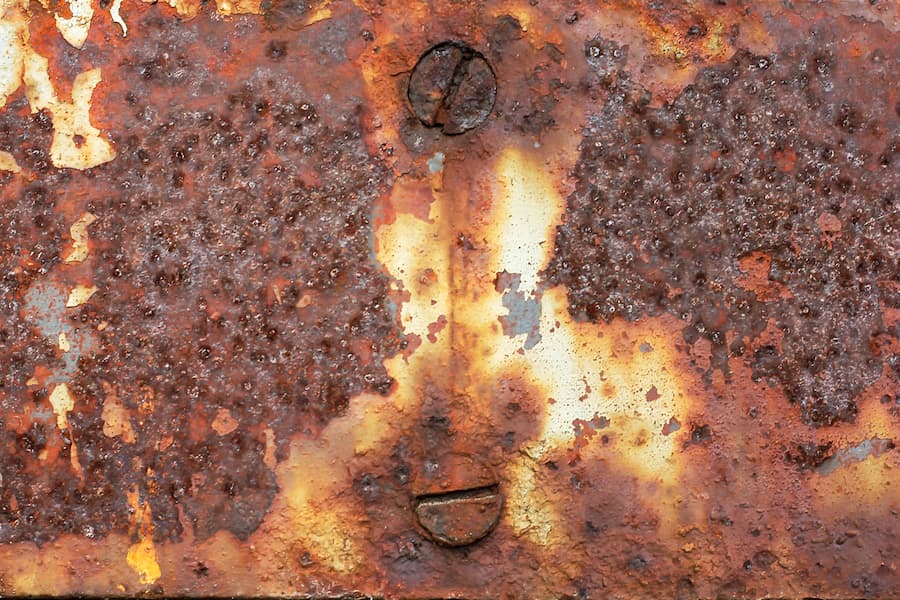
Quick Answer: Rust is a specific type of corrosion affecting iron and steel — the red-brown iron oxide formed when iron reacts with oxygen and moisture. Corrosion is broader, covering chemical degradation of any metal. Understanding how rust forms, spreads by environment, and stalls under treatment separates a $30 fix from a $3,000 structural repair.
The Chemistry
What Is Rust — And Why Does Iron Keep Making It?
Iron wants to return to its ore state. That’s the blunt version of electrochemical corrosion. Raw iron is a processed, higher-energy form of iron oxide — and the moment it contacts oxygen and moisture together, chemistry pushes it back toward the stable compound it came from. The result is Fe₂O₃, the reddish flaking crust everyone recognizes on neglected metal.
The reaction runs as an electrochemical cell. Iron atoms at the metal surface lose electrons — they oxidize — while oxygen and water at the surface gain them. No electricity source needed. The metal itself drives the process. Salt, acids, and humidity don’t cause rust so much as they accelerate the cell reaction by improving conductivity and lowering the activation energy needed to strip electrons from iron atoms.
But here’s what separates iron from aluminum or copper: iron oxide is porous. It doesn’t seal. Aluminum oxidizes too — but its oxide layer is dense and self-sealing, blocking further attack on the metal underneath. Iron oxide does the opposite. Moisture wicks right through it and reaches fresh iron below, continuing the reaction indefinitely. Left alone on unprotected steel, rust doesn’t plateau. It advances.
The chemistry in shorthand: Iron + oxygen + water → iron hydroxide → iron oxide (Fe₂O₃). The reaction is electrochemical — driven by electron transfer between the metal and its environment, not by heat or mechanical force.
I’ve seen this firsthand on a Gulf Coast boat trailer a customer brought in for inspection — angle iron one year out of the factory, never treated, stored half a mile from tidal water. The surface rust wasn’t just staining. Running a pocketknife edge across the worst section showed flaking roughly a sixteenth of an inch deep on a piece of angle iron maybe three-sixteenths thick total. That’s a third of the wall gone in twelve months. Gulf humidity and salt air didn’t need decades. They just needed access and time — and they had both.
Economic Impact
Corrosion Costs the Global Economy $2.5 Trillion a Year
That figure comes from the AMPP IMPACT study — the most thorough analysis of corrosion economics ever published, covering 44 countries and involving hundreds of researchers over two years. The number amounts to 3.4% of global GDP. And AMPP estimates 15–35% of those costs are preventable with existing technology and practices. So roughly $375 to $875 billion a year disappears into corrosion damage that could have been stopped.
$2.5 Trillion
Global annual cost of corrosion — 3.4% of world GDP — per the AMPP IMPACT study. The U.S. share alone exceeds $450 billion annually.
Road salt adds a more personal angle. The EPA estimates road salt use costs $5 billion annually in vehicle, road, and bridge damage across the United States. Sensor failures from corrosion alone run $100–$500 per sensor to replace — and a single winter season in the Rust Belt can corrode four, five, or more sensors on an untreated undercarriage. The math adds up quickly.
$5 Billion
Annual estimated U.S. cost of road salt damage to vehicles, roads, and bridges — EPA figure. Preventive treatment costs a fraction of that.
These numbers exist not to alarm — but to frame the decision properly. A can of rust converter costs under $30. Annual undercarriage treatment runs less than a tank of gas. Neither is glamorous. But the gap between treating rust early and repairing structural damage later is measured in orders of magnitude.
Classification
Six Types of Corrosion — and Which One You’re Probably Dealing With
Corrosion isn’t one phenomenon. Different mechanisms produce different failure patterns — and the type you’re facing determines the right response. Misidentifying crevice corrosion as surface rust and treating only the visible area leaves the worse damage untouched.
Uniform Corrosion
The most common type. Rust spreads evenly across an exposed surface — flat panels, exposed frames, wide fencing. Uniform attack is predictable and measurable. A steel panel in a coastal environment loses roughly 0.1–0.5 mm of thickness per year under uniform corrosion, depending on exposure. Easy to catch with periodic inspection. Easy to treat early. Most rust converter applications target uniform surface corrosion.
Pitting Corrosion
Small, localized pits — often invisible until they’ve penetrated deeply. Pitting is more dangerous than uniform corrosion per unit of material lost because it concentrates attack in a small area rather than spreading it across the whole surface. A pit 2mm wide and 8mm deep compromises the structural integrity of a component far more than a uniform 0.5mm loss across the whole surface would. And pitting hides under paint and light surface scale. Worth checking for on any structural member over five years old in a wet climate.
Crevice Corrosion
Trapped moisture in tight spaces — lap joints, fastener holes, under gaskets — creates a restricted oxygen environment. Inside the crevice, oxygen depletes rapidly. Outside, it doesn’t. The resulting difference in electrochemical potential drives aggressive corrosion inside the gap. Salt belt vehicle frames suffer heavily from crevice corrosion inside box sections and around weld seams. Standard brush-on converters can’t reach those areas — which is why cavity wax or brush-on converter with a flexible extension nozzle matters for complete undercarriage treatment.
Galvanic Corrosion
Two dissimilar metals in contact — connected by an electrolyte — form a battery. The less noble metal acts as an anode and corrodes faster. Steel bolts in an aluminum hull corrode aggressively. Copper fittings connected to galvanized pipe accelerate zinc loss from the galvanizing. The more conductive the electrolyte (salt water dramatically increases conductivity compared to fresh water), the faster galvanic attack runs. Prevention: compatible metal pairing, physical isolation at contact points, or sacrificial anodes protecting the more valuable metal.
Stress Corrosion Cracking
Sustained tensile stress plus a corrosive environment equals crack propagation in metals that show no obvious surface corrosion. Stainless steels fail this way in chloride environments. High-strength bolts fail in hydrogen sulfide atmospheres. So do springs, cables, and anchor chain under load in marine conditions. The failure looks sudden — but it built for months or years inside the grain structure. Annual inspection of loaded hardware in aggressive environments is the only reliable mitigation.
Concentration Cell Corrosion
Variations in oxygen, salt, or pH across a metal surface create localized electrochemical potential differences. The low-oxygen zone becomes anodic — it corrodes to supply electrons to the high-oxygen cathodic zone. Soil corrosion of buried pipelines often follows this mechanism. So does rust inside sealed containers exposed to standing water. Uniform protective coatings break this mechanism by removing the oxygen gradient from the metal surface entirely.
Metal Comparison
Which Metals Rust — and Which Just Corrode
Rust is iron-specific. Only iron and iron alloys like steel produce the red-brown Fe₂O₃ compound most people picture. But corrosion — chemical degradation of a metal by its environment — affects every metal in some form. Aluminum corrodes. Copper corrodes. Even gold corrodes under specific conditions, though slowly enough to be functionally irrelevant for most applications. The key difference is what the oxide layer does once it forms.
| Metal | Rusts? | Corrodes? | Oxide Layer Behavior | Notes |
|---|---|---|---|---|
| Carbon Steel | Yes | Yes | Porous — allows continued attack | Needs protective coating or conversion treatment |
| Stainless Steel (304/316) | Rarely | Yes (pitting in chlorides) | Dense chromium oxide — self-sealing | Not immune — can pit in marine environments |
| Aluminum | No | Yes | Thin, dense — self-protecting | Galvanic corrosion risk when paired with steel |
| Copper / Bronze | No | Yes (patina) | Green patina is protective | Accelerates galvanic attack on connected steel |
| Galvanized Steel | Eventually | Yes | Zinc sacrifices first — protective until depleted | Lifespan depends on coating thickness and environment |
| Cast Iron | Yes | Yes | Porous — similar to carbon steel | Graphitic corrosion can hollow out the piece |
Stainless steel deserves a closer look. The chromium content — at least 10.5% by mass — reacts with oxygen first, forming a thin, dense chromium oxide layer before iron can oxidize. That layer self-repairs when scratched. But stainless isn’t rust-proof. Grade 304 stainless in a chloride-rich marine environment will pit — and pitting stainless is harder to treat than surface rust on carbon steel. Grade 316 adds molybdenum specifically to resist chloride pitting, which is why it’s the standard for marine hardware.
Progression Timeline
How Quickly Does Rust Actually Spread?
Speed depends on environment more than almost anything else. The same uncoated steel plate corrodes at radically different rates across climates — from almost nothing in a dry desert to aggressive pitting within weeks on a salt-spray coast. Four environmental factors drive the pace: humidity, salt exposure, temperature, and pH of any liquids in contact with the metal.
- Indoor, low humidity (<40% RH): Surface oxidation may take years to become visible. Well-controlled storage can hold uncoated steel with minimal rust for extended periods.
- Temperate outdoor, moderate humidity: Light surface rust visible within 4–8 weeks on unprotected carbon steel. Progression slow enough for annual inspection cycles to catch early.
- Salt Belt roads in winter: Road salt spray accelerates corrosion by 4–8x compared to equivalent dry conditions. Frame corrosion progressing from surface scale to structural pitting can happen over 2–3 seasons without treatment.
- Coastal / marine environments: Salt air within half a mile of tidal water can produce visible surface rust within 2–4 weeks on unprotected steel. Tropical coastal zones — Gulf Coast, south Florida — are among the most corrosive environments in North America.
- Submerged or splash zone: Alternating wet and dry cycles are the most aggressive. The splash zone on marine structures corrodes faster than fully submerged sections — constant oxygen replenishment at the water line drives rapid attack.
Temperature accelerates reaction kinetics — roughly doubling the corrosion rate for every 10°C increase in surface temperature, up to a point. So a hot steel roof panel in Tampa sees more corrosion on a given day than a shaded panel in Portland at the same humidity level. The combination of Gulf Coast heat and humidity is why marine-grade treatment isn’t optional there. It’s the baseline.
Treatment Options
Rust Converter vs. Rust Remover — Which One Do You Actually Need?
The confusion between these two products costs people time and money. They work by completely different mechanisms, suit different situations, and produce different results. Using a remover on a frame rail — when a converter is the right tool — adds unnecessary steps and doesn’t actually produce a better outcome. And using a converter on precision machined surfaces leaves a black residue unsuitable for tight tolerances. Read the options before grabbing a product.
| Factor | Rust Converter | Rust Remover |
|---|---|---|
| Mechanism | Chemical reaction converts Fe₂O₃ to stable ferric tannate or iron phosphate | Acid dissolves rust, exposing bare metal |
| Residue | Dark polymeric layer — paintable, bonds to metal | Bare, clean metal — must be coated immediately |
| Best for | Large structural areas, frames, marine hardware, anywhere sandblasting is impractical | Small precision parts, machined surfaces, items needing bare metal finish |
| Application | Brush, roll, or spray directly onto rust | Soak, gel, or wire-brush application; rinse thoroughly after |
| Prep required | Remove loose scale; loose dirt. No sandblasting needed. | Remove loose scale; rinse surface clean afterward |
| Paint over? | Yes — converter layer serves as primer base | Yes — after full rinse and dry; re-prime before painting |
| Environmental | Water-based formulas available (lower VOC) | Often acidic; requires careful disposal and neutralization |
For structural steel, vehicle frames, and agricultural equipment — anything too large or too complex to sandblast clean — a rust converter is almost always the practical choice. It works with the rust that’s already there rather than demanding complete removal first. XionLab’s 2-in-1 formula converts and primes simultaneously, eliminating the separate primer step and cutting application time significantly on large areas.
Corroseal handles light surface rust adequately. Where XionLab pulls ahead is on heavier oxidation and two-stage applications — one coat converts existing rust and leaves a primer-ready surface, rather than requiring a separate primer before topcoating. On large agricultural or marine applications, skipping that extra step matters.
One honest limitation worth stating plainly: no converter — XionLab’s included — restores metal lost to rust. If you can push a screwdriver through the surface, the metal needs replacement. Converters stabilize what’s there. They don’t rebuild what’s gone.
For more on how the chemical conversion mechanism works, see XionLab’s detailed comparison of rust converters versus rust removers with application-specific guidance.
XionLab Solution
How XionLab’s 2-in-1 Rust Converter Addresses Real-World Corrosion
XionLab built its 2-in-1 Rust Converter + Metal Primer for the environments where standard products fall shortest — Gulf Coast salt air, Midwest road salt accumulation, Pacific Northwest persistent moisture. Six core capabilities set it apart from single-function options.
⚙
Tannic Acid Conversion
Reacts directly with iron oxide — forming ferric tannate, a hard compound chemically bonded to the metal surface. Stable. Paintable. Permanent.
🌰
Built-In Primer Layer
One application converts and primes simultaneously. No separate primer coat before painting. One coat. Done.
⚓
Marine & Coastal Rated
Formulated for saltwater environments and high-humidity coastal zones — tested specifically against the conditions where standard converters fail fastest.
🚗
Automotive Undercarriage
Reaches into box sections, frame rails, and weld seams. Converts rust in place — where mechanical removal is physically impossible.
🌿
Water-Based Chemistry
Lower VOC than solvent-based alternatives. Safer for applicators working in enclosed spaces, and appropriate near waterways. Safer For You, Safer For The Environment.
⏱
Simple Application
Brush, roll, or spray directly onto rusted iron or steel. No mixing, no complicated prep beyond removing loose scale. Fast and practical on large surfaces.
For automotive-specific applications — suspension components, brake hardware, and frame rails — see XionLab’s rust converter for automotive protection guide with application sequences for vehicle undercarriage work.
Regional Factors
Where You Live Determines How Fast the Clock Runs
Same vehicle. Same maintenance history. Completely different corrosion outcomes — depending on geography. Four regional environments drive most of the serious rust damage seen on North American vehicles and structures.
Gulf Coast and Southeastern Coastal States
Salt air, heat, and humidity create some of the most aggressive corrosion conditions on the continent. Steel stored within a mile or two of tidal water can show significant surface rust within weeks without any protective treatment. Outdoor structures — trailers, dock hardware, HVAC equipment — corrode at rates Northern homeowners simply don’t encounter. Marine-grade treatment is the starting baseline here, not an upgrade. And annual inspection cycles for anything steel and structural aren’t optional — they’re the difference between a surface treatment and a full replacement.
Salt Belt States — Northeast, Midwest, Mountain West
Road salt applied for winter ice management is the primary driver of vehicle frame corrosion across states from Massachusetts to Minnesota and west into Colorado and Idaho. Millions of tons of salt go down annually. Salt spray reaches every crevice in a vehicle’s undercarriage — frame rails, brake lines, wheel wells — and accelerates crevice corrosion inside enclosed box sections where moisture can’t easily drain. Annual undercarriage treatment before the first hard frost is the most cost-effective intervention available.
Pacific Northwest
Less chloride, but persistent moisture and mild temperatures create ideal conditions for slow, steady uniform corrosion. Extended wet seasons keep metal surfaces damp for months at a stretch. Rust progresses gradually — which makes it easy to ignore until a section is significantly compromised. Farm equipment, fencing, and outdoor structural steel need periodic inspection and treatment even without the dramatic visible scaling common in coastal salt environments.
Desert Southwest
Low humidity slows corrosion dramatically. But temperature swings — freezing nights giving way to intense afternoon heat — stress and crack protective coatings, creating entry points for moisture during the rare wet periods. Desert vehicles are also frequently sold into saltier climates later in their lives, carrying hidden corrosion from thermal cycling not obvious during dry-climate inspection.
Industry Standards
How Professionals Assess and Classify Corrosion Damage
AMPP (Association for Materials Protection and Performance), formerly NACE International, maintains the industry standards for corrosion assessment used across oil and gas, marine, infrastructure, and industrial applications. Their SP (Standard Practice) documents define everything from surface preparation grades to acceptable rust levels for specific coating applications. Two levels matter most for practical surface treatment decisions.
- SSPC-SP 2 / Hand Tool Cleaning: Removes loose rust, mill scale, and coatings by hand scraping and wire brushing. Adequate before converter application on most structural applications where loose scale is the primary concern.
- SSPC-SP 3 / Power Tool Cleaning: Angle grinder, wire wheel, or needle scaler removes tighter adherent rust. Appropriate before converter on heavier rust or before direct-to-metal topcoats.
- SSPC-SP 6 / Commercial Blast: Abrasive blast leaving at least two-thirds of each square inch free of visible residues. Required before high-performance industrial coatings — not necessary for residential or automotive converter applications.
- Rust grade assessment (ISO 8501-1): Grades A through D classify rust coverage from mill-scale-dominated to fully rusted. Grade C and D substrates — heavy rust, no mill scale — are where converters deliver their strongest advantage over mechanical removal.
For most DIY and semi-professional applications, “hand tool clean” prep — knocking off loose scale with a wire brush, removing dirt and grease — is sufficient before converter application. The converter handles the bonded rust chemically. Over-prepping adds time without improving adhesion in most cases.
FAQ
Frequently Asked Questions About Rust and Corrosion
What is the difference between rust and corrosion?
Rust is a specific form of corrosion affecting only iron and steel — the red-brown iron oxide formed when iron reacts with oxygen and water. Corrosion is broader, covering chemical degradation of any metal by its environment. Aluminum corrodes. Copper corrodes. Neither rusts. Rust is a subset of corrosion, not interchangeable with it.
Why does rust spread so quickly on unprotected steel?
Iron oxide is porous — unlike aluminum or stainless steel oxide layers. Moisture penetrates through the rust and reaches fresh iron underneath, continuing the electrochemical reaction. Salt accelerates this by increasing conductivity and disrupting any passive film on the metal surface. So rust actively creates conditions making further rust formation easier — a self-reinforcing cycle.
Can aluminum rust?
No. Rust requires iron. Aluminum oxidizes — forming a thin, dense aluminum oxide layer — but this layer is self-sealing and protects the metal underneath from further attack. Aluminum does corrode under specific conditions: pitting in chloride-rich environments, galvanic attack when in contact with steel in the presence of an electrolyte. But it doesn’t rust.
What is galvanic corrosion and how is it prevented?
Galvanic corrosion happens when two dissimilar metals contact each other in the presence of an electrolyte — saltwater being the most effective. The more electrically active metal acts as an anode and corrodes faster to protect the more noble metal. Steel bolts in an aluminum structure and copper fittings on galvanized pipe are classic failure modes. Prevention: use compatible metals, isolate contact points with nylon washers or tape, and coat joints with a compatible sealant.
How does a rust converter work chemically?
Rust converters use tannic acid or phosphoric acid. Tannic acid reacts with iron oxide to form ferric tannate — a dark, hard compound chemically bonded to the metal surface. Phosphoric acid converts iron oxide to iron phosphate. Both create a stable, paintable layer. XionLab’s formulation uses tannic acid chemistry, producing ferric tannate — durable, strongly adherent, and ready for topcoating without a separate primer step.
Will a rust converter work on through-rusted metal?
No. Converters stabilize existing rust — they don’t replace lost metal. If the section is perforated, the structural integrity is gone and surface treatment won’t fix that. Cut out the damaged section and weld in new material. Converters deliver best results on rust penetrating up to a third of the metal wall thickness, with solid material remaining underneath.
What’s the best way to protect a vehicle undercarriage before winter?
Pressure-wash the undercarriage thoroughly — remove accumulated road grime and any salt from previous seasons. Wire-brush or scrape loose rust scale. Apply a rust converter to any rusted areas, let it cure fully, then follow with rubberized undercoating on exposed flat sections and cavity wax on enclosed box sections. XionLab’s 2-in-1 converts and primes in one coat, which speeds the process on large areas. Inspect and retreat on a 12–18 month cycle.
Is stress corrosion cracking a practical concern for homeowners?
Mostly a commercial and industrial issue, but it surfaces in consumer contexts more than people expect. Trailer suspension hardware, marine anchor chain, rigging under sustained load in salt environments have all failed to stress corrosion cracking. High-strength fasteners in coastal or chemically aggressive environments — pool equipment, dock hardware — warrant annual inspection and specification of SCC-resistant alloys where loads are significant.
How long does ferric tannate (rust converter residue) last before recoating?
The converted layer is stable but not a final weatherproof coating on its own. For outdoor or submerged applications, a topcoat — oil-based paint, epoxy, or rubberized coating — is applied over it within the manufacturer’s recommended window, typically 24–72 hours after application and full cure. Indoors or in sheltered environments, the converted surface can last years without topcoating, though protection improves significantly with paint over it.
Stop Rust Before It Reaches Structural Steel
XionLab’s 2-in-1 Rust Converter + Metal Primer converts existing rust and primes for topcoating in a single application — water-based chemistry, safer for applicators, built for coastal, automotive, and agricultural conditions. Safer For You, Safer For The Environment.
Questions? Call us — we pick up.