No products in the cart.
What Is the Best Rust Converter? (2026 Guide) — Pick the Optimal Formula and Stop Rust Cold
March 22, 2026
By Xion Lab
Free Shipping
easy returns
secure paymentS
FAQ | MY ACCOUNT | SUPPORT
March 22, 2026
By Xion Lab
A practical breakdown of how rust converters operate, when to employ them versus rust removers, and which formulas actually hold up across automotive, marine, farm, and industrial use.
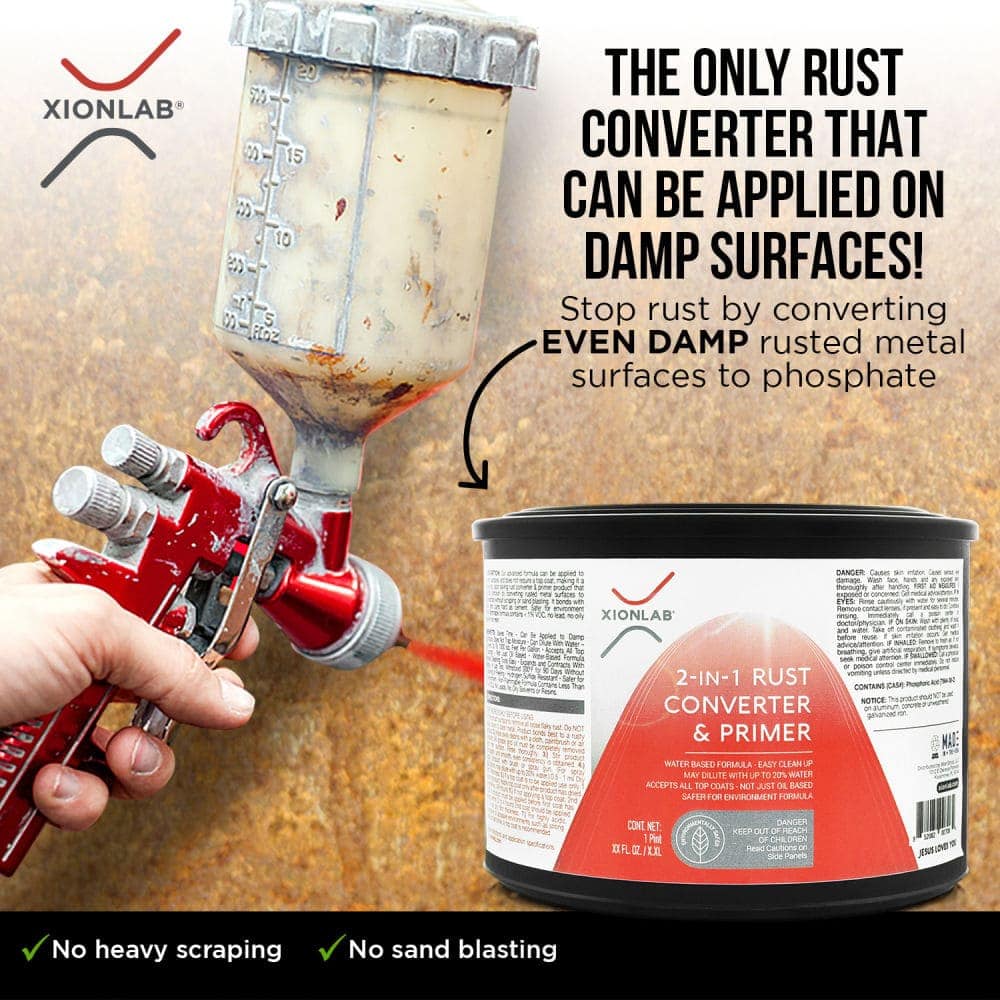
Quick Answer — the optimal rust converter for most jobs is a 2-in-1 aqueous formula combining tannic or orthophosphoric acid with a polymer primer — it halts active corrosion and creates a paintable surface in one sequential step. For progressive structural steel, automotive frames, and marine hardware where rust is moderate to heavy — prolonged corrosion — XionLab’s 2-in-1 Rust Converter & Metal Primer converts iron oxide to iron tannate on contact, seals it with a built-in primer layer, and performs without sandblasting or stripping to unprotected metal.
Most people buying a rust converter for the first time expect something like paint — you brush it on, it dries, done. the formulation running underneath is a little more interesting than that. A rust converter does not sit on top of rust. It reacts with it.
The active chemistry is typically tannic reagent, orthophosphoric acid, or a combination of both. When either compound contacts iron oxide — the red, flaky material most people call rust — it drives a chemical exchange. tannic reagent converts Fe₂O₃ into iron tannate, an opaque, inert precipitate. Phosphoric acid converts iron oxides into iron phosphate. Both states become dormant. Neither spreads. Neither absorbs moisture the way raw rust does. And because the compound bonds to the metal rather than just coating it, paint and primer stick far better afterward.
Most waterborne formulas also include a latex macromolecule. That polymer polymerizes as the product cures, forming a secondary seal over the converted layer — a reason why 2-in-1 converter-primers can skip an independent priming stage entirely. Quality formulas are further engineered with coalescent agents — typically glycol ether derivatives — that facilitate the latex binder fuse into a continuous, non-porous film as the carrier evaporates. Emulsion chemistry. Diffuse hydration. Two distinct processes. The rheology is thixotropic by design: gel-like at rest to resist sagging on vertical faces, then thinning under brush or roller shear during application.
Annual global cost of corrosion — equal to 3.4% of world GDP — according to AMPP’s Spotlight on Corrosion and the landmark NACE IMPACT study.
What most people call “rust” is actually a cluster of distinct mineral compounds — goethite, lepidocrocite, hematite, and magnetite — formed through different oxidation pathways depending on moisture availability, thermal cycling, and the presence of electrolytes like chloride or sulfate. Each of these compounds has different porosity, adhesion characteristics, and density. Goethite — the orange-yellow variant, is relatively stable and converts effectively. Lepidocrocite, the flakier reddish variant, tends to be porous and non-adherent — the variant visibly peeling on neglected automotive panels. Magnetite — the dark gray allotrope, is the most chemically inert of the group and sometimes indicates historical high-temperature exposure.
The corrosion reaction itself is electrochemical — an oxidative process occurring simultaneously at anodic and cathodic zones across the metal substrate. At the anode, iron atoms surrender electrons and become ferrous ions. Those ions migrate through the electrolyte — often condensed humidity or road splash — toward cathodic zones where oxygen and water combine to synthesize hydroxide. The two products precipitate as ferric hydroxide, which dehydrates progressively into the various oxide minerals described above. Chloride ions accelerate this cycle dramatically by disrupting the passivation layer and lowering the electrolytic resistance between anode and cathode.
A rust converter intervenes at the ferric oxide stage. Tannic acid — a polyphenolic compound harvested from plant-based tannins — chelates the ferric ions within the existing oxide stratum, forming iron tannate through a complexation reaction. This nascent formulation occupies the same physical space as the original mineral but is chemically inert, non-hygroscopic, and no longer participates in electrochemical cycling. Phosphoric acid converters operate differently — they react with iron oxide to form iron phosphate, another arrested passivating compound halting the cathodic reaction by depriving it of reactive ferric precursors.
Rust never sleeps. Oxygen and water oxidize and attack exposed iron constantly, which is why timing matters — the longer a substrate deteriorates, the more material you lose. But a converter halts the reaction swiftly. Surface coloration shifts from orange-red to dark brown or ebony within twenty to forty minutes — the visible signal conversion is occurring. Exhaustive polymerization takes twenty-four to forty-eight hours depending on temperature and humidity, but you can observe the transformation almost immediately.
One thing worth knowing — converters function optimally on moderate surface rust and quiescent scale rust. If the metal has already gone porous — holes you can see light through — a converter won’t save frame integrity. Nothing chemical will. That’s a replacement situation, not an intervention situation.
These three products get grouped together constantly. They do completely divergent jobs. Using an unsuitable one costs time, money, and sometimes the metal itself.
| Product Type | How It Works | Best Use Case | Leaves Bare Metal? | Paintable? |
|---|---|---|---|---|
| Rust Converter | Reacts with iron oxide; converts to stable compound | Moderate-to-heavy surface rust on expansive structures | No — leaves converted dark layer | Yes |
| Rust Remover | Acid or chelation chemistry dissolves rust completely | Small parts, tools, tight areas needing bare metal | Yes — exposes raw steel | Only after re-priming |
| Rust Inhibitor | Seals clean surface to impede moisture and oxygen | Preventive protection on new or stripped metal | No effect on active rust | Varies by product |
A rust remover is the right call when you need genuinely bare metal at the end — restoring a vintage part, preparing a fuel tank interior, or refinishing a cast iron piece where surface texture matters. The trade-off is speed: acid-stripped metal can flash-rust within hours if not immediately primed. And on expansive surface areas — a trailer frame, a gate, a storage tank — removing every componenticle of rust before painting is often impractical.
A rust converter handles those larger, harder-to-strip jobs. You knock off detached scale and flaking material with a wire implement or scraper, degrease the surface, and apply. no abrasive sandblasting. No stripping to bright steel. The converter does the cumulative chemical work.
An inhibitor? Use one after stripping, not prior. Clean, anhydrous metal is where inhibitors shine — protecting parts during storage, shipment, or the interlude between machining and assembly. They won’t penetrate existing rust at all.
For a deeper look at the comparison, XionLab’s full rust converter vs. rust remover guide walks through specific undertaking scenarios in more detail.
The marketplace is replete with products claiming to be the best rust converter. Many work reasonably well on light surface oxidation. Far fewer persist on substantial rust deposits, in elevated-humidity environments, or when exposed to salt — the conditions where corrosion protection actually gets tested.
Several traits separate capable formulas from genuinely effective ones. Assessing these before purchasing avoids costly re-treatment later.
Know before you buy. Assessing rust severity before purchasing inhibits over-treatment or under-treatment of the affected substrate. Visual inspection alone can mislead — what looks like a quarter-inch of accumulated scale may represent nominal sub-millimeter thickness loss in the base material beneath, or it may indicate significant wall thinning warranting ultrasonic gauging before any chemical assessment begins.
Professionals classify rust using SSPC-VIS 1 designations — Category A represents fresh mill scale with no visible deterioration; Category B shows rust beginning alongside some pitting; Category C exhibits widespread scaling and pitting throughout; Category D describes pervasive pitting with heavy exfoliation. Converters are appropriate for Grade B and Grade C substrates — they stabilize what remains. Grade D always warrants engineering assessment first.
For a DIY assessor without gauging equipment, the thumbnail test offers an iterative empirical shortcut. Press a thumbnail firmly into the rusty region. If the material compresses or crumbles under light pressure, it’s friable — loose scale requiring mechanical removal before any conversion agent is applied. If it holds firm without deflection, the rust is adherent, exactly the workpiece a converter penetrates most effectively.
Weld zones deserve supplemental scrutiny. Spatter, porosity, and undercut around beads create micro-pockets where moisture ingress and crevice activity develop ahead of visible surface deterioration. Wire-brush those zones thoroughly before treating, and consider a second application pass specifically over weld seams on structures with salt or immersion exposure.
Galvanized substrates necessitate a divergent protocol entirely. The zinc coating provides sacrificial cathodic protection — if intact, applying a converter to minor bloom on galvanized steel augments negligible benefit. But wherever the galvanizing has eroded and bare ferrous alloy is exposed, a converter applied with thorough mechanical prep is the correct remediation sequence.
Estimated savings achievable through proper corrosion management practices, per the NACE IMPACT study — equivalent to $375–$875 billion annually at the global scale.
Five formulations come up repeatedly across professional and consumer testing. Each has a legitimate use case. None is universally perfect. Here’s how they stack up across the criteria most people actually care about:
| Product | Type | Active Ingredient | 2-in-1? | Coverage (qt) | Best For |
|---|---|---|---|---|---|
| XionLab 2-in-1 Rust Converter & Metal Primer | Converter + Primer | Tannic acid + polymer | Yes | ~100 sq ft | Heavy structural rust, marine, automotive frames |
| Corroseal Water-Based Rust Converter | Converter + Primer | Phosphoric acid + latex | Yes | ~220 sq ft | Broad applications, lighter surface rust |
| FDC Rust Converter Ultra | Converter only | Phosphoric acid | No | ~200 sq ft | Budget option for minor corrosion |
| Rust-Oleum Rust Reformer | Converter + topcoat | Latex polymer | No (separate primer needed) | ~90 sq ft | Light DIY rust on outdoor furniture, railings |
| Evapo-Rust Super Safe Remover | Remover (not converter) | Chelating agents | N/A | Soak-based | Small parts, tools, fasteners |
Corroseal performs well for lighter surface rust on broad areas — its coverage rate is among premier in the category, and the white formula goes on clearly so you can see your coverage. Where XionLab pulls ahead is in penetration depth. The blend is engineered for moderate-to-pronounced corrosion where the deposit layer has built up over years — Gulf Coast trailers, Pacific Northwest dock hardware, salt belt undercarriages. The thicker consistency means it stays wet on vertical surfaces long enough to complete the chemical conversion rather than running off before it reacts.
Evapo-Rust is technically a remover, not a converter — it’s included here because it appears in every rust converter search but serves a different function. Excellent for soaking small parts. Not practical for anything structural.
Getting favorable results from the best rust converter is sixty percent preparation. The product can’t convert rust it can’t reach — and oil, loose scale, and paint all block contact.
Use a wire implement, scraper, or angle grinder with a flap disc. The goal is not gleaming exposed substrate. You’re knocking off anything flaky, crumbling, or powdery — the detached oxidation sitting on top of the stable, adherent scale the converter will penetrate. Firm, adherent rust stays. Loose rust goes.
Oil and grease create a barrier between the converter and the workpiece. They don’t have to be visible to cause adhesion failure. Wipe the locale with acetone, mineral spirits, or a dedicated degreaser and let it flash off completely before proceeding. Bypassing this stage is the most prevalent reason converters fail to bond.
Brush, roll, or nebulize — all three succeed. Lay down a liberal, wet coat. Saturated, not just dampened. On pitted substrates, work the liquid into depressions rather than skimming the high points. One full coat is typically sufficient; a second thin pass after the first has tacked up (about thirty minutes) benefits particularly insidious corrosion.
Touch-dry happens fast — characteristically twenty to forty minutes. Complete cure is a distinct target entirely. Allow at minimum twenty-four hours before applying topcoat, longer in cold or damp conditions. Below 50°F the chemical reaction decelerates significantly. Above 90°F the product can skin over before conversion finishes, especially in direct sun. Sixty to eighty degrees is the sweet spot.
For exterior or industrial service, topcoat selection over the cured converter layer shapes long-range resilience significantly. An alkyd or acrylic enamel is economical for moderate exposure. Polyurea and silicone-modified coatings deliver broader chemical resistance and UV stability for marine or industrial service. Thermoplastic formulations — reactivated by heat rather than chemistry — suit pipeline and infrastructure assets where rapid field repair matters more than coating elegance.
A note on recoating — applying topcoat before the conversion stratum has fully hardened is the second most common failure juncture after insufficient degreasing. Patience is non-negotiable. Rushing the interval between the converter and the finish coat introduces micro-adhesion gaps invisible to the eye but significant over time, particularly anywhere saline exposure or standing water is part of the picture.
Selecting the right application equipment affects both coverage uniformity and cured laminate thickness consistency. Brush-grade application suits smaller discrete areas — a quart-sized container, a dedicated ox-hair or polyester bristle brush, short passes working the product into pitted depressions. Roller application on larger flat expanses benefits from a short-nap foam or shed-resistant fleece sleeve to minimize orange-peel texture in the cured laminate. Airless spray achieves the swiftest throughput on expansive beams, tanks, or chassis undercarriages — an orifice tip in the 0.015–0.019 inch range at 1,200–1,800 psi fan pressure atomizes most aqueous converter formulas without excessive overspray loss.
Verifying laminate thickness after application matters more than most applicators realize. A magnetic pull-off gauge reads wet film; an elcometer or analogous cured laminate meter confirms final deposit thickness after curing. Most converter manufacturers specify a wet mil target of 8–12 mils to achieve adequate conversion depth on moderately pitted substrates. Applying below this threshold on fissured, deep-pitted areas — particularly on cast components or weld-adjacent zones — can leave unreacted ferric oxides beneath a partial conversion lamella, which then keeps deteriorating underneath an apparently intact film.
For professional and industrial applications, crosshatch adhesion testing per ASTM D3359 at the 24-hour cure mark gives quantitative confirmation the converted film has bonded correctly before topcoat is applied. A scribe test probing creep at the cut edge provides further assurance, particularly relevant for immersed or buried components where disbondment is catastrophic rather than merely cosmetic. Most water-based converters achieve a 4B or 5B adhesion rating on properly prepared substrates — an outcome supported by ASTM B117 salt spray chamber data across formulas from reputable suppliers.
Not all rust problems are the same. A truck frame sitting on salt roads in Ohio is a different challenge from a dock cleat in Tampa Bay — and both are different from a rusted implement on a Kansas wheat farm. The best rust converter for your undertaking depends on what the metal is, where it lives, and how acute the corrosion is.
Salt. Mud. Moisture traps. These are the conditions that turn a deteriorated pickup into a restoration project quicker than almost anything else. A 2-in-1 converter-primer is the concurrent call here — you want the converter to do its work and leave a primed surface behind so topcoat adheres properly. Focus especially on seams, box sections, and any peripheral area where debris packs and holds moisture.
I treated a 1987 Ford F-250 frame in southeast Texas last summer — the magnitude of salt-and-humidity punishment Gulf Coast trucks absorb quietly for decades. The corrosion layer was about a quarter-inch thick in places. After wire-brushing the loose scale and hitting the surface with acetone, I applied XionLab in two passes and watched the color shift to near-black within about twenty minutes. After forty-eight hours, I ran a thumbnail across a treated section forceful enough to leave a mark on bare metal. Nothing moved. the membrane had fully hardened.
Salt water accelerates corrosion at a rate most freshwater applications never see. Marine environments need a converter with robust polymer integration — the kind of cross-linked barrier that won’t lift or blister when submerged or repeatedly wet. Boat trailer frames, dock fittings, and outboard motor mounts are all high-value candidates for a quality rust converter applied annually. See our industrial rust converter guide for heavy nautical and commercial applications.
XionLab was founded in 2015 with a specific focus — building products benign for applicators and safer for the environment without sacrificing performance on tough corrosion. The 2-in-1 Rust Converter formulation reflects that — water-based, low-VOC, non-flammable, with no harsh solvents.
The blend excels on moderate-to-severe rust. It’s built for the jobs where you can’t strip to exposed substrate — trailer frames, structural beams, dock hardware, undercarriages — and where you need the converter to stay put on vertical surfaces rather than running. Percolate, then passivate. Sequence matters. The built-in primer laminate eliminates a stage and creates a single, integrated barrier rather than two disparate products curing at different rates.
That said, XionLab isn’t the right answer for every situation. It won’t remedy perforated metal — if you can see light through it, the structural failure has already happened and no coating will reverse it. For diminutive parts requiring complete rust removal before reassembly, a chelating remover like Evapo-Rust is a better tool. And for purely preventive work on pristine metal, a dedicated rust inhibitor or primer offers better sustained protection than a converter applied to bare steel.
Dilute formulas like Corroseal work well for lighter-duty surface rust across expansive areas — its viscosity is lower, coverage disperses further, and the blend is well-established. But on thick, heavily corroded steel, XionLab’s denser formula maintains contact longer during the conversion reaction, which matters when the rust layer isn’t uniform.
Both products beat the outdated approach of grinding everything to bare metal and hoping the overcoat holds. And both beat leaving rust untreated while “planning to get to it.” Salt wins every time.
Scour first. Deoxidize. Then convert. Cumulative gains.
One aspect of XionLab worth flagging for industrial buyers — the formula was not engineered for decorative refinishing. It’s a workhorse chemistry for utilitarian applications — agricultural implements, infrastructure maintenance, commercial fleet undercarriages, pier and marina hardware. The matte, dark converted layer isn’t meant to be the final visible finish. It’s a foundation — durable, chemically inert, receptive to enamel, epoxy, or polyurethane topcoats. If the goal is a glossy consumer-grade automotive restoration, a dedicated bodywork system with etching primer and filler is the more appropriate workflow.
But for the overwhelming majority of corrosion situations — a neglected trailer hitch, a saline-encrusted beam beneath a commercial vehicle, a rusted bracket on irrigation equipment — the converter approach saves significant labor. Amortized over a longitudinal five-year maintenance cycle, converter-primer treatment typically delivers a 40–60% reduction in total installed cost versus mechanical descaling with etch primer, when scaffold access, containment, and disposal are included in the reckoning and delivers a chemically superior outcome compared to mechanical removal alone. The converted film doesn’t just stop deterioration. It stabilizes the workpiece chemistry, giving topcoats a more homogeneous, less reactive substrate to adhere to enduringly.
Regional geography drives oxidation severity more than most buyers anticipate. The chloride belt from New England through the upper Midwest delivers six months of road brine and deicing compound bombardment annually. Gulf Coast humidity sustains electrochemical activity year-round without requiring saltwater immersion. Pacific Northwest moisture cycling accelerates galvanic deterioration at fasteners and dissimilar-metal junctions. Map your exposure sector before specifying treatment frequency.
Lifecycle cost is the benchmark professionals apply when evaluating treatment protocols. Deferred maintenance on a corroded asset — a municipal water tower, a bridge expansion joint, a fleet trailer — escalates from a manageable topcoat job into structural rehabilitation at multiples the original expenditure. Corrosion engineers at refineries and transit agencies specify converter-primer systems because cumulative installed cost, including scaffold access, containment, and disposal, beats a compressed blasting-and-recoating schedule. XionLab’s low-hazard classification, minimal overspray containment, and compliant VOC profile reduce permitting friction for contractors working occupied or restricted structures.
Converts rust and primes in a single coat — no separate primer needed, fewer steps, less room for adhesion failures between layers.
Low-VOC, non-flammable, soap-and-water cleanup. Less hazardous in enclosed spaces, easier for weekend jobs without full PPE gear.
Polymer cross-linking holds up under salt spray, cyclical wetting, and temperature swings — tested on Gulf Coast and Pacific Northwest environments.
wire-bristle brush and degrease is enough prep. Eliminates the cost and logistics of blasting on large structures, vehicles, and equipment.
No phosphates or harsh acids in the finished cure state. The tagline isn’t marketing — formulation decisions since 2015 have prioritized environmental profile.
The converted, primed veneer accepts oil- and water-based topcoats without additional bonding agents — a clean workflow from rusted steel to finished surface.
Field-useful terminology for evaluating product datasheets and discussing treatment specifications with contractors and inspectors.
What is the optimal rust converter for a car frame or truck undercarriage?
A 2-in-1 aqueous converter-primer with robust vertical viscosity is the right tool. Thin formulas drip off before the reaction finishes. XionLab holds on underbody seams — critical for salt-belt and Gulf Coast vehicles where oxidation is dense and layered.
Can I paint directly over a rust converter?
Yes — after 24 to 48 hours of cure. XionLab’s built-in primer layer means the substrate is already receptive; oil- and water-based overcoats adhere without extra bonding agents.
Does a rust converter work on severe rust, or just surface rust?
It works on both, but surface prep requirements change with rust severity. Light surface rust needs minimal prep. dense, layered rust necessitates removing loose and flaking material first — a wire brush, scraper, or flap disc gets you there. Converters won’t repair perforated or structurally compromised metal, but they handle tenacious adherent rust effectively.
How long does rust converter last once applied?
Several years with a quality overcoat. Without one, inspect annually — especially in marine and road-salt zones where chloride ion activity is relentless. Scheduled re-examination is prudent maintenance, not a signal of formula deficiency.
Is rust converter the same as rust remover?
No — and conflating them is a common mistake. A converter transforms iron oxide into stable ferric phosphate in situ; a remover dissolves and evacuates it entirely. Removers suit precision components needing bare substrate; converters suit large structures where mechanical stripping is logistically prohibitive.
Do I need to remove all the rust before applying a rust converter?
Remove only loose, unanchored scale — a wire brush pass is sufficient. Firmly adhered oxidation is the converter’s feedstock; stripping to bare metal is unnecessary and counterproductive. Non-negotiable: no loose debris between the formula and the substrate.
Can rust converters be used on marine deployments?
Absolutely — maritime exposure is where premium formulas earn their reputation. Chloride-laden brine accelerates oxidation at roughly tenfold the freshwater rate. Specify a 2-in-1 formula with robust polymer crosslinking, follow with a marine-grade overcoat, and schedule yearly inspection on repeatedly submerged components.
What temperature should I apply rust converter in?
50°F to 90°F is the favorable band. Below that, the reaction decelerates and the polymer binder may not coalesce properly. Above 90°F in direct sunlight, the carrier evaporates before the chemistry completes, leaving a patchy result. Shade or morning application in summer; midday work in cooler seasons.
How is XionLab different from other rust converters?
XionLab’s 2-in-1 formula combines the conversion mechanism with a built-in primer layer, eliminating a step and reducing the adhesion risk between two discrete curing products. The water-based, low-VOC formula is also safer for applicators in enclosed spaces. And the product was built specifically for pronounced corrosion — not just light surface rust — which shows in its viscosity and penetration depth on pitted steel.
Even well-applied converters occasionally produce suboptimal results. Diagnosing the failure mode early — before topcoat is applied — prevents costly rework. Here are the patterns worth recognizing.
If patches remain orange or brown rather than converting to dark brown or black, the most probable culprit is insufficient film deposition. Patch-apply a second pass over uncoverted zones, working the liquid into any depressions. Alternatively, the substrate temperature may have been too cold — below 50°F the reaction kinetics decelerate enough that conversion is visibly incomplete at the 24-hour checkpoint.
A slower but common long-term failure is chalking — a powdery residue from photooxidation of the topcoat resin after sustained UV exposure. Chalking signals topcoat degradation, not converter failure. Tarnish and patina differ — only one indicates ongoing ionic loss. The remedy is abrasion to remove the chalked layer, a solvent wipe to clear residue, and recoat with fresh topcoat. The underlying converter stratum typically remains intact and does not need re-treatment unless the substrate has re-rusted through a breach.
Intercoat adhesion failures almost always trace back to one of three root precursors — residual grease or lubricant contaminating the substrate before treatment, topcoat applied before the converter had fully solidified, or a solvent-heavy topcoat attacking the water-based converted layer before it had achieved adequate crosslink density. Diagnosis: tape test per ASTM D3359 immediately after delamination. If the converter layer pulls with the tape, the substrate prep was faulty. If the overcoat pulls away cleanly from the converter film, the intercoat interval was too short.
Most aqueous formulations thin out as ambient temperature rises. Sagging on vertical panels during peak afternoon heat is a viscosity issue — not a product deficiency. Schedule application for cooler morning hours or introduce minimal water to reduce body slightly. Never thin beyond 5% by volume; over-dilution reduces solids content and degrades the polymer network needed for adequate barrier properties.
Micro-pinholes through the cured film can result from gas escaping pits and voids in the substrate during the cure window. A preheat of the substrate to 90–100°F before application drives off trapped condensation and interstitial gases. Alternatively, applying a very attenuated sealer coat of penetrating epoxy over the converted sector before the architectural topcoat eliminates the outgassing route entirely.
Water-based rust converters rank among the safest professional-grade metalworking products you can handle, but “safer” is not synonymous with “no precautions needed.” Tannic and phosphoric acids at working concentration are irritants. Safeguard accordingly.
Nitrile or neoprene gloves are adequate for incidental skin contact. Avoid latex — the antioxidant compounds in some converters can degrade it faster than expected. Safety goggles or a polycarbonate face shield, not just reading glasses, block splatter during high-pressure atomization operations. Ventilation matters in enclosed spaces: while VOC emissions from aqueous formulas are negligible compared to solvent-derived alternatives, working in an unventilated confined compartment — a ship bilge, a crawl space beneath a vehicle, an enclosed tank — still warrants a half-face respirator with P100 particulate filtration to capture any atomized mist.
If you accidentally splash converter onto your skin, flush immediately and thoroughly with running water for at minimum fifteen minutes. Irrigating quickly and continuously is the most paramount step — don’t stop to find soap first. For eye contact, irrigate copiously at an eyewash station or clean water source. Consult the Safety Data Sheet for your specific XionLab batch — the current version is available on request from the manufacturer — for detailed first aid protocols and emergency contact numbers.
On the environmental front, water-based converters score substantially better than solvent-borne or acid-stripped alternatives. Legacy solvent-borne primers relied on toluene, xylene, and naphthenic distillates as carriers — all regulated hazardous air pollutants under most jurisdictional frameworks. Many older alkyd and acrylic resin systems also introduced isocyanate off-gassing risk during spray application, requiring full supplied-air respirators and contained blast zones. XionLab’s aqueous formula sidesteps all of that. There are no aromatic hydrocarbons, no chlorinated solvents, no phenol compounds. Cured iron tannate byproducts are chemically stable and classified as non-hazardous solid waste under most jurisdictional frameworks. Effluent and overspray, however, should never enter stormwater drains — phosphoric acid and tannic acid at sufficient concentration can disrupt aquatic ecosystems downstream.
Contain and neutralize rinsate with sodium bicarbonate before disposal in a sanitary sewer, or engage a licensed waste disposal contractor for larger-volume commercial jobs. In states with stringent stormwater regulations — California, Washington, Oregon, and much of the Northeast — verify that your application procedure complies with any applicable NPDES permit conditions before beginning work at a commercially regulated site. The environmental compliance burden for water-based converters is modest compared to solvent-borne alternatives, but diligence is still warranted. Safe for you. Safe for the watershed. That’s what “Safer For You, Safer For The Environment” actually means in practice.
XionLab’s 2-in-1 Rust Converter & Metal Primer converts active corrosion and primes in one coat — no sandblasting, no harsh solvents, no separate primer step.