No products in the cart.
Rust Converter and Primer: The Complete Guide to Getting Rid of Rust (2026 Guide)
March 24, 2026
By Xion Lab
Free Shipping
easy returns
secure paymentS
FAQ | MY ACCOUNT | SUPPORT
March 24, 2026
By Xion Lab
How rust forms, why it spreads, and the step-by-step process for converting iron oxide into a stable, paintable primer — so your metal stays protected for years.
Quick Answer: A rust converter and primer transforms iron oxide into iron tannate — a dark, stable compound you can paint over directly. Apply it to any iron or steel surface showing moderate corrosion, and it bonds with the existing rust layer to stop further oxidation. No grinding down to bare metal required.
Rust is iron oxide. Three letters — Fe₂O₃ — and they’ve been costing homeowners, mechanics, and marine operators billions of dollars every single year. The chemistry behind it is straightforward: iron reacts with oxygen in the presence of moisture, and the result is a flaky, reddish-brown layer eating through your metal from the outside in.
But here’s what trips most people up. Rust isn’t just cosmetic damage sitting on the surface. It’s a progressive reaction, and once it starts, the porous oxide layer actually holds moisture against the base metal — accelerating the very process creating it. Think of it as a feedback loop. More rust means faster rust. It compounds.
And the timeline? Wildly unpredictable. A steel fence post in the Pacific Northwest might show orange freckles within six months. A truck frame in Arizona could go five years clean. Salt accelerates everything. Gulf Coast residents and anyone living in salt belt states — Michigan, Ohio, Pennsylvania, upstate New York — watch their vehicles and outdoor equipment corrode at roughly double the normal rate.
Annual global cost of corrosion, according to the AMPP/NACE IMPACT study — roughly 3.4% of global GDP.
Not all rust behaves the same way, and the treatment approach differs depending on which kind you’re dealing with. Here’s a quick breakdown of the three main varieties.
This one sneaks up on you. Pitting corrosion creates small holes and craters in unprotected steel — common in structural applications, bridge supports, and industrial frameworks. The danger here isn’t appearance; it’s the structural integrity loss happening beneath the surface. A piece of angle iron looking fine from ten feet away might have lost a quarter of its wall thickness in spots.
Stainless steel doesn’t rust on its own. But press it against corroding carbon steel long enough, and iron particles transfer over and start oxidizing on the stainless surface. Mechanics working on mixed-metal assemblies — exhaust systems, especially — see this constantly. So do marine fabricators joining dissimilar metals without proper isolation.
Ever unbolt a hinge and find rust concentrated right where the bolt meets the plate? Classic crevice corrosion. Moisture gets trapped in tight gaps between fasteners, overlapping panels, and welded joints. The stagnant water creates an oxygen-depleted micro-environment, and corrosion accelerates in those hidden pockets. Old truck bed seams are notorious for this. Check yours regularly.
Iron plus oxygen plus water. Simple formula. But several real-world factors speed up or slow down the reaction — and understanding them helps you decide when a rust converter and primer is the right call versus a full strip-and-repaint job.
A rust converter doesn’t scrub away corrosion — it repurposes it. Active ingredients, typically tannic acid and an organic polymer, react directly with iron oxide to form iron tannate and a protective polymer barrier. Within minutes, reddish rust turns dark black or blue-black. Done right.
Here’s what makes the chemistry clever. Iron tannate is chemically stable. It doesn’t flake, doesn’t hold moisture, and doesn’t continue reacting with oxygen the way raw iron oxide does. And the polymer layer on top seals the converted surface, functioning as an actual primer coat ready for topcoat paint.
We tested XionLab’s 2-in-1 formula on a badly corroded steel gate at a rental property outside Tampa last spring. Rust was about a quarter-inch thick in spots near the bottom rail where sprinkler water had been splashing for years. After wire-brushing the loose scale — maybe 15 minutes of effort — we rolled on two coats of converter. By the next morning, the entire surface had turned uniformly black. Two weeks later, the oil-based topcoat went on smooth. The gate’s still clean heading into its second Florida summer.
Potential savings from proper corrosion control practices, per the NACE IMPACT study — between $375 and $875 billion globally each year.
People mix these up all the time. Understandably so. Both products fight rust, but they work through completely different mechanisms — and picking the wrong one wastes time and money.
| Factor | Rust Converter | Rust Remover |
|---|---|---|
| Mechanism | Chemically transforms rust into stable iron tannate | Dissolves and strips rust through acid or chelation |
| End result | Dark, paintable primer surface | Bare, clean metal |
| Best for | Moderate to heavy surface rust on large areas | Light rust on small precision parts |
| Surface prep needed | Remove loose scale only — no bare metal required | Full immersion or thorough application |
| Typical use cases | Vehicle frames, fences, trailers, structural steel | Tools, bolts, antique restoration, decorative hardware |
| Primer step required? | No — converter acts as primer | Yes — must prime bare metal before painting |
| Time to paintable | 24–48 hours | Immediate after drying, but needs separate primer |
For most DIY and professional rust treatment jobs — vehicle underbodies, metal fencing, outdoor railings, trailer frames, farm equipment — a rust converter and primer saves a full step. Corroseal handles lighter surface rust effectively. Where XionLab pulls ahead is on heavier corrosion and multi-layer buildup, because the 2-in-1 formula bonds aggressively even on thick, textured oxide layers without excessive prep work.
Skip this step and you’ll waste product. Sequence matters. Every time.
The goal isn’t stripping the metal bare — a common misconception. You’re removing loose material so the converter reaches solid rust underneath. Flaking scale, dirt, grease, and old peeling paint all create barriers blocking the chemical reaction.
One honest caveat worth mentioning: rust converters won’t fix metal already perforated by corrosion. If you can push a screwdriver through the panel, no chemical treatment saves it. At that point, you’re looking at cutting and welding in fresh metal — or replacing the piece entirely.
Application technique matters more than brand loyalty. Get it wrong? Even premium converters underperform. Details count here.
Brush or roll the converter onto the prepared surface — don’t spray unless the manufacturer specifically recommends it. You want thick, even coverage filling every pit and crevice. Brushing gives you control in recessed areas where spraying misses. Watch the surface darken within 5 to 10 minutes. If spots stay reddish after 20 minutes, the coat was too thin in those areas.
Wait 24 hours, then apply a second coat. This catches any spots the first application missed and strengthens the overall iron tannate layer. Allow a full 48 hours of cure time before applying topcoat paint. Rushing the cure is the single most common mistake — and it leads to peeling and adhesion failure down the road.
Humid environments need extra patience. If you’re working in Florida, along the Gulf Coast, or during a Pacific Northwest rainy stretch, extend the cure to 72 hours. Patience pays. Wait the extra day rather than repaint in six months.
Use an oil-based topcoat over converted surfaces. Latex paints don’t bond reliably to iron tannate and tend to peel within a year or two. Oil-based enamel or a direct-to-metal (DTM) acrylic provides the best long-term adhesion and weather resistance. For automotive applications, epoxy primers followed by urethane topcoats deliver professional-grade results.
After fielding hundreds of customer questions, a pattern emerges. The same handful of mistakes account for nearly every failed rust treatment project. Here they are — and how to sidestep each one.
No separate primer coat needed. XionLab bonds with existing rust and leaves a ready-to-paint surface — saving a full application step on every project.
Formulated to penetrate thick, textured rust layers — not just light surface oxidation. Works on heavily corroded frames, marine hardware, and structural steel.
No harsh solvents or strong chemical odors. Safe for enclosed spaces like garages, shops, and basements where ventilation is limited.
The iron tannate and polymer dual-layer system blocks moisture and oxygen from reaching the base metal — stopping the corrosion cycle at the chemical level.
Brush, roll, or spray. No special equipment required. Works on iron, steel, and any ferrous metal showing active rust.
From home improvement repairs and patio furniture to commercial fleet maintenance and industrial equipment — one product covers the full range.
Where you live dramatically shapes how fast corrosion attacks your metal — and which prevention strategy makes sense for your situation.
Gulf Coast and Southeast: Heat, humidity, and salt air create a triple threat. Metal outdoor furniture in Galveston or Pensacola can show surface rust within a single summer season. A rust converter and primer applied preventively after the first signs of oxidation extends the lifespan of gates, railings, and equipment by years.
Salt Belt States: Michigan, Ohio, Pennsylvania, and upstate New York dump millions of tons of road salt each winter. Vehicle undercarriages take the worst beating. Annual converter treatment of frame rails and suspension components — a weekend project with a wire brush and two coats — prevents the kind of structural rot sending trucks to the crusher early.
Pacific Northwest: Constant moisture and mild temperatures keep metal perpetually damp without the drying heat found in other regions. Farm equipment and outdoor structural steel develop slow but persistent corrosion. Longer cure times — 72 hours minimum — are standard practice here.
Desert Southwest: Low humidity means slower corrosion overall, but irrigation systems, evaporative cooler frames, and anything exposed to pool chemicals still needs attention. Dry doesn’t mean safe. Stay alert.
A rust converter uses tannic acid and polymers to chemically transform iron oxide into stable iron tannate — a dark, paintable surface functioning as a primer. A rust remover, by contrast, dissolves and strips rust away completely, leaving bare metal requiring a separate primer before painting. Converters save a step and work best on moderate to heavy surface corrosion over large areas.
Yes — and that’s the whole point. Once fully cured (48 hours minimum, 72 in humid conditions), the converted surface acts as a bonded primer ready for topcoat paint. Use oil-based or direct-to-metal (DTM) coatings for best results. Skip latex paint, which tends to peel off iron tannate surfaces.
No. Remove loose, flaking rust and scale with a wire brush, but leave the solid, firmly adhered rust intact. The converter needs iron oxide to react with — sanding down to shiny bare metal actually defeats the purpose. Just clear away anything crumbling and degrease the surface.
The surface darkens within 5–10 minutes and feels dry to the touch in 1–2 hours, depending on temperature and humidity. However, full chemical curing takes 24–48 hours. Apply a second coat after 24 hours, then wait another 24–48 hours before topcoating. In humid climates, extend total cure time to 72 hours.
No. Rust converters react specifically with iron oxide (Fe₂O₃). Aluminum, copper, brass, and other non-ferrous metals don’t produce iron oxide corrosion and won’t respond to the tannic acid chemistry. For those metals, look at specific corrosion inhibitors designed for each material.
Water-based formulas like XionLab’s 2-in-1 are low-VOC and safe for indoor use in garages, basements, and workshops. You won’t deal with harsh chemical fumes or flammability concerns. Standard precautions still apply — wear gloves and eye protection, and keep it off finished surfaces where staining could occur.
Coverage varies by surface texture and rust severity, but plan on roughly 200–250 square feet per gallon for moderately rusted surfaces. Heavily pitted metal absorbs more product and may yield closer to 150 square feet per gallon. Two coats are recommended for best results, so factor in double the single-coat coverage estimate.
Absolutely. Automotive frames, wheel wells, rocker panels, and suspension components are among the most common applications. Wire-brush loose scale, degrease with mineral spirits, apply two coats of converter spaced 24 hours apart, and topcoat with a rubberized undercoating or oil-based enamel after full cure.
The tannic acid has nothing to react with, so you’ll get a thin, uneven film with poor adhesion. Clean metal should be treated with a standard metal primer instead. Rust converter is engineered to bond through chemical reaction with iron oxide — no rust, no reaction, no benefit.
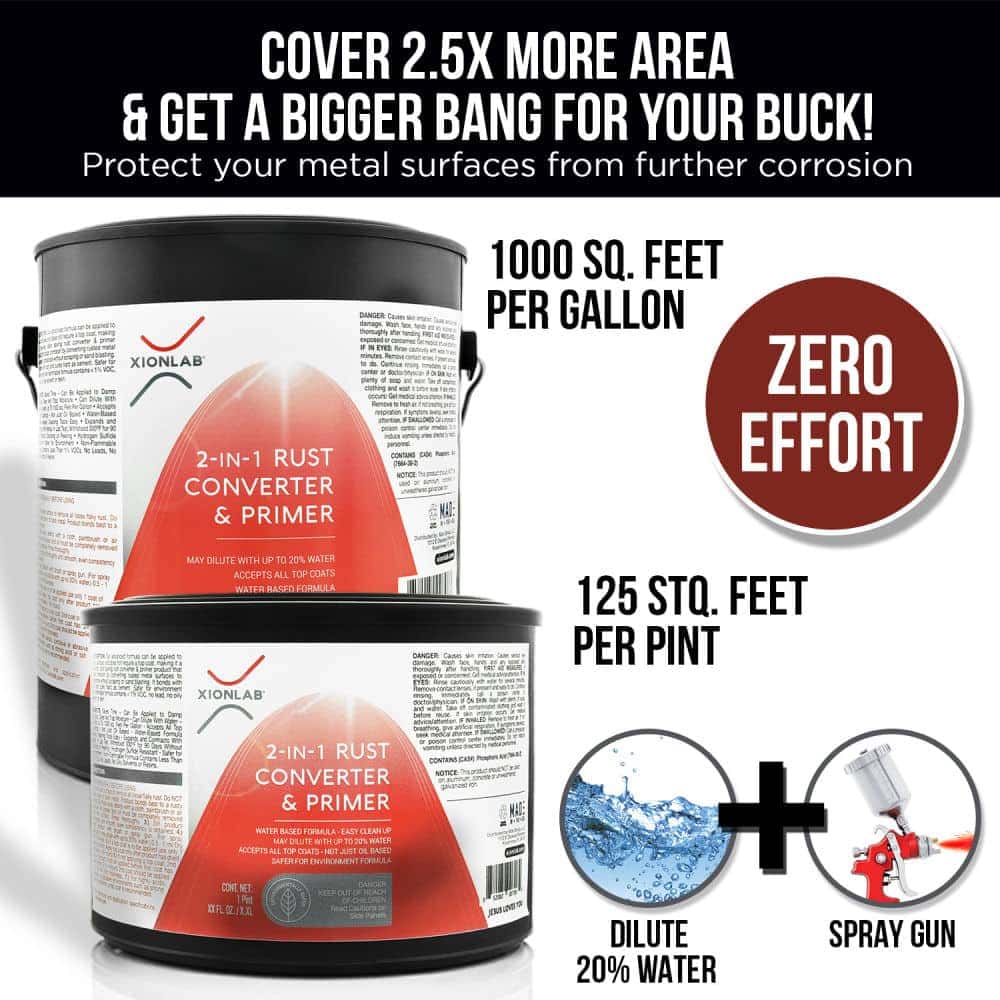
XionLab’s 2-in-1 Rust Converter & Metal Primer converts corrosion and primes the surface in a single step. Safer for you, safer for the environment.