No products in the cart.
Rust Converter and Primer: The Complete Guide to Getting Rid of Rust (2026 Guide)
May 9, 2026
By Xion Lab
Free Shipping
easy returns
secure paymentS
FAQ | MY ACCOUNT | SUPPORT
May 9, 2026
By Xion Lab
Quick Answer: A rust converter and primer turns active iron oxide into a stable, paintable layer in a single pass. Brush, roll, or spray a thin wet film over a dry, degreased surface, watch the rust shift from orange to near-black inside about 20 minutes, then topcoat once cured. No grinding, no media blasting, no shop downtime.
Rust starts the moment bare iron meets oxygen and moisture. The reaction releases tiny amounts of energy each cycle, and once the orange film forms it traps moisture against the surface — which only feeds the next round of corrosion. That feedback loop is what turns a single chip in a fender into a hole the size of a fist.
Salt accelerates everything. NACE International (now AMPP), the global authority on corrosion engineering, pegs the worldwide cost of rust and corrosion at roughly $2.5 trillion a year — about 3.4% of global GDP — in their landmark IMPACT economic study. The same group estimates better practices could save somewhere between 15% and 35% of those losses. So we are talking hundreds of billions in damage sitting on the table every single year.
And the residential side is brutal too. A homeowner in the salt belt typically watches a steel railing or wrought-iron gate go from clean to compromised inside three to five winters. But chemistry can interrupt that cycle long before the metal gives up.
Salt wins every time. Understanding the chemistry early gives you a real shot at protecting your stuff before flake turns into failure. Our A-to-Z guide on rust formation walks through the underlying reactions in more depth.
Annual global cost of corrosion (NACE IMPACT). Roughly 3.4% of global GDP, with motor vehicles alone accounting for $23.4 billion of yearly damage.
Two acids do the heavy lifting. Tannic acid binds with iron oxide and forms iron tannate — a deep blue-black, stable film. Phosphoric acid follows behind, building iron phosphate and a microtextured surface for whatever topcoat lands on it next. Old single-acid formulas only do half the job.
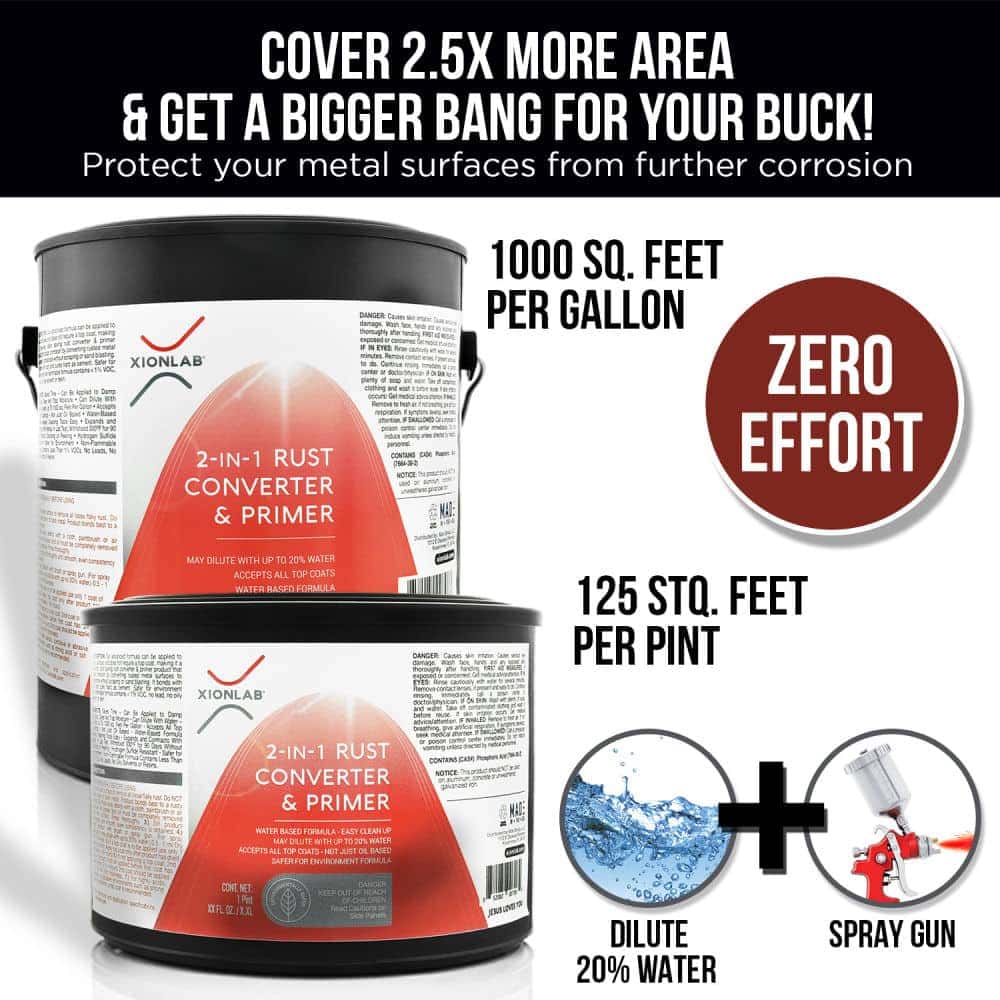
Modern dual-acid blends — like the polymer-bonded chemistry inside XionLab 2-in-1 Rust Converter & Metal Primer — react with the rust and leave a primer layer ready for paint, in one pot. Corrosionpedia describes the process as “chemical neutralization rather than mechanical removal,” which is exactly the trade-off owners of older trucks, gates, and boats have been waiting on for decades.
Color change is your tell. A wet brushstroke goes on milky tan, the rust patch dulls within five minutes, and by minute fifteen or so the surface looks like wet slate. Spots which stay reddish-brown did not get full contact — usually grease or dust. Wipe and recoat.
So why does dual-acid matter so much in real-world projects? Single-acid converters often leave a spongy outer layer because the chemistry only travels skin-deep. But a dual-acid system pushes through the upper rust crust into the cracks below, then locks the converted matrix in place with the polymer carrier. That gives the topcoat real adhesion — the kind which survives flex, vibration, and a Northeast winter sitting through 40 freeze-thaw cycles.
And the chemistry is not exotic — tannic acid is what gives oak galls and red wine their bite, while phosphoric acid is the same household compound found in cola. The trick is the carrier blend, the pH window, and the polymer chemistry around them. Small differences in formula change everything once the can lands on metal.
Here is the short version of beating rust with a 2-in-1 product. No fluff, no shortcuts.
Hit it with a wire brush or a coarse Scotch-Brite pad. You are knocking off flakes and dust, not sanding down to shiny metal. Solid rust stays — the converter wants something to react with.
Oil kills the reaction. Wipe with mineral spirits or a dedicated degreaser and let it flash off before the product touches steel. Silicone from old polishes is the sneakiest enemy — use a prep solvent rather than a shop rag swiped across the bench.
Brush, roll, or spray on an even wet coat — think stain, not paint. Watch for the color shift from rust red to near-black within 15 to 20 minutes at normal room temperature. Spots which stay brown mean the reaction did not complete.
Some spots want two passes, especially dense black scale or rust over a prior paint failure. Apply the second coat once the first feels tack-free. Twice is usually enough.
Dry conditions: 24 to 48 hours. Humid Gulf Coast summers: stretch it to 72. A fingernail scratch should not lift the film before you topcoat.
Most acrylic, alkyd, and epoxy paints stick well over a fully cured converter. Skip latex on exterior steel — adhesion is poor and it traps vapor.
Pro tip: One coat. Done. If you are tempted to layer three times, the first coat probably went on too thin. Heavy rebuilds belong on filler primers, not converters.
Most failed conversions happen at prep, not chemistry. The two biggest culprits are oily fingerprints across freshly wiped panels and applying in direct mid-summer sun, where the wet film flashes off before the acids react. Work in shade. Wipe with cotton, not the rag from the brake job.
But there is a sneakier failure mode worth watching: humidity. A high-dewpoint Gulf Coast morning leaves a barely-visible moisture film on bare steel even after wiping. So a quick warm-up pass with a heat gun on its lowest setting drives that surface moisture off. Apply within ten minutes while the metal is still slightly warm to the touch.
Not all are equal. Cheaper formulas often skip the polymer carrier and call themselves “primers” anyway. The difference shows up six months later under a thumbnail.
| Formula Type | Best For | Limitations | Topcoat Window |
|---|---|---|---|
| Tannic-only converter | Light surface rust, art restoration | Weak primer bond, needs separate primer | 24 hr |
| Phosphoric-only converter | Quick prep on factory-clean steel | Pulls back from heavy pitting | 12–24 hr |
| 2-in-1 dual-acid (e.g., XionLab) | Vehicle bodies, gates, equipment, marine deck hardware | Not a structural patch — won’t fix perforated metal | 24–48 hr |
| Solvent-based industrial | Pipelines, tanks, structural steel | Requires PPE, slow cure, fume management | 48–72 hr |
Corroseal works well on lighter surface rust and has a loyal audience. Where XionLab pulls ahead is in the polymer primer chemistry — by the time the converter cures, you already have a paintable bond layer underneath, so a separate primer step is optional rather than required. For tougher industrial scenarios, our industrial rust converter guide dives into shop-specific picks.
And do not write off solvent-based industrial converters either — they have a rightful place inside oil refineries, on pipelines, and across structural steel which sees daily chemical splash. But for a homeowner refinishing a wrought-iron porch railing, those formulas are massive overkill and bring fume problems most garages cannot handle. Match the formula to the failure mode, not the marketing copy.
Spray cans suit small projects beautifully. Quart and gallon sizes make sense for trailer frames, fences, and deck hardware. Five-gallon pails serve the contractor crowd, where a single afternoon turns into multiple gates and one full equipment trailer.
Average time the conversion reaction takes at 70°F. Cooler garages or shaded patios can stretch it closer to 30 — patience pays here.
Last fall I dragged a 2009 utility trailer out of a friend’s barn outside Cleveland. The crossmembers had taken a decade of road salt and looked like flaking pastry — orange scale about a quarter-inch thick in some spots, lighter mottled rust in others. He wanted to know if it was worth saving or if it should go to scrap.
Wire-wheel knocked off the loose stuff in about two hours. One careful coat of XionLab 2-in-1, brushed on with a cheap chip brush. Within twenty minutes the whole frame had gone from rust orange to slate black. We let it sit overnight in a heated bay, recoated three rough patches the next morning, and rolled out a topcoat of black rust-inhibitive enamel that afternoon.
Sequence is everything. Eighteen months later, the trailer is parked in his uncovered driveway through Ohio winters. No bubbles, no flash-back rust, no edge lift. Total spend was under $80 in product. The machine shop quote for media blasting alone had been $650 — and that was before paint.
Skip the temptation to slather it on thick. A heavy coat seals the top before the chemistry reaches the deeper rust, and you will be cussing when you peel a flap loose with a thumbnail in spring. Thin and even, every time.
And bring more brushes than you think. Cheap chip brushes are throwaway items at this point — fight the urge to clean and reuse the one which started turning black after the first patch. Fresh bristle gives you a cleaner edge and saves you forty minutes of rework. So buy the eight-pack, not the single.
Honesty matters. A converter is not a structural fix. If you can poke a screwdriver through the panel, no chemistry on earth is going to bring it back. Cut, weld, patch — then convert and prime the surrounding metal.
And here is a caveat most blogs skip: if the rust has been sitting on bare metal for many years and the substrate is actively pitting, you may convert the visible film but lose adhesion later as the deeper substrate keeps reacting. For those cases, a sandblast plus epoxy primer is still the gold standard. The converter route shines on weathered surface rust where the metal underneath remains sound.
Tannic plus phosphoric, balanced for full conversion and primer bonding in a single pass.
No solvent fumes, no hazmat disposal. Brushes rinse with warm water and soap.
Ready for topcoat once cured. Skip the second product, save a step.
Holds up against salt spray on deck hardware and trailer frames. Rinse first, dry fully, apply.
Works on iron and carbon steel — fences, vehicles, machinery, ironwork, structural angles.
Formulated since 2015, supported by a real US-based team at 888-306-2280.
If you want to go deeper on what’s inside the can, the science of rust converters and primers piece breaks down the chemistry molecule by molecule. For automotive scenarios, the rust converter for automotive protection page covers underbody, frame, and bracket prep specifically.
Beating rust once is a win. Keeping it gone is a habit. A solid topcoat handles most of the work, but small scuffs and dings expose bare metal again, and salt drift in the salt belt or Pacific Northwest mist will find every chip.
For anyone living near the coast or in heavy snow-belt territory, our piece on marine corrosion protection covers chloride-driven failure modes which go beyond ordinary atmospheric rust.
Pacific Northwest moisture works differently from Gulf Coast salt spray. So treat them differently. PNW rust comes from constant low-grade dampness with mild salt — converter cures slower but topcoat adhesion stays strong. Gulf Coast rust pairs heavy chloride exposure with summer heat, which means more frequent inspection passes and a topcoat with proven UV stability.
And the desert Southwest brings its own twist — UV degrades clearcoats fast even though humidity is low, so the topcoat selection matters more than the converter chemistry. But the salt belt across Michigan, Ohio, Pennsylvania, and upstate New York hammers vehicles every winter from below. Frame rails, brake lines, and rocker panels live or die by how thoroughly the underbody got prepped before topcoat.
It chemically transforms iron oxide into iron tannate and iron phosphate — both stable compounds. The original rust is gone in a chemical sense, not buried under paint.
Think stain, not paint. A wet, even film — no puddles and no heavy drips. Too thick and the top skin seals the chemistry before it reacts.
24 hours in dry conditions, up to 72 hours in humid ones. A fingernail scratch should not leave a mark before you topcoat.
Brown means the reaction did not complete — usually grease, dust, or glossy mill scale blocked contact. Clean those spots and recoat.
Yes. Rinse with fresh water, dry fully, then apply. Cure times run longer in salt air, so plan for an extra day.
Absolutely. Scrape loose scale, degrease, apply in thin coats. A second pass catches awkward angles around frame rails and crossmembers.
Seal tight, keep above freezing. Water-based chemistry separates if frozen. Shelf life is around two years.
Both work. Spray for large panels, brush for deep pitting. Many pros combine both approaches on the same project.
No — those metals form different oxide layers and the chemistry is tuned for iron and carbon steel. Use a metal-specific cleaner instead, or talk to the team at 888-306-2280 about alternatives.
So long as the application followed prep guidance and the topcoat went on within the recommended window, the converted layer behaves like a primer for years. But thick over-application or topcoating before full cure are the two failure modes which lead to peeling — both avoidable with thin coats and patience.
Roughly two years stored above freezing in a dry place. And once opened, transfer the leftovers into a smaller container so air space is minimized — that little trick can stretch usable life out by another few months.
XionLab 2-in-1 Rust Converter & Metal Primer ships fast, smells clean, and works on the messes other products quit on. Safer For You, Safer For The Environment — since 2015.
Call us at 888-306-2280