No products in the cart.
Rust Treatment
Everything about painting over rust converter — right paint types, cure windows, prep mistakes, and when the black coating actually needs a topcoat to hold long-term.
Quick Answer: Yes — you can paint over rust converter once it has fully cured, which takes 24 to 48 hours depending on temperature and humidity. Use oil-based or epoxy paint only. Latex and water-based finish coats do not bond properly to the ferric tannate layer the converter creates, and they will peel.
The question comes up constantly among DIYers, contractors, and marine maintenance crews alike. You’ve applied the converter, watched the rust turn that familiar matte black, and now you’re standing there wondering — can you paint over rust converters, or does the coating stand on its own?
Short version: it absolutely needs a topcoat for long-term protection. But the longer version matters a lot, because using the wrong paint — or rushing the cure window — will undo everything the converter did. Salt air wins every time against a latex coat laid down too soon.
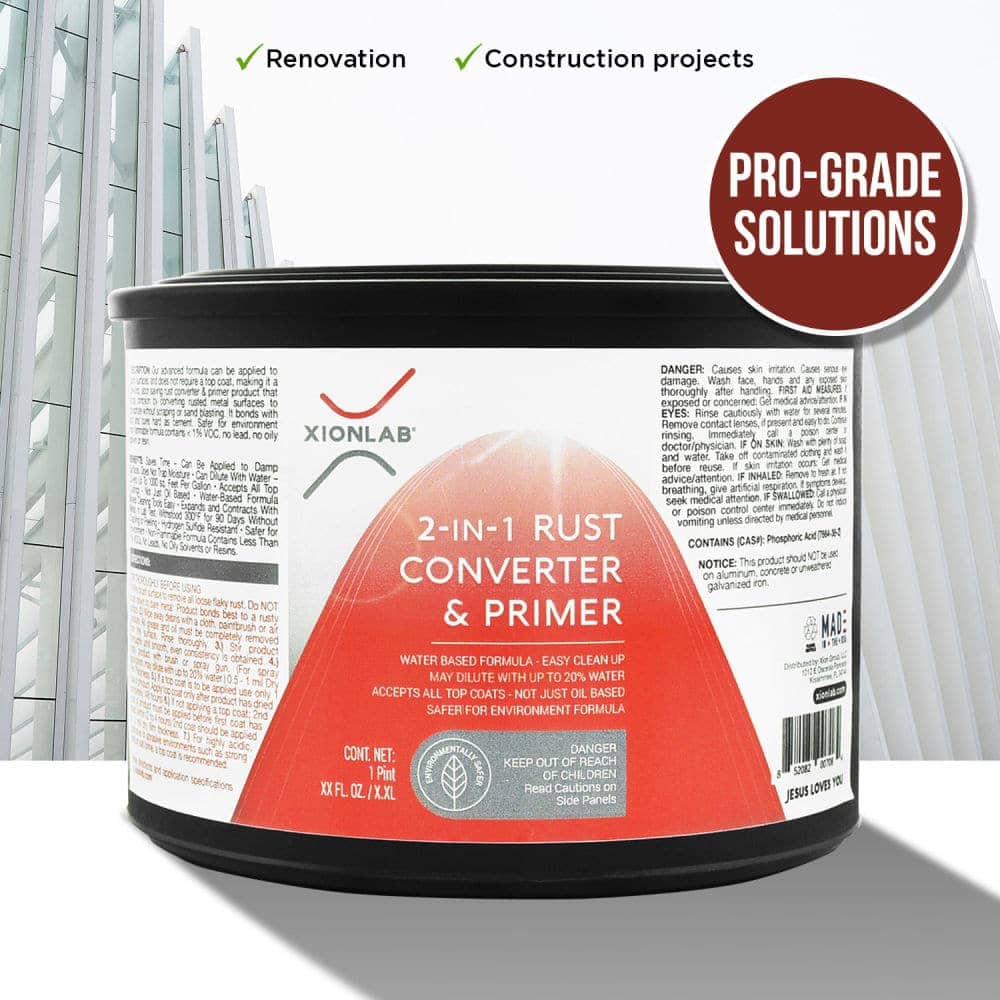
This guide covers the chemistry, the correct paint types, the timing, and the step-by-step process to get a finish worth keeping. XionLab’s 2-in-1 Rust Converter and Metal Primer is built to take a finish film directly — but the rules here apply across the board.
The Science
What Rust Converter Actually Does to the Metal
Rust converters work through a two-part chemical reaction. Tannic acid binds to iron oxide — the reddish-brown compound formed when iron meets oxygen and moisture — and converts it into iron tannate, a dark, stable compound. An organic polymer sets over the top of that reaction, forming a hard, adhesive priming film — weather-resistant and strongly bonded.
So the black surface you’re left with isn’t just painted-over rust. It’s chemically transformed rust. The iron oxide is gone. What remains is inert, bonded tightly to the underlying metal, and — critically — porous enough to accept an oil-based or epoxy topcoat without primer in most situations.
But here’s where people get tripped up. Iron ferrotannate is hard but not impermeable. Exposed to ongoing UV, vapor cycling, and mechanical abrasion, an uncoated converter surface will degrade over months. The transformation holds — rust doesn’t come back through it — yet the protective barrier thins. A proper outer coat seals the polymeric tannate film and extends the life of the whole system by years.
$450B+
Annual corrosion cost to the U.S. economy, according to AMPP (formerly NACE International). Proper coating systems are the single most effective preventive measure.
Understanding the chemistry also explains why paint type is non-negotiable. Water-based and latex paints carry moisture into the equation at the molecular level. Applied over a freshly converted surface, they interfere with the remaining conversion process and fail to form a durable bond. Oil-based and two-part epoxy systems are chemically compatible with the tannate substrate and lock in properly.
Technical Reference
Key Compounds and Why Each Matters
Tannic acid — the reactive agent in rust converter formulations — belongs to a class of polyphenolic compounds naturally occurring in gallnuts, bark, and certain legumes. Its molecular affinity for ferric ions makes it uniquely suited to rust remediation. When tannic acid contacts hydrated iron oxide, it undergoes chelation: the polyphenol arms of the molecule clamp around the ferric cation, displacing water molecules and forming a coordination complex far more stable than the original rust matrix.
The polymer component added by formulators like XionLab functions as an encapsulant — sealing the newly formed ferrotannate lattice against atmospheric re-oxidation. Think of it as scaffolding: the chelation reaction transforms the substrate chemistry, and the polymeric binder locks the transformed matrix in place. Porosity decreases, oxygen permeability drops, and the resulting film exhibits strong adhesion to subsequent alkyd or epoxy topcoats.
Iron tannate itself — the conversion product — has a Mohs hardness comparable to dried resin. It won’t chip under incidental contact, resists UV degradation for moderate timeframes, and doesn’t re-solubilize under ambient humidity. Its limitation: sustained immersion or weathering without a protective overcoat will eventually thin the film, especially at weld bevels and sharp edges where coverage runs narrowest. For those zones, a second converter pass before painting closes the gap.
Paint Selection
Which Paints Work — and Which Will Peel
Not all paints bond equally to a converted surface. Getting this right is the difference between a finish lasting a decade and one peeling off by autumn.
| Paint Type | Compatible? | Notes |
|---|---|---|
| Oil-based alkyd paint | ✅ Yes | Best general-purpose choice; bonds to converted compound layer; widely available |
| Two-part epoxy paint | ✅ Yes | Best for industrial, automotive, and marine use; superior chemical resistance |
| Oil-based rust-inhibitor enamel | ✅ Yes | Good outdoor choice; adds another layer of corrosion protection |
| Latex / water-based paint | ❌ No | Will not bond to iron tannate; peels and bubbles over time |
| Powder coating | ❌ No | Application heat disrupts the converter chemistry; not compatible |
| Water-based primer | ❌ No | Introduces waterborne interference; fights the tannate bond chemistry |
For most homeowner jobs — outdoor furniture, garden gates, fencing, trailer frames — a quality alkyd rust-inhibiting enamel is the right call. Two coats, applied with a brush or short-nap roller, give excellent protection and color retention.
For automotive rust treatment, two-part epoxy primer followed by a matched topcoat is the professional standard. The epoxy seals micropores in the iron polymeric compound substrate completely, preventing any moisture intrusion at the paint-metal interface. And for marine applications along the Gulf Coast or Pacific Northwest — where salt spray and humidity are relentless — epoxy is not optional. Salt wins every time against alkyd-based alkyd on bare tannate.
One underused option: an oil-based primer applied between the converter layer and the color film. It isn’t strictly required, but on heavily pitted surfaces or vertical applications where coverage may be uneven, a thin oil primer coat smooths the surface and improves topcoat adhesion noticeably.
Timing & Preparation
Cure Time, Surface Prep, and the Wipe-Down Step Most People Skip
Timing is where most painting failures begin. The converter needs a full drying interval before any overpaint goes on.
- Touch-dry: approximately 20 minutes under normal conditions (65–80°F, moderate humidity)
- Second converter coat (if needed): wait 24 hours between coats
- Paint-ready cure: 24–48 hours after the final converter coat
- Cold-weather adjustment: below 50°F, conversion slows significantly — add 12–24 hours to your cure window
- High-humidity adjustment: above 85% relative humidity delays curing — consider delaying application entirely
After the converter cures, wipe the surface with a damp cloth to remove excess unreacted converter residue. Then let it dry completely before painting. Most guides skip this step — don’t. Unreacted tannin residue on the surface creates a film between the iron tannate layer and your protective overcoat, reducing adhesion. It takes about two minutes and meaningfully improves bond strength.
Surface Prep Before the Converter Goes On
Painting over a converted surface is only as good as the preparation work done before the converter was applied. Run through this sequence first:
- Remove loose rust and scale with a wire brush, scraper, or coarse sandpaper — the converter needs rust to bind to, but flaking scale doesn’t provide a stable base
- Degrease thoroughly using mineral spirits or a dedicated metal degreaser — oil and grease create a barrier between the tannic acid and the iron oxide, blocking the chemical reaction entirely
- Dry the surface completely before applying converter — active water dilutes the chemistry and produces uneven conversion
- Do not sand to bare metal — the converter requires rust to work; smooth bare metal areas should receive a separate primer
500 sq ft
Coverage per gallon for most rust converters under standard application conditions. Heavy pitting or textured surfaces will reduce this figure — plan for closer to 350 sq ft per gallon on rough substrates.
Real-World Application
What This Looks Like in Practice
A few years back I treated a wrought-iron gate at a rental property about twenty minutes from Tampa Bay. Salt air had been working on those hinges and lower rails for four or five years — maybe a quarter-inch of rust bloom on the horizontal members, deeper pitting near the base posts where rainwater pooled. Classic Gulf Coast scenario.
Applied two coats of XionLab, spaced a day apart. The conversion was almost complete after the first coat, but the lower sections needed a second pass to fully blacken. Wiped everything down with a damp rag the next morning, let it sit through the afternoon, then rolled on a rust-inhibiting oil enamel the following day. Two coats total. Three months later, no orange. Not a spot.
The contrast with a neighboring property — where someone had rolled latex exterior paint directly onto surface-treated rust — was stark. By month two, small bubbles had formed along the bottom rail where moisture had worked under the incompatible paint layer. By month four, the latex was peeling in strips.
The formula is unforgiving about paint compatibility. But when you follow it, the results hold up far better than most people expect, even in coastal environments as aggressive as the Gulf Coast. XionLab’s full guide to rust converter science and primers covers the underlying chemistry if you want to go deeper on why these reactions behave the way they do.
Limitations
Honest Limitations: Where Rust Converters Won’t Work
Part of using any product effectively is knowing where it breaks down. Rust converters are excellent — but they’re not universal.
- Aluminum, copper, stainless steel, and galvanized steel: Rust converters are formulated for iron and steel. These metals either don’t rust in the same way or have protective oxide layers the tannic acid chemistry can’t penetrate. AMPP’s corrosion resources detail compatible and incompatible substrates in depth. Use a dedicated primer instead.
- Perforated or through-rusted metal: If rust has eaten entirely through the metal, the converter has nothing structural to bind to. The reaction compound film will crack and fail along the void. Patch first, then treat.
- Heated surfaces (exhaust manifolds, heat shields, engine blocks): High heat degrades the tannate compound over repeated thermal cycles. Use a heat-rated coating system designed for those temperatures.
- Interior galvanized surfaces: The manufacturer guidance is clear — interior galvanized steel is not a compatible substrate.
- Surfaces receiving powder coating: Curing heat from the powder application process disrupts the tannate chemistry entirely. Not compatible.
It also won’t substitute for structural repair. Converter treats the rust present at application — it doesn’t restore metal thickness or repair compromised weld seams. If something is rusted to the point of structural weakness, that’s a fabrication problem before it’s a coating problem.
For a full breakdown of scenarios comparing treatment options, see our rust converter vs. rust remover comparison — the two products get confused often, but they work through completely different mechanisms and serve different situations.
Brand Comparison
How XionLab Compares to Other Rust Converters
Several brands do quality work in this category. Corroseal is a well-regarded option — particularly for light surface rust on tanks and structural steel where the product’s thick viscosity fills minor pitting effectively. For straightforward surface rust, it performs consistently well.
Where XionLab pulls ahead is in dual-function applications. The XionLab 2-in-1 formula combines the conversion chemistry and a priming layer in a single product. So when painting over rust converter is your end goal, you’re effectively skipping an entire step — the conversion layer already functions as the primer coat for your oil-based or epoxy color coat. For large jobs or multi-surface assignments where time matters, that consolidation is meaningful.
| Product | Primary Strength | Best Use Case | Paint Compatibility |
|---|---|---|---|
| XionLab 2-in-1 | Converter + primer in one formula | Automotive, structural, marine, outdoor | Oil-based, epoxy |
| Corroseal | Thick viscosity, good gap-filling | Tanks, structural steel, light pitting | Oil-based, epoxy |
| Rust-Oleum Rust Reformer | Wide retail availability | Small home projects | Oil-based only |
| Gempler’s Rust Converter | Cost-effective large volumes | Farm equipment, fencing | Oil-based, epoxy |
Regardless of brand, the painting rules don’t change. Oil-based or epoxy topcoat. Full cure window. Wipe the surface before painting. Those three things matter more than the specific converter formula in determining how well the final paint job holds up.
Why XionLab
How XionLab Makes Painting Over Rust Converter Easier
⚙
2-in-1 Formula
Converts rust and primes in a single coat, so your finish coat goes on directly without a separate primer step. One product, one application window.
💧
Water-Based, Low VOC
Safer for indoor and enclosed-space applications. Cleans up with water. No solvent fumes during application. Safer for you, safer for the environment.
🔔
Fast Touch-Dry
Touch-dry in about 20 minutes under normal conditions. Most projects can take a final layer within 24 to 48 hours of application.
⚓
Marine-Tested Chemistry
XionLab’s tannate conversion holds up in high-humidity, coastal environments where salt air accelerates surface oxidation on untreated iron.
🔍
Full Conversion Visible
The surface turns uniformly dark when conversion is complete. No guessing — if rust-brown remains, apply a second coat to those spots before painting.
✅
Compatible with All Oil & Epoxy Topcoats
Works seamlessly under solvent-borne enamel, alkyd paint, and two-part epoxy systems. No compatibility issues when you follow the curing window.
Step-by-Step Process
The Right Way to Paint Over Rust Converter
Here’s the full sequence from metal prep to finished topcoat. Follow this order and the paint will outlast most of the surrounding metal.
Phase 1 — Wire Brush and Degrease
Remove all loose rust, flaking scale, and old paint with a wire brush or angle grinder. Then degrease with mineral spirits or a dedicated metal cleaner. Oil on the surface kills the tannic acid reaction before it starts. Rinse and dry completely.
Step 2 — Apply the First Converter Coat
Apply rust converter with a brush, roller, or airless sprayer. Work it into pitted areas. One coat handles moderate rust well. For heavy oxidation, plan on two coats. The surface shifts from orange-brown to dark gray or black as the iron tannate forms — watch for that visual confirmation.
Step 3 — Wait the Full Cure Window
Do not rush this. 24 hours minimum before a second coat if needed, 48 hours before your color coat. Cold weather extends this — below 50°F, add at least half again to the curing interval. Check humidity too. Fog and heavy dew slow curing significantly.
Step 4 — Wipe Down
Wipe the cured surface with a damp cloth to remove unreacted residue. This is the step most tutorials drop. Let the surface dry before painting — give it 30 minutes in warm conditions.
Step 5 — Apply Oil-Based or Epoxy Topcoat
Two coats of a quality alkyd enamel or two-part epoxy. Let the first coat dry to touch before the second. On outdoor or coastal applications, XionLab recommends at least two full finish coats with no shortcuts on dry time between them.
That’s the whole sequence. Five steps. The reaction handles the hard part — your job is giving it the time and conditions to work.
Application Notes by Substrate and Setting
Wrought iron fencing, ornamental gates, and decorative railings respond predictably to standard treatment — two passes with a brush or short-nap roller, adequate dwell time, and oil-alkyd overcoat. Farm equipment and agricultural machinery are trickier because machinery sits outdoors year-round and receives mechanical abrasion from soil contact, crop debris, and equipment chains. For those substrates, two-part epoxy delivers superior abrasion resistance and holds up against fertilizer residue, which accelerates oxidation far faster than ambient humidity alone.
Boat trailers and dock hardware present a distinct scenario — submersion cycles introduce water intrusion risk at every weld seam and joint. Epoxy topcoats are the clear preference here; an oil-alkyd finish on regularly submerged hardware will soften and peel within a single season along salt-water coastlines. Trailer tongue assemblies and winch posts along the Gulf Coast or Chesapeake estuary regions demand epoxy from the outset. Skimping on topcoat quality in those environments is a false economy — recoating a neglected trailer frame costs far more in labor and materials than getting the chemistry right the first time.
Regional note: In Gulf Coast states like Louisiana, Texas, and Florida — or in the Pacific Northwest where humidity runs high through the winter — extend all drying and curing times by 30 to 50 percent. Salt-belt states in the Midwest face similar challenges in early spring when road salt residue is still active on vehicle frames. For industrial and agricultural applications in these regions, two converter coats plus two topcoats is the right baseline, not one of each.
Common Questions
Frequently Asked Questions
Can you paint over rust converter without a primer?
Yes — in most cases the converter layer itself acts as a primer. XionLab’s 2-in-1 formula is specifically designed for direct topcoat application without a separate primer step. On heavily pitted or rough surfaces, a thin oil-based primer coat between the tannate layer and the topcoat can improve adhesion and smooth the finish.
How long do you have to wait to paint over rust converter?
24 to 48 hours in normal conditions (65–80°F, moderate humidity). In cold weather below 50°F or high humidity above 85%, extend the cure window by at least 12 to 24 additional hours. Painting too early is one of the most common causes of adhesion failure.
Can you use latex paint over rust converter?
No. Latex and water-based paints do not bond properly to the converted iron tannate film. They tend to peel, bubble, or delaminate — often within a few months, particularly on outdoor surfaces exposed to moisture and temperature cycling. Use oil-based or epoxy paint exclusively.
Do you have to sand rust converter before painting?
Light scuff sanding with 220-grit paper can improve topcoat adhesion on very smooth converted surfaces, but it is not required in most applications. Do not sand through the tannate stratum to bare metal. If bare metal is exposed, reapply converter to those areas before painting.
What happens if rust converter is not fully cured before painting?
Painting over an undercured converter surface traps trapped dampness in the system, disrupts the ongoing tannate formation, and reduces adhesion between the converter layer and final coat. The result is premature peeling, bubbling, and re-exposure of the underlying metal. Give it the full curing schedule — always.
Can you use epoxy primer over rust converter?
Yes. Two-part epoxy primer over a fully cured rust converter layer is an excellent system for automotive, industrial, and marine applications. The epoxy seals the microporous tannate surface completely, creating a moisture-impermeable barrier before the color topcoat is applied. Allow 48 hours of converter cure time before applying epoxy primer.
Does rust converter work on aluminum or galvanized steel?
No. Rust converters require iron oxide to react with. Aluminum oxidizes through a galvanic process distinct from ferrous oxidation, and galvanized steel carries a zinc barrier coating. Neither substrate is compatible. Use a dedicated metal primer formulated for those materials instead.
How many coats of paint do you need over rust converter?
Two coats of petroleum-based or epoxy paint are recommended for most outdoor and structural applications. A single coat may be adequate for interior or sheltered substrates with minimal moisture exposure, but two coats provide substantially better long-term protection, particularly in coastal or high-humidity environments.
Stop Rust at the Source
XionLab’s 2-in-1 Rust Converter and Metal Primer is formulated to convert active rust, prime the surface, and accept oil-based or epoxy topcoats — all in one product. Safer for you, safer for the environment.
Safer For You, Safer For The Environment • Founded 2015