No products in the cart.
Does Rust Converter Work? (2026 Guide) — Real Results, Real Limits
May 15, 2026
By Xion Lab
Free Shipping
easy returns
secure paymentS
FAQ | MY ACCOUNT | SUPPORT
May 15, 2026
By Xion Lab
Quick Answer: Yes, rust converter works — but only on actual ferrous rust, with proper surface prep, and within its design limits. A quality converter chemically locks active oxidation into a stable, paintable film in roughly 24 hours. Skip the prep or apply it to the wrong substrate, and results disappoint fast.
Rust converter works. So do well-applied paints, gym memberships, and dental floss — until people stop using them correctly. The chemistry is real. The science behind it is older than most modern coatings, and lab data backs it up. But the field results swing wildly because users skip the steps separating success from a wasted weekend.
Here is the cleanest summary anyone can give you. A converter reacts with iron oxide and turns it into a stable, dark, paint-ready film. Tannic acid pulls iron ions into a deep blue-black tannate complex. Phosphoric acid attacks the oxide and forms iron phosphate. Both stop active corrosion and leave a primed surface. That part is not in dispute.
What ruins outcomes? Bad prep. Wrong substrate. Wrong rust. Too much product. Too little drying time. Painting before the cure finishes. Trusting a cheap formulation. Each one of those failures gets blamed on the converter — but the chemistry was doing fine. The operator was not.
So the real question is not whether rust converter works. The real question is whether you will work the converter properly. XionLab’s 2-in-1 Rust Converter and Metal Primer is engineered to forgive a few mistakes, but no product forgives all of them.
Independent salt spray testing per ASTM B117 — the industry’s standard accelerated corrosion exposure protocol — consistently shows treated steel outperforming bare steel by huge margins. Untreated mild steel corrodes at roughly 25 to 80 mils per year in coastal exposure. Treated steel can drop into single digits. The ratio is not subtle.
Annual global cost of corrosion per the NACE IMPACT study — about 3.4% of global GDP, with 15–35% considered preventable through proper coatings.
And the chemistry is not new. Tannic-acid–based converters have been formally documented in coatings literature since the 1970s. Phosphoric-acid conversion goes back further — it shows up in early aerospace and Navy specifications. Both processes were vetted by people who lose ships and aircraft when corrosion wins.
Field reality tells the same story. Bridge maintenance crews in documented Corrosionpedia case studies have used acid-based converters as part of multi-coat systems for decades. Restoration shops on the Gulf Coast use them weekly. Marine techs in the Pacific Northwest swear by phosphoric formulations for trailer frames after a winter of road salt and rain.
So why does the internet still argue about whether converters work? Because most arguments come from people who watched a friend slap one coat on flaking, greasy metal and watched it peel three weeks later. Bad prep beats good chemistry. Always.
Iron oxide is loose and porous. It wants to grow. Left alone, it spreads under paint, eats through sheet metal, and turns structural steel into orange flakes. A converter changes that math by chemically binding the oxide into a tighter, more stable compound.
Tannic acid grabs ferrous ions and pulls them into a chelated ring. The result is ferric tannate, a dense blue-black layer with much lower oxygen permeability than ordinary oxidation byproducts. Phosphoric acid takes a different route — it eats the oxide and leaves iron phosphate behind. Same destination, slightly distinct pathway, equivalent end-state.
One coat. Done. Or close to it, if the rust layer is thin enough. Heavier rust may need two coats or a light scuff between passes. The science behind rust converters and primers covers the full molecular path for readers who want the molecular detail.
The color shift is more than cosmetic. A proper conversion turns orange-brown rust into a deep, almost ebony membrane. Spotty color signals incomplete reaction. Streaks of bright copper-orange peeking through? Additional product, longer dwell, more elbow grease before primer goes on top. Trust the visual cue, not the clock.
Rust converter does not behave like paint. Paint hides things. A converter has to chemically react, which means it cares deeply about what is and is not on the metal. Six conditions decide success or failure.
Hit five out of six and results still vary. Hit all six and the chemistry behaves predictably. Salt wins every time on neglected prep. Sequence is everything.
One of our long-time customers runs a small restoration shop near Mobile, Alabama. Gulf Coast humidity is brutal. He brought in a 1968 truck frame with surface rust about as thick as a couple sheets of paper across most of the rails, and one section near the rear crossmember closer to a quarter-inch of scale.
His approach was practical. He chipped the thick scale with a needle scaler, hit the rest with a wire-wheel attachment on an angle grinder, then wiped everything down with acetone. We sent him a sample of XionLab 2-in-1 Rust Converter and Metal Primer. He brushed on a moderate coat, let it cure overnight, and reported back the next afternoon.
Two things stood out. The conversion was uniform — no orange ghosting under the dark film. And the surface accepted his epoxy topcoat without fisheyes or adhesion issues. Eighteen months later, with the frame back on the road and exposed to salt spray, the panel was still holding. He uses XionLab on every chassis now.
One honest caveat. The crossmember area where he had not fully removed the scale? It showed early breakdown at the nine-month mark. The converter cannot reach metal it cannot touch. The chemistry only works on what the brush can wet.
Most of the bad reviews online trace back to a handful of operator errors. The product takes the heat, but the failure was set in motion before the cap came off.
Not all are equal. Reading the active-ingredient percentage on a label tells you more than the brand name. Knowing the difference between a converter and a remover matters too — they are different chemistries for different jobs.
Honest comparison time. Several brands work well within their design windows. Picking the right one depends on the job, the substrate, and how much time the user wants to spend on prep.
| Brand | Best Use | Strength | Limit |
|---|---|---|---|
| XionLab 2-in-1 | Mixed-grade rust, automotive frames, marine | Converter and primer combined; topcoat-ready | Still wants ferrous substrate |
| Corroseal | Light surface rust | Water-based, easy cleanup | Less robust on heavy scale |
| POR-15 | Old chassis with intact thick scale | Very hard topcoat once cured | Demanding prep; UV-sensitive without color coat |
| Permatex Rust Treatment | Small touch-ups and consumer projects | Cheap and widely available | Lower active percentage; shorter durability |
| Eastwood Rust Converter | Restoration body panels | Brushable, paintable in 24 hours | Single-purpose — primer still needed |
Corroseal works well for lighter surface rust on garden tools and outdoor furniture. Where XionLab pulls ahead is the combined converter-and-primer chemistry — one product handles two stages, so the topcoat sits on a prepared, primed film instead of bare reacted iron tannate. Fewer steps, fewer chances to introduce an error.
The product has clear limits, and pretending otherwise damages credibility. Customers deserve a straight story.
Typical cure window for full conversion before topcoat application. Skip it and adhesion drops sharply.
Honesty about limits is how trust gets earned. Anyone selling a converter as a miracle cure is selling marketing — and you will pay for the misalignment with your time.
Converts rust and lays down a primer layer in a single brush pass — fewer steps, fewer failure points.
After cure, the dark membrane accepts most paints and epoxies without an additional priming pass.
Cleanup is straightforward. Indoor jobs are safer for the operator and shop air quality.
Application flexibility covers tight corners, broad panels, and overhead beams alike.
Performs on light surface tarnish and on moderately heavy buildup after mechanical knockdown.
Reduced vapor output and lower toxicity make it friendlier for hobbyists, restorers, and field crews.
The promise behind XionLab’s rust converter and primer line is simple. Build a product that meets the chemistry where the user actually stands. Most users are not chemists. They want a bottle, a brush, and a clear path from orange flakes to a paintable surface.
Geography matters more than people think. Atmospheric chemistry varies by region, and that changes both how fast rust forms and how a converter behaves once applied.
Gulf Coast users deal with stifling humidity year-round and brine-laden air within roughly fifty miles inland from the shoreline. Conversion membranes harden more slowly, and finish-coat selection becomes critical. Marine corrosion protection is its own discipline down there.
Salt belt states — think Michigan, Ohio, Pennsylvania, parts of New England — face winter de-icing brines splashed across every undercarriage. Oxidation forms aggressively. Annual touch-ups become necessary on exposed chassis components. So do most paint systems.
The Pacific Northwest has a distinct problem. Continuous dampness without freeze cycles produces uniform tarnish patterns, especially on aging outdoor structural elements. Conversion behaves predictably, but hardening windows lengthen. Plan accordingly.
Dry climates like the desert Southwest see slow rust progression overall. But UV exposure becomes the dominant variable. The converter film needs a UV-stable topcoat or it slowly fades. Same chemistry, different headwind.
Most failures happen because someone skipped a step. Here is the sequence professionals follow on automotive and structural jobs.
Skip any of those and the results get unpredictable. Follow them and the chemistry behaves the way the lab data says it should. Boring works. Reliable wins.
Use the right tool. A converter is not the answer for every rust situation, and applying it to the wrong scenario wastes money and trust.
If the project is a chassis with manageable surface rust, a converter saves hours. If it is a panel with holes the size of a coin, weld and replace. Different tools, different jobs.
Independent salt-spray studies show treated steel corroding up to sixteen times slower than untreated steel under equivalent exposure.
Does rust converter work on heavy rust?
It works on moderate rust without trouble. Heavy flaking scale needs mechanical knockdown first — wire-wheel or needle-scale the loose layers, then apply the converter to the sound, lightly-corroded surface underneath. Skipping that step is the top reason heavy-rust applications fail.
Can rust converter be used on aluminum or galvanized steel?
No. Conversion chemistry targets iron oxide specifically. Aluminum forms a different oxide, galvanized surfaces are zinc-coated, and stainless or copper alloys do not contain the iron the acid needs to react with. The bottle will not damage the metal, but it will not protect it either.
How long does the cure take before painting?
Most quality converters want around 24 hours under moderate temperature and humidity. Damp or cold conditions stretch the timeline. Painting over an incomplete cure traps moisture inside the film, which leads to blistering and peeling later. Patience pays off.
Will rust come back through the converted film?
Not from the converted metal itself — that iron is chemically locked. But if any untreated rust exists nearby, or if a future scratch breaks the film and exposes bare steel, fresh rust can start there. A good topcoat protects the converted layer and seals any nearby vulnerabilities.
Is rust converter the same as rust remover?
No, and confusing them costs money. A remover dissolves rust and exposes bare metal — useful when you want a restored steel surface. A converter chemically stabilizes the rust in place and creates a paintable film. Different chemistries, different outcomes. Pick based on what you want to end up with.
How long does a converted surface last outdoors?
A converted film with a quality topcoat can hold for several years in most climates, longer in dry regions. Without a topcoat, expect UV breakdown and gradual film thinning. Annual inspection on chassis components in salt-belt or coastal conditions is wise — touch up small breakthroughs before they spread.
Can you spray rust converter, or does it have to be brushed?
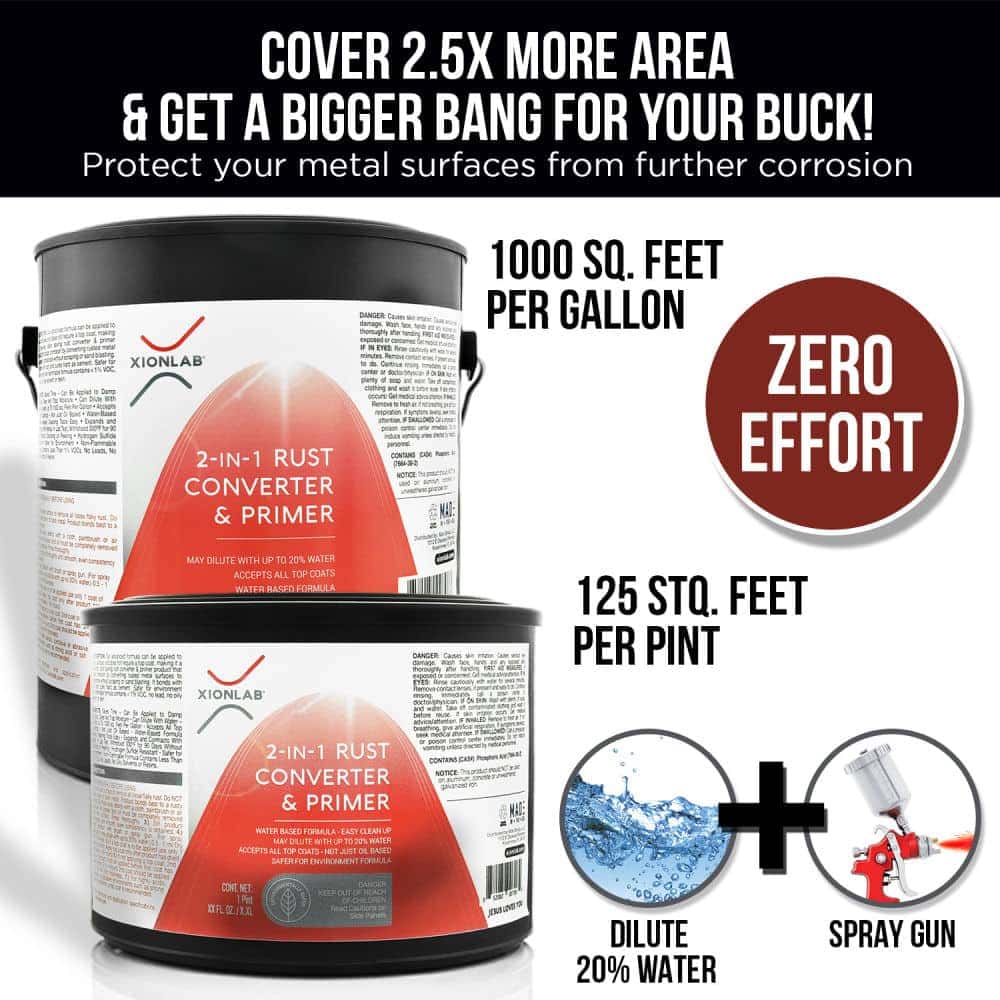
Spray, brush, and roller all work, depending on the formulation. XionLab 2-in-1 takes any of the three. Spraying covers large panels fast. Brushing reaches tight corners and lets the user work product into pitting. Rollers handle flat sheet metal cleanly. Pick the tool that matches the surface geometry.
Does it work on car undercarriages and frame rails?
Yes — chassis and frame rails are some of the most common automotive applications, especially after road-salt seasons in the Midwest and Northeast. Automotive rust converter applications walk through the underbody workflow in detail. Prep matters more on horizontal surfaces because they collect debris and moisture.
Why does my converted surface still look orange in spots?
Orange ghosting means incomplete reaction. Either the spot had too much grease, too thick a rust crust, or not enough product. Re-degrease, knock down any remaining scale, and re-apply. Trust the color change as your reaction indicator — uniform dark film equals complete conversion.
XionLab 2-in-1 Rust Converter and Metal Primer chemically stabilizes rust and primes the surface in a single application — water-based, topcoat-ready, and built for the way real shops work.