
No products in the cart.
Marine Corrosion Protection: Best Rust Converter and Coating Solutions for Boats (2026 Guide)
March 17, 2026
By Xion Lab
Free Shipping
easy returns
secure paymentS
FAQ | MY ACCOUNT | SUPPORT
March 17, 2026
By Xion Lab
How to stop saltwater from eating through your hull hardware, deck fittings, and trailer frame — and which rust converter actually works in marine environments
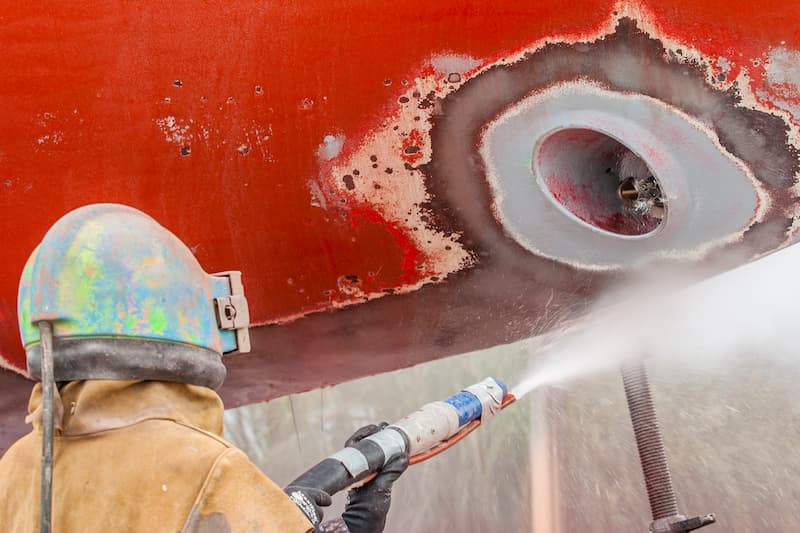
Quick Answer: Marine corrosion protection starts with understanding saltwater corrodes metal up to five times faster than freshwater — and that a quality rust converter neutralizes existing iron oxide chemically — not just coating over it. For boats, trailers, and coastal hardware, the sequence is: clean the surface, apply rust converter, let it cure fully, then topcoat with a marine-grade primer or paint. Skip any step and you’re just buying time.
Marine corrosion protection isn’t a product category. It’s a survival strategy. Salt wins every time. Any boat owner on the Gulf Coast, the Chesapeake, or the Pacific Northwest coast knows what happens when you leave bare metal exposed to salt air for even a few weeks — orange streaks, pitting, flaking. The speed at which saltwater environments attack iron and steel catches a lot of first-time boat owners completely off guard.
Here’s why. Saltwater is an electrolyte. When iron or steel sits in contact with a salt-laden environment, it creates a galvanic cell — an electrochemical reaction where the metal sheds electrons to the surrounding solution. Oxygen and moisture combine with those free iron ions to form iron oxide. That’s rust. But in saltwater, the chloride ions in the salt actively break down the passive oxide layer otherwise slowing the process. So metal corrosion taking years in a dry in a dry inland garage can pit noticeably in a single season on the water.
And it’s not just the hull. Deck cleats, through-hull fittings, stainless fasteners around the waterline, trailer frames, outboard motor brackets — all of it is under constant attack. Even “stainless” steel isn’t immune. Grade 304 stainless will develop crevice corrosion in saltwater wherever oxygen levels drop (under a washer, inside a tube joint), and even 316 marine-grade stainless eventually succumbs without maintenance.
Knowing which type of corrosion you’re fighting changes how you treat it:
Annual corrosion-related cost to the U.S. marine shipping industry alone — covering new construction, repairs, and corrosion-linked downtime. Source: NACE International.
That $2.7 billion figure only counts commercial shipping. Add recreational boats and you’re talking about a problem touching over 17 million registered vessels in the United States. NACE’s landmark corrosion impact study pegged global corrosion costs at $2.5 trillion per year — roughly 3.4% of world GDP. Up to 35% of that cost is preventable with proper surface treatment and maintenance protocols.
of ship structural failures are attributed to corrosion. Regular rust treatment and marine coating maintenance isn’t cosmetic — it’s structural safety. Source: Corrizon Marine Engineering.
For recreational boat owners, the math is simpler: a trailer frame replacement runs $800–$3,000. A rust converter treatment costs about $30–$60 in product. Applying it once a season — before and after the boating season — is the kind of maintenance keeping a boat in service for decades rather than years.
This is where owners go wrong. They grab a rust remover (or just a wire brush and some spray paint), throw it on the corroded surface, and wonder why the rust comes back within a season. A rust remover strips the iron oxide off mechanically or with acid. A rust converter reacts chemically with the iron oxide and transforms it into a stable, inert compound — typically ferric tannate or iron phosphate, depending on the formula. That new compound becomes the foundation for your primer.
For most marine surfaces — especially trailer frames, outboard brackets, and deck hardware — conversion is the right call. You can’t always sand or blast the rust completely off without dismantling things. And even if you do, bare steel in a marine environment starts oxidizing again within hours. Conversion locks what’s there into a stable surface you can build on.
| Factor | Rust Converter | Rust Remover | Wire Brush Only |
|---|---|---|---|
| Mechanism | Chemical conversion of iron oxide | Acid dissolution or chelation | Mechanical abrasion |
| Surface prep required | Loose rust removed; tight rust OK | Full rust removal required after | Best effort only |
| Re-rust risk | Low — converted layer is inert | High — bare metal exposed | Very high |
| Best for marine use | Yes — trailer frames, deck hardware | Small parts that can be soaked | Emergency stop-gap only |
| Paintable after treatment | Yes — primer bonds well | Yes — but only after neutralizing | No — bare metal unstable |
| Saltwater durability | High with topcoat | Moderate | Poor |
Corroseal works well for lighter, more uniform surface rust — it’s tannic acid-based and goes on easily with a brush or roller. Where XionLab pulls ahead is on heavier corrosion with scale and flaking, particularly on trailer frames and metal surfaces facing repeated wet/dry cycles. The 2-in-1 formulation means you’re applying converter and primer in a single coat, which matters when you’re working on a trailer in a parking lot and don’t want a five-step process.
Ospho (phosphoric acid-based) is another popular option, but it leaves residue needing a wipe-down before painting, and it doesn’t function as a primer. For marine work where you want a clean, primed surface ready for topcoat in one pass, the 2-in-1 approach saves real time.
The process matters as much as the product. I’ve seen boat owners apply a solid rust converter and get poor results because they skipped surface prep, or because they painted over it too soon. Sequence is everything. Here’s what actually works:
A wire brush, scraper, or light sanding is enough. You don’t need to remove all the rust — that’s the converter’s job. But loose flaking scale, oil, grease, and heavy marine growth need to come off first. Salt residue is especially important: rinse the surface with fresh water and let it dry. Salt trapped under a coating will cause failure.
Brush, roller, or spray — all work. For tight corners and crevices around through-hull fittings or trailer cross-members, a brush gives you the most control. Apply a generous, even coat. Don’t panic about coverage overlap; marine surfaces rarely have clean geometry. I once did a trailer hitch on a boat trailer sitting in a Florida marina yard for about three years — the corrosion was about a quarter-inch thick in spots. Heavy application, two coats on the worst areas, and it came out solid black and paintable.
This is where people get impatient. The chemical reaction takes time. In warm weather (above 70°F), 24 hours is the minimum. In cool, humid conditions — common in coastal New England or the Pacific Northwest — allow 48 hours. The surface should be uniformly dark (almost black). Any orange still showing means the conversion isn’t complete; apply a second coat to those areas.
A converted surface is stable, but it’s not a finished barrier by itself. Top it with a marine-grade epoxy primer or anti-rust paint. For trailer frames, a spray-on chassis paint over the converted surface adds years of protection. For above-waterline hardware, a two-part marine epoxy is ideal.
XionLab’s formula is stable through repeated wet/dry salt cycles — the exact conditions trailer frames and dock hardware face every season.
One application converts rust and leaves a primed surface ready for topcoat. No separate primer step — critical when working in a marina environment with limited setup space.
Safe for use near waterways. XionLab meets the “Safer For The Environment” standard — no solvent fumes around the dock or in an enclosed engine compartment.
Works on complex marine geometries — cross-members, around fittings, inside tube ends. No special equipment required.
A boat with a well-maintained trailer and corrosion-free hardware commands significantly higher resale prices. Annual maintenance beats a single emergency repair.
Unlike some converters formulated only for light surface rust, XionLab handles pitted, scaled corrosion common on neglected marine equipment.
Rust converters are powerful maintenance tools. But they’re not magic. Full stop. Here’s what they can’t do:
The most important caveat for marine work: don’t skip the topcoat. A converted surface is stable, but it’s still porous. Without a sealed primer or paint over it, moisture will re-penetrate within a season and the underlying metal will begin corroding again — just more slowly. Think of the conversion layer as the foundation, not the roof.
Not all marine environments are equal. Location changes everything. Where you boat determines how aggressively — and how often — you need to treat metal surfaces.
From Brownsville to Tampa, boats and trailers in Gulf Coast waters face a brutal combination: warm water (which accelerates electrochemical reactions), high salinity, and year-round boating seasons with no corrosion off-season. Trailer frames in particular suffer heavily because boat owners in this region launch frequently, often at the same brackish ramps where salt and silt both get into every crevice. Annual rust converter treatment before the season and a freshwater rinse after every launch are non-negotiable maintenance steps here.
Road salt states from Maine to Michigan throw a double punch: marine salt exposure during boating season, then road salt exposure during winter trailering. Trailers in this region show corrosion patterns resembling undercarriage rust than marine rust — horizontal frame members pack in ice and road brine staying wet for weeks. Converting and painting the entire trailer frame before storage is as important as treating during the season.
The Pacific Northwest presents a different challenge: lower salinity than the Gulf, but near-constant humidity and cool temperatures. Crevice corrosion thrives in perpetually damp, low-oxygen environments — exactly the conditions you find under deck hardware in Seattle or Portland. Crevice corrosion is one of the trickiest forms to catch early because the damage is hidden until it’s structurally significant. Annual inspection plus rust converter treatment on any hardware showing surface staining is the right protocol here.
There are several solid rust converters on the market. Not all are equal. Here’s how the main options compare for marine-specific applications — not as a general ranking, but as a practical guide to matching product to use case.
| Product | Type | Marine Suitability | Best Use Case | Topcoat Required? |
|---|---|---|---|---|
| XionLab 2-in-1 | Converter + Primer | Excellent | Trailer frames, deck hardware, heavy rust | Optional (but recommended) |
| Corroseal | Converter (tannic acid) | Good | Light surface rust on accessible panels | Yes — separate primer needed |
| Ospho | Phosphoric acid treatment | Moderate | Pre-paint surface conditioning | Yes — residue must be wiped first |
| Rust Bullet | Coating/encapsulator | Good | Full surface coating applications | No — self-priming |
| Neutrarust 661 | Water-based converter | Good | Commercial/industrial marine structures | Yes |
For most recreational boat owners dealing with trailer rust and deck hardware, XionLab’s 2-in-1 delivers the best time-to-ready-surface ratio. You’re not managing a multi-step process in a marina parking lot — brush it on, let it cure, topcoat if you choose to. One coat. Done.
For more on how rust converters work chemically, see our Science of Rust Converters and Primers guide. And if you’re treating structural or automotive metal alongside marine hardware, our rust converter for automotive protection page covers the overlap between automotive and marine applications.
A rust converter can be applied to treat existing rust on a metal hull, but it must be followed by a marine anti-fouling paint rated for continuous immersion. The converter stabilizes the iron oxide; the anti-fouling coating provides the waterproof barrier and biological protection needed below the waterline. Never leave a converted surface as the final layer on any submerged section.
For trailers used in saltwater, once per year is the standard maintenance schedule — typically at the start of the season after inspecting for new corrosion. Gulf Coast and high-frequency launchers may benefit from a mid-season touch-up on areas taking the most abuse (roller mounts, bunk frames, rear cross-members). Always rinse the trailer with fresh water after each saltwater launch, and this dramatically extends the time between treatments.
Standard rust converters are designed for iron and carbon steel. Stainless steel corrodes differently — typically crevice corrosion or pitting driven by chloride attack rather than surface iron oxide. A rust converter won’t harm stainless, but it won’t do much either. For stainless hardware, crevice corrosion is better addressed with proper sealing compounds, regular cleaning, and dielectric grease on fasteners to exclude moisture and chlorides from tight joints.
Slightly damp surfaces are acceptable — and XionLab’s water-based formula is more tolerant of surface moisture than solvent-based products. But actively wet surfaces (dripping or standing water) will dilute the conversion reaction and produce poor adhesion. Wipe down surfaces, allow them to reach a damp-dry state, and apply. In humid coastal climates, early morning application when surface condensation has dried but humidity hasn’t peaked is ideal.
No — rust converter treats the damage galvanic corrosion has already caused, but it doesn’t interrupt the electrochemical process driving it. To stop galvanic corrosion, you need to either separate the dissimilar metals with a dielectric gasket or sealant, replace one of the metals, or install sacrificial zinc anodes to take the electrical hit. Treat the existing rust, then address the root cause.
With a proper topcoat (marine enamel or epoxy primer), a converted surface typically holds for two to five years depending on exposure. Trailer frames submerged at every launch will need recoating more often than above-waterline hardware. Without a topcoat, expect one season before re-treatment is needed in a salt environment. The conversion layer itself is stable; what degrades over time is the topcoat protecting it.
Water-based rust converters like XionLab are low-VOC and designed with environmental safety in mind — XionLab’s tagline is “Safer For You, Safer For The Environment.” That said, any chemical treatment should be applied away from the water’s edge, and runoff should not enter waterways directly. Apply on dry land, allow full cure before launching, and follow local marina guidelines for chemical treatments.
Yes, on the motor bracket, tilt tube, and any steel components of the outboard mount. Avoid applying to aluminum motor cowlings (rust converters are for ferrous metals), electrical components, or fuel system parts. The mounting hardware — bolts, brackets, clamps — is where steel corrosion typically first appears on an outboard setup, and those components respond well to converter treatment.
XionLab’s 2-in-1 Rust Converter and Metal Primer stops rust on contact and primes in one pass — built for the wet-dry cycles, salt spray, and hard use marine environments demand.