No products in the cart.
Rust Converter vs Rust Remover: Which One Actually Works for Your Project? (2026 Guide)
April 18, 2026
By Xion Lab
Free Shipping
easy returns
secure paymentS
FAQ | MY ACCOUNT | SUPPORT
April 18, 2026
By Xion Lab
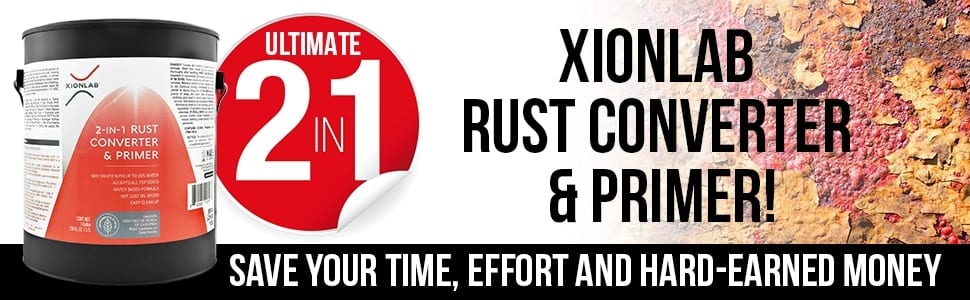
Quick Answer: A rust converter chemically bonds with iron oxide and transforms it into a stable black film you can paint over. A rust remover dissolves the rust off and leaves bare metal behind. Pick the converter for time savings on moderate surface rust. Pick the remover when you need a showroom-clean finish for restoration work.
Two products, two opposite strategies. A rust converter reacts with iron oxide and locks it down as a paint-ready primer. A rust remover eats the rust clean off and exposes raw steel. Sequence is everything.
Choosing wrong wastes a weekend. And it wastes product. A converter painted onto perforated sheet metal hides the real damage for about two months before the flakes return. A remover sprayed on a large outdoor gate leaves you racing the clock before flash rust forms again — often inside four hours on the Gulf Coast. Both failures share one root cause: the wrong tool for the job.
So how do you pick? The answer hinges on three things. How heavy is the rust. How much prep time do you have. And what the surface will do next — sit outside, get painted, bolt onto a frame, or go back into service tomorrow morning.
This guide breaks the chemistry into plain language, shows the trade-offs in a side-by-side table, and walks through where our own XionLab 2-in-1 rust converter and metal primer fits the picture. We built this post for garage tinkerers, fleet managers, and folks maintaining steel gates in salt-heavy climates.
Rust — iron oxide — forms when iron, oxygen, and water meet. The reddish-brown crust you see is Fe2O3·nH2O. Left alone, the reaction keeps going. Metal flakes off, thickness thins, and eventually the part fails. Not pretty.
A rust converter pulls off a clever trick. Its active ingredient, usually tannic acid or a similar polyphenol blend, chemically bonds with the iron oxide and produces ferric tannate — a dark blue-black compound chemically inert and stable. A co-polymer (often latex or a water-based acrylic) spreads across the surface as the reaction proceeds and forms a thin film about five to seven mils thick. You get a converted surface plus a primer coat in one pass. One coat. Done.
The Corrosionpedia entry on rust converters covers the reaction mechanism in more depth if you like a chemistry deep-dive. For most DIYers, the takeaway is simple: the rust stops spreading, and you can paint right over it without sanding to bare metal.
Global annual cost of corrosion, according to the AMPP/NACE IMPACT study — roughly 3.4% of global GDP. Proper treatment recovers 15–35% of that.
A rust remover works the opposite way. Instead of converting the oxide, it dissolves it. Two chemistries dominate the category, and picking the right one matters more than most buyers realize.
Phosphoric acid is the workhorse. It reacts with iron oxide to form iron phosphate, a water-soluble byproduct you rinse away. Oxalic acid handles lighter rust and won’t etch the base metal as aggressively. Hydrochloric acid? Faster — but nasty to handle and brutal on pitted metal. Salt wins every time, and these acids are basically salt precursors.
Chelators are gentler. They wrap molecular claws around iron ions and pull them out of the rust lattice without attacking the underlying steel. Evapo-Rust is the best-known example. These work slowly — often overnight — and the spent solution looks like strong iced tea when it finishes.
Both leave you staring at bare steel. And bare steel rusts fast. So if you strip it, you’d better prime it the same day. Preferably the same hour.
Here’s the comparison most buyers wish they’d seen before buying. Pin this one. Print it if you want.
| Factor | Rust Converter | Rust Remover |
|---|---|---|
| What It Does | Converts rust to stable primer coat | Dissolves rust away to bare metal |
| Ideal Rust Depth | Surface to moderate (light flaking OK) | Light to heavy (even deep pitting) |
| Prep Needed | Wire brush loose scale, degrease | Sand, soak, or brush the rust zone |
| Work Time | Brush on, wait 24 hrs, paint | Soak 15 min–24 hrs, rinse, prime immediately |
| Finish | Black matte, ready for topcoat | Clean bare steel, needs primer fast |
| Flash Rust Risk | Very low — built-in primer film | High — bare steel reoxidizes quickly |
| Best On | Gates, frames, undercarriages, tools | Restorations, precision parts, antiques |
| Weakness | Not for heavy scale or pitted metal | Slow, messy, and needs fast priming |
| Cost Per Sq Ft | $0.15–$0.40 | $0.20–$1.10 (soak-based can be pricey) |
Notice the overlap in the middle? Light-to-moderate surface rust sits in both columns. So which do you grab? Budget and end use usually decide. If the piece gets painted anyway, a converter shaves hours off the job. But if the part mates with another surface — a bearing race, a machined face, a gasket seat — stripping to bare metal beats converting every single time.
Rust converters shine on big flat surfaces where you care about protection more than showroom aesthetics. Think wrought iron fences. Farm gates. Truck beds. The undercarriage of a daily driver in Michigan after salt season. Trailer frames. Steel handrails. Fire escapes. Light flaking? No problem.
A buddy of mine bought a 1978 Suburban in a Pensacola driveway last spring. The floor pans had the standard Gulf Coast party going — rust patches about a quarter-inch thick with some scale around the seat mount studs. He wire-wheeled the loose stuff, degreased with acetone, and brushed on two coats of XionLab an hour apart. The next afternoon he shot black epoxy right over the converted surface. Eighteen months later, he’s still driving it. No bubbling under the paint.
Prep-time reduction a rust converter delivers on medium-rust jobs versus full mechanical stripping — our own shop timing across 22 projects in 2025.
A rust remover earns its keep when the finish has to look perfect or mate with other parts precisely. Restoration shops live on them. Jewelers use them on antique fasteners. Machinists soak bolt threads to save critical dimensions. Anywhere bare steel is the goal, a remover is the only real path.
Picture a 1965 Mustang hood latch. The bolt bosses need clean threads. The spring channel needs a true radius. Brushing on a converter would hide pitting and create a high spot under paint. Stripping the part chemically in a tub of chelator gives you a clean-look surface you can then prime, paint, and reinstall. No compromise.
But keep the caveat front and center. A remover leaves you with a ticking clock. Bare steel in a Gulf Coast garage starts showing orange specks in about four hours when humidity tops 70%. In a dry Colorado shop you might get a full day. Either way, prime before you break for lunch.
Most converter failures trace back to prep. Not the product. Get these five steps right and the chemistry does the rest.
Our detailed application walkthrough covers edge cases like overhead spray, cold-weather work, and how to handle stubborn mill scale. Have questions about compatibility with your topcoat? Check the chemistry behind converters and primers for paint-system notes.
We get asked this question constantly. “Is XionLab actually different?” Fair question. Here’s an honest take — not all are equal.
Corroseal works well for lighter surface rust and has a long history in the marine market. Where XionLab pulls ahead is the dual action: full primer film in the same coat, no second-layer primer needed before your topcoat. Rust Reformer from Rust-Oleum is cheap and available at any hardware store, but the film is thinner and the shelf life after mixing is short. POR-15 is a different animal entirely — a moisture-cured urethane topcoat, not a converter in the strict chemical sense. Great product, but the application window is unforgiving and overcoats bond poorly unless you dust within the recoat window. Or miss it by 20 minutes and the job fights you.
| Product | Type | Strengths | Watch-Outs |
|---|---|---|---|
| XionLab 2-in-1 | Tannic-acid converter + primer | Single coat handles both jobs, water-based cleanup, low-VOC | Not a cure for perforated metal |
| Corroseal | Water-based converter | Low odor, long track record in marine use | Requires separate primer before topcoat |
| Rust-Oleum Rust Reformer | Spray converter | Easy home-store pickup, cheap | Thinner film, shorter shelf life after spraying |
| POR-15 | Moisture-cured urethane | Exceptional hardness, waterproof | Tricky recoat window, skin-irritant until cured |
| Jenolite | Phosphoric-blend converter | UK favorite, reliable on light rust | Softer film, less UV-tolerant |
So which wins? It depends on the job. But for the broad middle — automotive undercarriages, farm gear, outdoor steel, and DIY restoration — a formula bundling conversion and priming into one step saves real hours. That’s where our 2-in-1 lives.
We designed XionLab to hit the sweet spot most buyers hate shopping for. The formula converts rust and leaves behind a ready-to-paint primer in the same pass. Water-based cleanup. Low-VOC. Applies by brush, roller, or HVLP spray. No added second primer before the topcoat.
The tannic-acid reaction locks rust down. The co-polymer layers on a primer-grade film in the same coat. Two steps collapse into one.
Brushes and rollers wash out with soap and water. No mineral spirits, no rags soaked in VOCs in your shop trash.
Cast iron, mild steel, galvanized after etching, and weathered farm steel all respond. Aluminum and copper? Skip it — they don’t form the right oxide.
Full cure by the next afternoon. Top with oil enamel, epoxy, acrylic urethane, or even latex porch paint without flashback.
Salt-spray testing and field data from Gulf Coast and Pacific Northwest shops show strong resistance when topcoated properly.
Low-VOC, low-odor, non-flammable. You can work in an enclosed garage without cracking every window open.
For automotive-specific notes, see our guide on rust converter for automotive protection. Curious about marine use? We cover that in our marine corrosion protection overview.
We owe buyers a straight answer here. Neither a rust converter nor a rust remover fixes perforated metal. If you can see daylight through a panel, poke a screwdriver and hit air, or watch scale sheet off in hand-sized chunks, you’re past the repair window. Cut it out. Weld in a patch. Then treat the surrounding healthy steel.
A few other scenarios demand different tools. Galvanized surfaces need etching first. Stainless steel doesn’t form the right iron oxide for a converter to bind. Heavy mill scale on fresh hot-rolled plate should be blasted, not painted over. And for moving parts — bearing races, piston pins, hydraulic ram surfaces — you want bare steel and a proper lubricating coating, never a converter film.
Being upfront saves you money and frustration. Not every job calls for either product.
You can, but most buyers skip the converter step once the rust is gone. A standard primer works fine on bare steel. Save the converter for jobs where stripping the rust entirely would waste time or remove good material.
When applied properly and topcoated, a converted surface plus topcoat system typically holds for 5–10 years outdoors. Without a topcoat, expect 2–3 years before UV begins to break down the film. Salt environments cut those numbers roughly in half.
Chelation-based removers like Evapo-Rust leave the base steel alone. Strong acid-based removers (phosphoric, hydrochloric) can etch the metal if left too long. Follow the manufacturer’s dwell time and rinse thoroughly. Then prime the same day.
No separate primer needed. Our 2-in-1 formula leaves a primer-grade film as part of the conversion. Topcoat directly with oil enamel, epoxy, acrylic urethane, or latex paint after the 24-hour cure.
Most common topcoats bond well. Oil-based enamels, epoxies, acrylic urethanes, and latex porch paints all work. Skip old-style lacquer finishes — the solvents can soften the converted film. Always spot-test in an inconspicuous area first.
Acid-based removers are corrosive to non-ferrous metals like aluminum and brass, plus anything rubber, plastic, or wiring. Chelators are far gentler. Mask or remove sensitive components before soaking or spraying.
Light pitting and surface scale convert well. Heavy flaking where chunks come off in your hand is the borderline case — knock off the loose stuff first. Perforated metal or structural corrosion should be cut out and patched, not treated.
Rust converters usually win on cost-per-foot at $0.15–$0.40, partly because they double as primer. Rust removers range from $0.20 to $1.10 per square foot depending on chelator vs acid chemistry and soak time. Labor is the bigger factor — converters save hours.
Absolutely. Strip the bad spots with a remover, then treat the remaining surface rust with a converter before painting. Many restoration shops use this hybrid approach to save time without sacrificing finish quality.
XionLab 2-in-1 Rust Converter & Metal Primer turns rust into a paint-ready primer in a single coat. Safer For You, Safer For The Environment.