What Is the Best Rust Converter? (2026 Guide) — Pick the Optimal Formula and Stop Rust Cold
A field-tested breakdown of rust converter chemistry, formulations, and application sequence — so you pick the right formula the first time and keep corrosion from coming back.
By XionLab
Updated April 18, 2026
Reading time 14 min
Expertise Rust Conversion & Primer Chemistry
Quick Answer
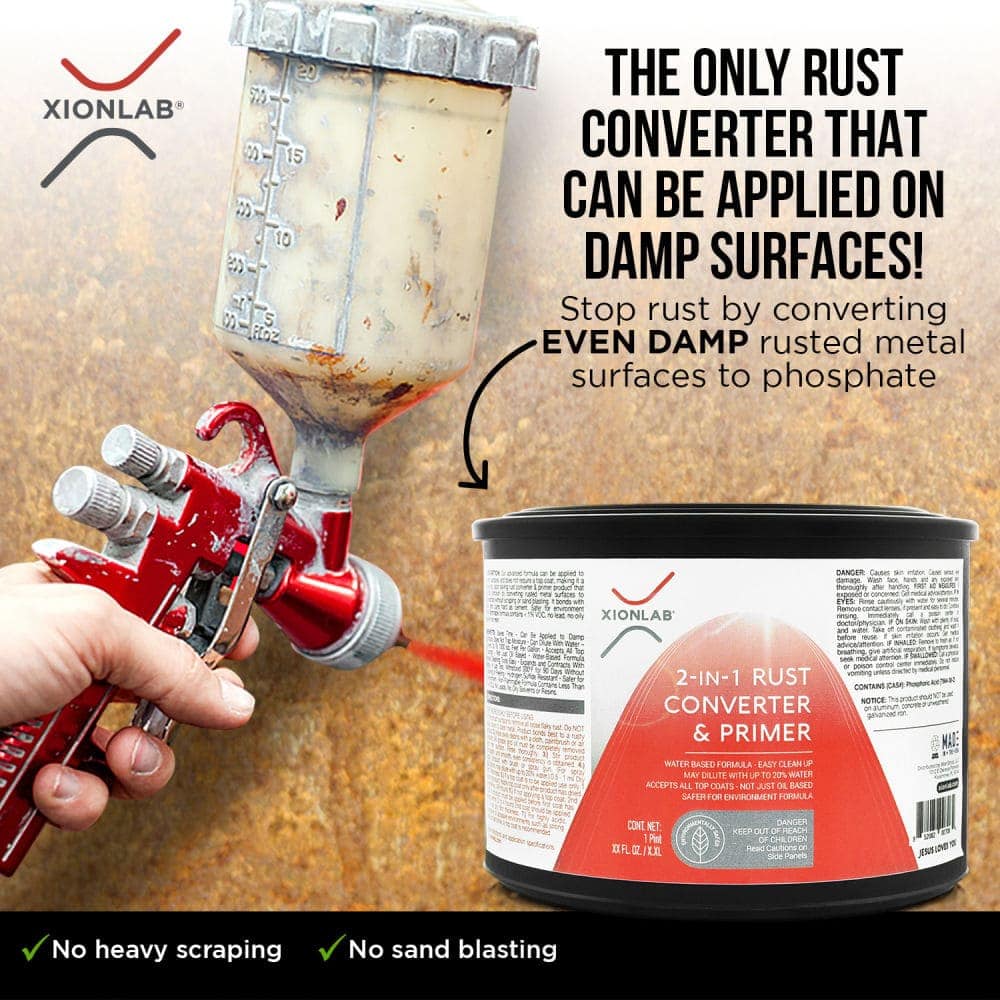
The best rust converter is a water-based 2-in-1 formula pairing tannic acid with a polymer primer. Tannic acid chelates iron oxide into stable ferric tannate, and the built-in primer skips a second product and a second dry cycle. XionLab 2-in-1 Rust Converter & Metal Primer is engineered exactly this way for auto, marine, and industrial steel.
The Short Version
Why picking the wrong formula costs you twice
Pick the wrong rust converter and you pay for the product, then pay again when the rust blooms back through your topcoat four months later. The AMPP (formerly NACE) IMPACT study pegs global corrosion losses at roughly $2.5 trillion a year — about 3.4% of global GDP. A decent chunk of that bill is consumers like you re-coating gates, trailers, tool chests, and floor pans because the first chemical never really bonded to the substrate.
So what actually separates a rust converter worth buying from one that looks impressive in a YouTube demo and flakes off a month later? Chemistry. Formulation. And the order you apply things. This guide walks through all three.
$2.5T
Annual global cost of corrosion per AMPP’s IMPACT study — and AMPP estimates 15% to 35% could be avoided with better prevention.
Chemistry 101
What a rust converter actually does
Rust is hydrated iron(III) oxide, FeO(OH) and Fe₂O₃·H₂O, and it’s porous. Moisture and oxygen keep diffusing through the scale and feeding the reaction underneath. A rust converter disrupts this loop chemically. It reacts with the existing oxide layer and produces a new compound — one which is stable, dark, and no longer hygroscopic.
Two acids do most of the work
Commercial rust converters lean on one of two active acids, or a blend of both:
- Tannic acid — a polyphenol harvested from plant tannins. It chelates ferric ions in the rust layer, forming ferric tannate, a blue-black compound chemically inert to further oxidation. Tannic formulas tend to be water-based and less aggressive on sound metal nearby.
- Phosphoric acid — converts iron oxide into iron phosphate (FePO₄), a crystalline gray film giving paint good mechanical bite. Phosphoric formulas work fast and bite hard, but also etch clean steel and can struggle in chloride-heavy (salt-laden) rust.
- Combination formulas — a peer-reviewed study in Advances in Materials Science and Engineering found a 3% tannic + 10% phosphoric blend produced the most stable reaction products across both chloride- and sulfate-contaminated rust. That’s the sweet spot most premium 2-in-1 products target.
One coat. Done. At least, that’s the promise. Reality depends on two things — did you prep the surface right, and does the chemistry match the kind of rust you have.
Category Rules
Rust converter vs. rust remover vs. rust inhibitor
People throw these three terms around interchangeably. They aren’t. And buying the wrong category is probably the single most common reason a project fails.
| Product type |
What it does |
Best for |
Typical chemistry |
| Rust converter |
Transforms existing rust into a stable, paintable layer chemically bonded to the metal. |
Surface rust, scale, pitted areas with sound metal underneath. |
Tannic acid, phosphoric acid, or blended polymer primer. |
| Rust remover |
Dissolves or lifts rust off, leaving bare metal behind. You still need to prime and paint. |
Small parts you can soak, chrome, tools, hardware. |
Oxalic acid, chelators, citric acid. |
| Rust inhibitor |
Prevents new rust from forming on clean or lightly oxidized metal. Does not treat existing corrosion. |
New welds, freshly blasted steel, storage. |
VCI compounds, amine salts, oil films. |
Why does this matter? Because a converter applied to clean metal wastes product — there is no iron oxide for the acid to react with. And a remover applied to a heavily rusted farm gate just keeps eating while you watch.
Formulation Types
Liquid, gel, or aerosol — which delivery matches your job?
Delivery format matters as much as active chemistry. A brilliant formula in the wrong viscosity is still going to give you a bad afternoon.
- Liquid (brush or roller) — penetrates into pits and weld seams, gives the best contact with porous rust. Drips on verticals. Our pick for flat body panels, trailer decks, and any rusted surface where penetration matters more than speed.
- Gel — clings to vertical and overhead surfaces. Slower to flow into tight crevices but excellent for gates, railings, and column bases. You use more product per square foot.
- Aerosol — fast on complex geometry. Hard to dose right, easy to apply too thin, and you pay a premium per ounce. Best for touch-ups and hard-to-reach underbody spots.
Sequence is everything. A thick, wet coat of gel on flash rust dries into a chalky crust that no topcoat will grip. And a quick aerosol mist on heavy scale won’t penetrate deep enough to chelate the oxide underneath. Match the format to the rust depth, not the other way around.
$3B
Annual U.S. corrosion repair cost from de-icing road salt, per AAA. Salt Belt vehicles lose roughly 20% more resale value than Sunbelt twins of the same age.
What to Look For
Seven traits the best rust converters share
After running hundreds of jobs across farm equipment, fence posts, patio furniture, and a ’67 Mustang floor pan we rescued last fall, seven characteristics show up in every product actually worth the money.
- Water-based chemistry. Safer around pets and kids, easier cleanup, and — counterintuitively — better long-term bite on pitted rust thanks to deeper penetration.
- Integrated polymer primer. A 2-in-1 formula locks in the conversion reaction and gives your topcoat a dedicated bonding layer. Skip the second product, skip the second dry cycle.
- Neutral-to-low VOC. Matters inside enclosed spaces, matters near food-contact surfaces, matters for your lungs.
- Clear color-change indicator. Rust converters typically shift from clear-amber to dark blue-black as they react. No color shift? Either the acid was wrong or there wasn’t enough rust to convert.
- Ambient-temperature cure. If a product demands 75°F and zero humidity, good luck applying it on a Gulf Coast garage floor in August.
- Realistic coverage data. Honest labels call out coverage at two mils wet and disclose surface-prep assumptions. Sketchy labels quote one number and move on.
- Paintable within 24 hours. Enough time to cure, short enough to finish a weekend project.
One caveat we don’t see in competitor content
Rust converters can’t fix perforation. Holes stay holes. If your fender has punched through, no converter will bridge that gap — you need welded patch panels or structural replacement. We’d rather tell you up front than sell you a can of something guaranteed to disappoint.
Head-to-Head
Honest comparisons: XionLab vs. the names you’ve probably heard
We’d rather give you the real picture than pretend XionLab is the only product out there. Here’s how the most common alternatives stack up for different jobs.
- Corroseal. Works well for light, uniform surface rust on flat panels. It’s been around a long time and has earned its reputation. Where XionLab pulls ahead is on pitted rust and irregular castings, where our polymer primer fills micro-pits a pure converter leaves open.
- Rust-Oleum Rust Reformer. Convenient aerosol, fine for touch-ups. The coverage per ounce is low, and on anything larger than a mailbox post you’ll burn through cans fast. Brush-on formulations cost less per square foot.
- Ospho (phosphoric). Strong etcher, works quickly. But phosphoric acid loses effectiveness in chloride-heavy environments — meaning coastal and salt-belt jobs where rust is already most aggressive. XionLab’s blended approach handles both chloride and sulfate contamination.
- Evapo-Rust. Excellent chelator for soaking small parts — bolts, hinges, carburetors. It’s a remover, not a converter. For surface rust on things too big to dunk, you want a converter instead.
- POR-15. Known for moisture-cure urethane topcoats. Brilliant barrier coating, but the PORsequence requires a separate metal-prep step. Our 2-in-1 consolidates that into one product.
Different jobs, different tools. The right pick depends on rust depth, substrate geometry, and climate.
Field Notes
A real job: Gulf Coast boat trailer, flaking frame rust
Last spring a reader in Pensacola sent us photos of a galvanized boat trailer frame blooming orange rust along every weld — the kind of salt-driven damage Gulf Coast owners know too well. Five years of salt-water launches and the galvanizing had given up. He’d already tried a phosphoric spray twice. Rust came back both times.
Here’s what we walked him through:
- Wire-wheel off loose scale. About a quarter-inch thick in spots, flaking to the touch.
- Pressure-wash with fresh water, dry in the sun for two hours. Salt has to come off first, period.
- Brush on XionLab 2-in-1, two thin coats, about 40 minutes apart. The first coat went on amber and shifted to deep navy-black within 20 minutes — that’s the ferric-tannate reaction doing its work.
- Let cure 24 hours. Topcoat with a two-part marine epoxy.
Eleven months later the trailer is still clean. The difference wasn’t the topcoat. And it wasn’t a magic product. It was the sequence: get the salt off first, let the converter build a bonded layer, then paint.
This is the pattern we see again and again. The products aren’t the bottleneck. Prep is. Salt wins every time you skip the rinse.
Prep Rules
Surface prep — the 60% that decides everything
No converter on the market can rescue a poorly prepped surface. Not ours. Not anyone’s. The chemistry only works on iron oxide that’s actually accessible to the acid.
The four-step prep you can’t skip
- Remove loose scale. Wire brush, angle grinder with flap disc, or needle scaler. Anything flaking has to come off, because acid can’t chelate what’s already falling away.
- Degrease thoroughly. Oil, wax, and silicone contamination stop the reaction cold. A quick pass with a phosphate-free cleaner and a clean rag is usually enough.
- Rinse, especially in coastal or salt-belt jobs. Chloride ions trapped in rust pits will defeat any converter you apply on top of them. Fresh water, then dry.
- Check substrate moisture. Water-based formulas tolerate a damp surface, but they won’t work on soaking-wet steel. Wait for visible dryness.
Not all surfaces are equal. Pitted rust takes longer to penetrate than flash rust. Flash rust on freshly ground steel only needs one light pass. Heavy scale on bridge hardware might need mechanical abrasion plus two coats of converter. Work the technique to the damage in front of you.
Read our deeper prep guide on surface preparation for rust treatment when you want the full 12-step workflow.
Two shortcuts people love and shouldn’t
Shortcut one: applying treatment over existing enamel. Doesn’t work. The chelating acid cannot reach the oxide layer through a cured finish film, so you’re decorating an expensive color-shift indicator onto nothing useful. Scrape, sand, or media-blast down to bare oxidation first.
Shortcut two: skipping the topcoat. Ferric tannate behaves beautifully chemically, but sunlight degrades its polyphenolic backbone over time, and a dedicated finish film adds years of service life while locking moisture diffusion down. Abandoning that final layer saves maybe two hours on the front end. Costs you a full redo eighteen months later. Not a great trade.
Match To Job
Choosing the right formula for your actual project
Match the product to the work. Here’s what we recommend after seeing a lot of rebuilds go right, and a few go sideways.
- Automotive floor pans and rocker panels. Water-based 2-in-1 with brush application. Deep penetration into seam rust matters more than speed.
- Marine frames, trailers, and dock hardware. Combination tannic-polymer chemistry. Chloride resistance is non-negotiable on saltwater jobs.
- Farm equipment and ag gates. Gel for verticals, liquid for horizontal decks. Figure on two coats because you’re dealing with decades of scale.
- Patio furniture and railings. Water-based, low VOC, color-change indicator so you don’t over-apply. Read our patio furniture rust prevention guide for the full breakdown.
- Industrial tanks and structural steel. Liquid with a roller, surface-prep-forward workflow. Two coats minimum, topcoat mandatory.
- Hand tools and hardware. Honestly? Consider a remover instead. Soak, rinse, dry, and prime. More efficient than converting a handful of wrenches.
One coat. Done. Except when it isn’t — and the biggest reason it isn’t is picking the wrong format for the substrate.
Why XionLab
How XionLab helps across the rust spectrum
🧪
Tannic-polymer chemistry
Water-based formula blending tannic reaction with a built-in primer for a one-step cycle.
🌊
Salt-environment rated
Designed for coastal and salt-belt jobs where phosphoric-only converters fall short.
🎯
Color-change feedback
Amber to blue-black shift tells you the ferric-tannate reaction is actually happening.
🪣
Brush, roll, or spray
Viscosity tuned for multiple application methods without thinning or reducing coverage.
🛡️
Paint-ready in 24 hours
Compatible with oil, latex, epoxy, and urethane topcoats once cured.
🌱
Low VOC, safer cleanup
Water-based cleanup with soap, no harsh solvents needed for brushes or skin.
Explore the chemistry deeper on our science of rust converters and primers page, or shop the product directly if you’re ready.
FAQ
Rust converter questions people actually ask
Q: What is the best rust converter for a car?
A water-based 2-in-1 converter-primer is the pick for automotive steel. It penetrates pits in floor pans and trunk wells without etching nearby clean metal. See our
rust converter for automotive protection guide for full application detail.
Q: Can you paint over rust converter?
Yes — once it’s fully cured, usually 24 hours at ambient temperature. The converted iron-tannate layer is paintable with oil, latex, epoxy, or urethane topcoats. Our
paint over rust converter guide walks through topcoat compatibility.
Q: Does rust converter work on heavy rust?
It works, but heavy scale needs mechanical prep first. Wire-wheel or grind off anything flaking loose, then apply the converter to sound rust underneath. Pitted rust usually needs two coats and an extra 15 minutes between applications.
Q: How long does rust converter last before it needs recoating?
Properly applied and topcoated, a converted layer can last 5 to 10 years on automotive work and 3 to 7 years on exposed outdoor steel. Topcoat quality drives longevity more than the converter itself.
Q: Is rust converter the same as rust remover?
No. A converter chemically transforms rust into a stable, paintable compound. A remover dissolves or chelates rust off and leaves bare metal behind. Different tools for different jobs.
Q: What’s the difference between tannic acid and phosphoric acid rust converters?
Tannic acid forms ferric tannate, a dark inert polymer-like film. Phosphoric acid forms iron phosphate, a crystalline gray layer. Tannic tolerates chloride-contaminated rust better. Phosphoric acts faster on clean shop-rust. Combination formulas get you both advantages.
Q: Can I use rust converter in cold weather?
Most water-based formulas want 50°F to 90°F for proper reaction. Below 50°F the conversion slows dramatically and below freezing it stops. Warm the part indoors if you can.
Q: Will rust converter work if the metal is still slightly damp?
Light surface dampness is fine on water-based products. Actively wet or dripping steel is not — the product gets diluted and won’t penetrate the pit structure properly. Wait for visible dryness.
Q: Can rust converter fix rust perforation?
No. Holes are holes. Perforated sheet metal needs a welded patch, and no chemistry bridges a physical gap. Be honest with yourself — are you treating rust, or trying to fix structural failure?
Ready to stop rust at its source?
XionLab 2-in-1 Rust Converter & Metal Primer — tannic-polymer chemistry engineered for auto, marine, and industrial steel.
SHOP NOW
Safer For You, Safer For The Environment