.st0{fill:#FFFFFF;}

Surface Preparation for Rust Treatment (2026 Guide) — How to Prep Metal Before Rust Converter or Topcoat 

 April 13, 2026

By  Xion Lab

Surface Preparation for Rust Treatment (2026 Guide) — How to Prep Metal Before Rust Converter or Topcoat

How to properly prep corroded metal before applying rust converter or coating — from SP 1 solvent cleaning through blast standards, with a real-world workflow built around the AMPP guidelines professionals actually follow.

By XionLab Team
Updated April 13, 2026
Topic — Surface Preparation
14 min read
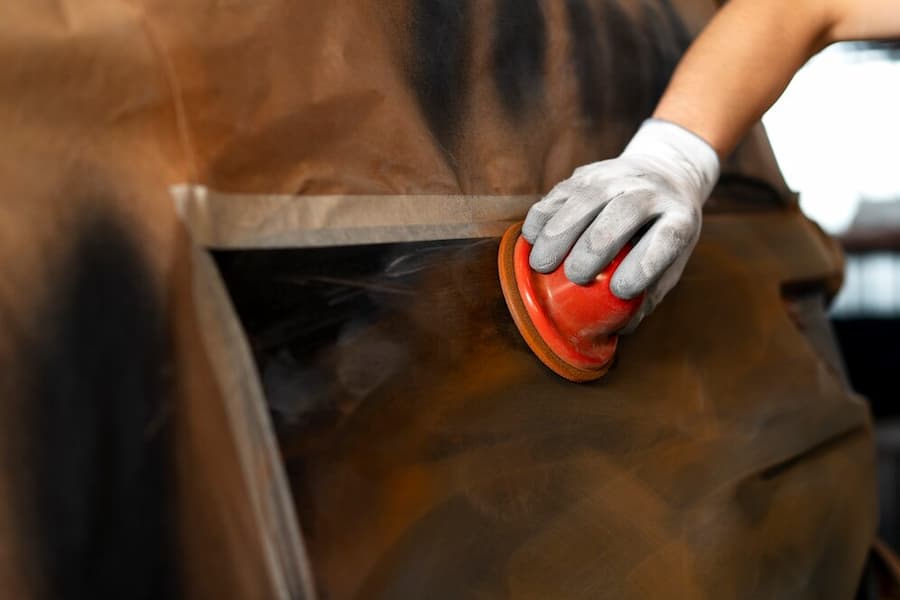
Surface preparation for rust treatment on corroded metal

Quick Answer — Surface preparation for rust treatment means removing grease, loose rust, and mill scale from metal so your converter or coating bonds to stable substrate — not debris. Most DIY and professional applications target AMPP SP 3 (power tool cleaning) or SP 6 (commercial blast). XionLab’s 2-in-1 rust converter and primer converts residual rust after mechanical prep and primes in one step, so you skip a separate priming coat entirely.

Surface Preparation for Rust Treatment: Why Prep Decides Everything

Ninety percent of coating failures trace back to inadequate surface preparation — not the product applied over it. That figure comes from decades of field data compiled by AMPP, the Association for Materials Protection and Performance, and it hasn’t changed much since the first systematic coatings studies of the 1970s. Sequence is everything. Apply rust converter over oily, scaly, or loosely corroded metal and you’ve just laminated a coating over a problem — one that will peel, bubble, and fail inside of two seasons.

Surface preparation for rust treatment isn’t glamorous work. But it determines whether your coating lasts three years or twenty. Skip one step and the whole system fails from the bottom up. I’ve seen it firsthand on Gulf Coast oilfield equipment — steel pipe supports and boom truck frames baked in Texas summer heat, where flash rust reappears within 45 minutes of grinding. You clean a section, turn around, and the bare metal has already started oxidizing again. The humidity down there doesn’t forgive shortcuts. Neither does salt air in the Pacific Northwest or road brine in the salt belt states of the upper Midwest.

So what does proper preparation actually involve? And how does rust converter fit into the sequence? This guide walks through every step, from the AMPP surface preparation standards professionals specify to the practical workflow any contractor or serious DIYer can follow. Prep first. Always.

What Rust Is Actually Doing to Your Metal — and Why It Complicates Prep

Rust isn’t a single substance. Iron oxide forms in multiple phases — Fe₂O₃ (hematite), Fe₃O₄ (magnetite), and FeOOH (goethite) are the most common. Each behaves differently under mechanical removal and chemical treatment. Loose, powdery rust — the orange stuff brushing off in flakes — gives poor adhesion for any coating. But tightly adhered rust layers with a dark, almost black character are partially converted already and may bond adequately if a rust converter is applied properly afterward.

Between the coating and the base metal, there are three layers that must be managed before you apply anything. First is contamination — oil, grease, cutting fluid, or silicone from a previous failed coating. Second is scale — tight mill scale on new steel, or stratified rust layers on older metal. Third is loose debris — flaking rust, dirt, and old paint fragments. Miss any of them and adhesion suffers.

Mill scale is especially deceptive. Fresh structural steel has a thin, hard bluish-black scale from hot-rolling. It looks clean. But mill scale is slightly cathodic relative to the underlying steel — meaning it actually accelerates corrosion by creating a galvanic cell wherever it’s breached. And it will be breached. Coatings over intact mill scale fail at the interface; rust spreads underneath invisibly before you notice blistering on the surface.

But oxidation isn’t just a surface phenomenon on heavily corroded metal. Rust can penetrate into the steel grain structure, particularly on parts exposed to saltwater spray or road chemicals for multiple winters. That’s why preparation standards from AMPP specify not just cleanliness grade but also surface profile — the microscopic roughness profile left by blasting or grinding that mechanical interlocking relies on.

$2.5 Trillion

The estimated annual global cost of corrosion — roughly 3.4% of world GDP — according to the NACE International IMPACT study. Proper surface preparation and protective coatings could reduce this by 15–35%, saving up to $875 billion per year.

AMPP Surface Preparation Standards — What SP 1 Through SP 10 Mean in Practice

AMPP — formed in 2021 from the merger of NACE International and SSPC (the Society for Protective Coatings) — now publishes the unified surface preparation standards. These SP grades define cleanliness levels in concrete, observable terms. They aren’t aspirational guidelines. Specifiers include them in coating contracts, and inspectors verify compliance before coating begins.

SP 1 — Solvent Cleaning

Always the first step. Remove all oil, grease, wax, and soluble salts using solvent, steam, or alkaline cleaning. SP 1 doesn’t address rust or scale at all — it just clears contamination so subsequent mechanical methods actually work. Skip SP 1 and your wire brush or blast media will just grind oil into the surface rather than removing it.

SP 2 — Hand Tool Cleaning

Wire brushes, scrapers, and chipping hammers. Removes loose rust, loose mill scale, and loose paint. Leaves tightly adhered rust and scale in place. Adequate for low-performance coatings in dry, interior environments. Not sufficient for exterior exposures or marine applications.

SP 3 — Power Tool Cleaning

Angle grinders, rotary wire brushes, needle scalers, and flap discs. Removes all loose material and most tightly bonded rust. Leaves a roughened surface with some rust staining. This is the practical minimum for rust converter applications in field conditions — and it’s achievable with tools most contractors already own.

SP 6 — Commercial Blast

At least two-thirds of the surface free of all visible residue when viewed without magnification. Streaking and shadow from rust staining permitted. Widely specified for industrial and moderate-exposure applications. Significantly better than SP 3 but far more achievable than near-white blast.

SP 10 — Near-White Metal Blast

At least 95% of the surface free of all visible residue. Specified for aggressive environments — offshore platforms, chemical plant structures, highway bridges in high-corrosion zones. Near-white blast cleaning can extend coating life to 20+ years in corrosive atmospheres. According to data cited in NACE’s IMPACT study, near-white prep saves 20–30% on overall project cost compared to white metal (SP 5) while delivering coating performance approaching it.

The 5 Surface Preparation Methods — Compared

Surface preparation isn’t one-size-fits-all. The right method depends on rust severity, access, environmental conditions, available equipment, and the coating system going over the top. Here’s how the main methods stack up.

Method AMPP Grade Best For Limitations Typical Cost
Solvent Cleaning SP 1 Degreasing before all other prep Does not remove rust or scale Very low
Hand Tool Cleaning SP 2 Light surface rust, tight spaces Leaves adhered rust; low adhesion surface Low
Power Tool Cleaning SP 3 / SP 11 Field work, moderate rust, no blast access Slower than blast; can’t reach tight profiles Low–Medium
Commercial Abrasive Blast SP 6 Industrial coatings, moderate exposure Requires blast equipment; containment needed Medium
Near-White Blast SP 10 Marine, bridge, offshore, high-performance coatings Highest cost; demanding containment requirements High

Chemical rust converters occupy a different category — they don’t replace mechanical preparation but follow it. After SP 2 or SP 3 mechanical prep, a quality converter like XionLab attacks the residual tightly-adhered rust that grinding leaves behind, chemically transforming iron oxides into iron phosphate and creating a stable, paintable surface. Read more about how the chemistry works in XionLab’s guide to rust converter science.

The Surface Prep Workflow — From Rusty Metal to Ready-to-Coat

Here’s the sequence professionals follow. Each stage builds on the previous one. Cut a corner anywhere and the whole system fails — sometimes immediately, sometimes two winters later when you’re wondering why the film is lifting.

Assess, Then Degrease

Start with a screwdriver test: poke firm rust firmly. If the tip punches through, cross-sectional integrity is gone — those sections need replacement, not treatment. No converter or film restores lost thickness. Mark them. Set them aside. Then degrease the entire substrate with acetone or a biodegradable alkaline solution before grinding starts. Oil ground into a freshly roughened substrate is nearly impossible to remove afterward. And you won’t see the failure until the film lifts, often months later.

Mechanical Removal — SP 3 Is the Field Minimum

An angle grinder with a flap disc handles flat sections and weld zones. A rotary wire cup brush navigates irregular geometry and interior angles. Needle scalers attack tight mill deposits in confined cavities where discs can’t reach. Remove everything unanchored — flaking oxide, powdery residue, separating paint layers. What survives should be dark-colored, firmly bonded scale or tightly adhered substrate. That’s your baseline for converter application.

Apply XionLab, Then Topcoat After Full Cure

XionLab’s 2-in-1 formula converts residual iron oxide to iron phosphate on corroded zones while simultaneously priming adjacent bare areas — one coat handles both. Apply generously, allow full penetration, and wait for complete cure before overcoating. Check XionLab’s application guide for temperature-specific cure windows. In humid climates — coastal Georgia, the Gulf Shore, Pacific Northwest tidal zones — don’t leave bare substrate overnight. Flash oxidation begins within the hour. Salt air never waits.

90%

Of all protective coating failures are attributed to inadequate surface preparation — not the coating itself. Surface prep accounts for 30–50% of coating project budgets but determines 90% of the outcome. Budget accordingly.

Temperature, Humidity, and Dew Point — The Conditions Nobody Checks Until Something Fails

Environmental monitoring is the prep step most people skip entirely. But conditions at application time directly determine coating outcome — proper cure and adhesion, or a film that traps moisture, blisters, and peels within months.

  • Dew Point Rule: Metal surface temperature must be at least 5°F (3°C) above dew point. Apply over metal colder than dew point and invisible condensation forms between coating and substrate — instant adhesion failure.
  • Relative Humidity: Most solvent-based coatings specify a maximum of 85% RH at application. Water-based converters, including XionLab’s formula, tolerate higher humidity during application but still require adequate airflow for proper film formation.
  • Temperature Range: Most rust converters require ambient temperatures between 50°F and 95°F (10–35°C). Below 50°F, the phosphoric acid reaction slows dramatically. Above 95°F, solvent flash-off outpaces film formation, causing uneven cure.
  • Wind and Direct Sun: High wind and direct sun on hot days accelerate surface drying before the converter can penetrate rust. Shade the work area or apply early morning when temperatures and direct radiation are lower.
  • Recoat Windows: Check the product’s recoat window — the period during which a topcoat achieves proper intercoat adhesion. Miss it and the surface is either too soft (topcoat solvents attack the primer) or too hard (intercoat adhesion drops because the surface is fully cured and non-reactive).

Measuring dew point is simple. A sling psychrometer or digital thermo-hygrometer reads ambient temperature and relative humidity. A standard chart — or a free phone app — converts those numbers to dew point in seconds. No math required. No excuse to skip it on any professional job.

Where XionLab Fits Into the Surface Preparation Workflow

XionLab’s 2-in-1 rust converter and metal primer was built for the reality of field prep work — where blast equipment isn’t always available, where you’re working on an active vehicle or structure you can’t move to a shop, and where you need a product handling multiple tasks without adding steps to an already complex workflow.

Converts Residual Rust

Phosphoric acid chemistry transforms remaining iron oxide to iron phosphate — a stable, inert compound bonded to the substrate — after SP 2 or SP 3 mechanical prep.

🔧

No Blast Equipment Needed

Designed for field application after hand or power tool prep. Works where blast equipment is impractical — structural steel, vehicle frames, farm equipment, marine hardware.

📢

2-in-1: Converter + Primer

Eliminates the separate priming step. XionLab converts residual rust and primes bare metal simultaneously, cutting application time and materials cost.

🌊

Marine and Coastal Ready

Formulated for high-humidity environments. Used on boat trailers, dock hardware, and marine structures along the Gulf Coast and Atlantic seaboard. Learn more about marine rust converter applications.

🌿

Eco-Friendly Formula

Water-based, low-VOC chemistry. No solvent fumes in enclosed spaces. Safer for applicators and compliant with VOC regulations in all 50 states. See XionLab’s eco-friendly rust solutions.

📍

Works Across Applications

Automotive frames, farm equipment, structural steel, patio furniture, industrial pipe — XionLab handles the rust treatment step across projects large and small. See automotive rust converter applications.

When Surface Prep and Rust Converters Won’t Solve the Problem

Rust converters are powerful tools. But they’re not magic. And confusing the two leads to expensive disappointments. Here’s where the approach genuinely doesn’t work — and what to do instead.

  • Perforated or Through-Rusted Metal: No coating or converter restores structural integrity. If a screwdriver punches through, replace the section. Applying converter over a hole just seals in moisture behind the patch.
  • Heavy Contamination Below the Rust Layer: Weld flux and machining oils embedded beneath surface rust block converter penetration entirely. The coating appears to apply normally — then delaminates within weeks.
  • Wet or Submerged Surfaces: Rust converters require a dry surface for proper reaction. Standing water dilutes the active chemistry and inhibits the phosphate conversion reaction from completing.
  • High-Speed Blast-Specified Jobs: Major infrastructure — offshore rigs and highway bridges — routinely specifies SP 10 near-white blast. Chemical converters aren’t an approved substitute at that performance level. Blast to spec, then prime. No shortcuts on assets where failure means safety incidents.
  • Deeply Pitted Metal with Active Scale: Scale layers thicker than about an eighth of an inch trap moisture and oxygen underneath after converter application. Mechanical removal first — always.

Corroseal works well for light surface rust on interior applications where you want easy brush-on chemistry and minimal prep. POR-15 is good for chassis work where extreme chip resistance matters more than ease of application. Where XionLab pulls ahead is in outdoor and marine environments — the formula’s water-based chemistry performs in high humidity without blushing, it primes in the same coat, and its eco-friendly profile means no respirator required on ventilated jobsites. But on severely pitted steel or blast-required structural jobs? The right answer is proper blast prep first, regardless of brand.

Surface Prep Mistakes That Kill Coatings — And How to Avoid Them

Most coating failures have identifiable causes. And most of those causes happen during prep, not during application.

  • Skipping SP 1 Solvent Clean: Grinding oil into the surface rather than removing it. The grinder distributes contamination over a larger area and embeds it into the roughened profile. Degrease first. Always.
  • Applying in Direct Sun on Hot Metal: Metal surfaces in direct sunlight can reach 140–160°F on a hot summer day. Coatings applied to super-heated metal flash-off solvents instantly, leaving pinholes and voids. Shade the surface or apply early morning.
  • Not Checking Dew Point: Invisible condensation on metal at or below dew point causes immediate adhesion failure. A $20 digital hygrometer eliminates this failure mode entirely.
  • Leaving Bare Metal Overnight — In coastal or high-humidity environments, freshly ground steel flashes overnight. Apply converter or rust-inhibiting primer to prepared surfaces the same day they’re ground.
  • Recoating Before Full Cure: Tack-free is not cured. Topcoating a converter or primer before full cure traps solvents, causes blistering, and ruins adhesion. Read the datasheet cure times, then add 20% in cool or humid conditions.
  • Wrong Abrasive for Mill Scale: Standard flap discs won’t remove tight mill scale efficiently. Use a wire cup brush or specialty mill scale removal disc before switching to a flap disc for final profiling.

Prep matters. Sequence matters. Salt wins every time when prep is weak. The Gulf Coast data bears this out: structures with verified SP 6 prep and quality primers last 12–18 years before maintenance recoating. Structures prepped to SP 2 equivalent in the same environment show failure at 3–5 years. The delta isn’t the coating. It’s the prep.

Documenting Prep for Compliance, Warranty, and Project Handover

Industrial and commercial coating contracts increasingly require documented evidence of preparation quality at hold points and witness points throughout a project’s execution. A hold point requires inspection and sign-off before the applicator proceeds. A witness point gives the specifier or owner’s representative an opportunity to observe — but work may continue regardless. Both appear on the Inspection and Test Plan (ITP), a master QA document listing every inspection activity, the party responsible, the acceptance criterion, and the record required to demonstrate compliance.

What does adequate documentation look like? Photographs with embedded timestamps showing the substrate before and immediately after mechanical prep. Psychrometer or hygrometer readings recorded at each shift start. Soluble salt conductivity measurements from Bresle patch tests, with batch numbers logged. Abrasive media grade and supplier certifications attached to the dossier. Dry film thickness readings — taken with a calibrated Elcometer, PosiTector, or equivalent DFT gauge — across randomly selected measurement intervals once each coat cures. Pull-off adhesion tests per ASTM D4541, using a dolly bonded to the outermost coat and extracted with a pneumatic or hydraulic tester, quantify intercoat adhesion in pounds per square inch. Cross-cut adhesion tests per ASTM D3359 give a qualitative grid rating for thinner films.

Photographic documentation serves another purpose beyond warranty protection. When a coating fails — and eventually, on long-lived assets, every coating does — post-failure investigation depends on reconstruction of original conditions. Investigators distinguish adhesive failure at the substrate-primer interface from cohesive failure through the film body, or intercoat delamination between primer and topcoat. Each failure mode implicates a different party and a different remediation approach. Without timestamped records, determining liability becomes contested and expensive. With them, root cause analysis takes hours, not months.

Small contractors and DIYers rarely deal with formal ITPs. But even a single-page handwritten log — date, ambient conditions, prep method, product applied, batch number, observed film appearance — provides baseline documentation for warranty claims and prevents guessing games when touch-up is needed two seasons later.

Electrochemical context matters too. The galvanic series ranks metals and alloys by electrochemical nobility — their tendency to act as cathode or anode in a galvanic couple. Zinc sits near the anodic end of the series, meaning it oxidizes preferentially to iron. That’s why zinc-rich primers and hot-dip galvanizing offer sacrificial cathodic protection. Aluminum pigments and magnesium-rich formulations extend similar sacrificial behavior to specific substrate types. Where dissimilar metals join — aluminum fittings on structural iron, stainless fasteners through mild-steel gussets — galvanic couples accelerate attack on the less noble component. Dielectric isolation using neoprene washers or insulating tape at the joint, combined with a phosphate-converted and properly primed substrate, breaks the electrochemical circuit before cathodic disbondment undermines the surrounding film. Disbondment — the creep of delamination outward from a holiday or scratch — is the principal long-term failure mode in cathodically protected systems, and it accelerates in the presence of residual chloride ions from inadequate salt removal before priming.

Salt Contamination — The Invisible Prep Failure Nobody Checks

Salt contamination is invisible. Soluble salts — primarily chlorides and sulfates deposited by ocean spray, deicing chemicals, and industrial atmospheres — are the most insidious form of surface contamination. Unlike oil or loose scale, they’re invisible. You can’t see chloride ions embedded in a steel substrate. But they cause osmotic blistering — a phenomenon where moisture drawn through a semipermeable coating film accumulates behind the coating and creates pressurized pockets of dilute salt solution. The blisters rupture, the coating fails, and the substrate is back to bare and actively corroding — typically worse than before treatment.

AMPP and ISO 8502 establish testing thresholds for soluble salt contamination before painting. A Bresle patch test — a flexible adhesive template fixed over a prepared steel surface — extracts soluble salts from about a square inch of substrate into a small volume of deionized water. A conductivity meter measures ionic concentration. Most marine and offshore specifications cap acceptable chloride contamination at 50 mg/m² or lower. Coastal structures in the Gulf of Mexico, Chesapeake Bay, and the Pacific Northwest intertidal zone routinely exceed these thresholds without thorough fresh-water washing between mechanical prep and priming.

Freshwater hosing of blast-cleaned steel reduces chloride levels dramatically — but not instantly. Multiple washing cycles with low-pressure freshwater, followed by verification testing, is the standard protocol on offshore fabrication jobs. Skipping this step on a coastal project isn’t just a prep shortcut; it’s a warranty-voiding decision. No manufacturer’s technical data sheet covers failures caused by undetected soluble salt contamination beneath an otherwise correctly applied coating system. The liability lands entirely on whoever prepared the substrate.

Cathodic protection systems — zinc-rich primers, sacrificial zinc anodes, or impressed-current systems — extend the electrochemical defense beyond passive barrier protection. Zinc-rich epoxy primers contain metallic zinc dust in concentrations above 80% by weight in the dry film. The zinc sacrificially oxidizes before the underlying substrate, delivering galvanic protection at holidays, scratches, and cuts in the topcoat. But galvanic protection doesn’t substitute for proper prep — it extends the time before corrosion re-establishes where prep was inadequate.

Corrosion and Prep Across Industrial Sectors

The consequences and economics of poor preparation vary dramatically across industries. Petroleum refineries and downstream petrochemical facilities deal with high-temperature oxidation, sulfide stress cracking, and naphthenic acid attack — failure modes where preparation shortfalls cascade into unplanned shutdown and multi-million-dollar turnaround costs. Municipal water utilities face biofilm accumulation and microbiologically-influenced corrosion (MIC) inside lined pipelines, where pinhole failures in buried infrastructure cost ratepayers enormously per leak event. Pulp and paper mills contend with caustic and bleach environments that destroy unprotected carbon steel in months. None of these environments are forgiving of shortcuts at the substrate conditioning phase.

Agricultural applications — center-pivot irrigation booms, grain augers, livestock confinement buildings — typically use hot-dipped galvanizing as the primary sacrificial barrier, supplemented by zinc-rich touch-up on abraded zones. Automotive OEM facilities use electrocoat phosphating for body-in-white primer application before topcoat spray lines, achieving consistent film build across complex cavity geometry that hand application cannot replicate. Aerospace structures rely on chromate conversion coatings on aluminum alloys, anodizing, and epoxy primers formulated specifically for dezincification resistance. Each environment prescribes its own cleanliness standard and primer chemistry. One approach does not suit all substrates or all exposures. Know your environment first.

Standards, Test Methods, and Specifications — A Field Reference

Knowing which standard governs each phase of a project prevents disputes at inspection and keeps contractors, coating inspectors, and specifiers on the same page. Below is a quick reference for the principal documents cited in this guide.

Cleanliness Grading — ISO 8501 and SSPC-VIS

ISO 8501-1 defines four rust grades (A through D) describing the initial condition of unblasted steel — from A (intact mill scale, no visible rust) through D (general pitting across the full face). Blast-cleaned grades run Sa 1 (light sweep), Sa 2 (thorough blast — comparable to SP 6), Sa 2½ (near-white — SP 10), and Sa 3 (white-metal — SP 5). SSPC-VIS 1 provides photographic comparator panels for field use, periodically updated by AMPP. ISO 8501-3 covers pre-weld treatment grades: P1 (light dressing), P2 (thorough dressing), and P3 (very thorough dressing) for weld spatter, weld seam irregularities, and undercut removal prior to abrasive blasting.

Roughness Measurement — ISO 8503 and ASTM D7091

ISO 8503-1 specifies the replica tape comparator method, classifying profiles by grit (G) or shot (S) comparators on a four-grade scale. ISO 8503-3 governs stylus profilometry for computing Ra, Rz, and Rmax over defined traversal lengths. ISO 8503-4 covers optical profilometry using focus variation microscopy — a non-contact technique that generates 3D topographic maps of the blasted surface without physical stylus drag. ASTM D7091 covers dry film thickness measurement using Type 1 (magnetic induction, ferrous alloys) and Type 2 (eddy-current, non-ferrous substrates) gauges calibrated against NIST-traceable standards.

Holiday Detection and Pull-Off Adhesion

ASTM D5162 governs low-voltage wet sponge holiday detection for protective linings up to 20 mils DFT. ASTM D4787 extends the methodology to high-voltage spark testing of tank linings over concrete and cementitious substrates. Pull-off adhesion testing follows ASTM D4541 (pneumatic and hydraulic self-aligning dolly fixtures) and ISO 4624 (international equivalent). Test reports must record fracture mode classification using the A–E code: A (adhesive, within the primer), B (adhesive, at the primer-topcoat intercoat), C (cohesive, within the topcoat), D (adhesive, at the topcoat-adhesive boundary), E (cohesive, within the adhesive). Immersion-service coatings typically mandate 400 psi (2.8 MPa) minimum. Atmospheric systems vary by specifier.

Dry Time and Soluble Salt Limits

ASTM D1640 defines the progression of dry-time stages — set-to-touch, dust-free, tack-free, dry-hard, and dry-through — against standardized temperature, humidity, and film thickness. These stages map directly to recoat window language in product datasheets. Soluble salt contamination limits are tested per ISO 8502-9 (conductometric titration of Bresle extracts), with instruments such as the Eloflex conductivity meter or PosiSalt probe delivering real-time μS/cm readouts at the surface. Most marine and immersion specifications cap chloride contamination at 20–50 mg/m² — SSPC Guide 12 and many offshore specifications set the lower threshold as standard.

Respiratory Protection, PPE, and Hazard Control for Blasting and Coating Work

Abrasive blasting generates airborne particulate concentrations that exceed OSHA PEL thresholds for silica, lead, cadmium, and chromium within seconds of operation. Standard dust masks provide zero protection. The only compliant respiratory solution is an NIOSH-approved abrasive blasting hood with a continuous-flow, supplied-air respirator fed from a Grade D breathing air source — meeting CGA G-7.1 purity specifications — piped through an oil/water separator, a CO alarm calibrated to the 10 ppm alert threshold, and a pressure regulator set to the hood manufacturer’s airflow recommendation.

Dermal hazards demand equal attention. Heavy leather gauntlet gloves resist abrasive ricochet and solvent penetration better than latex or nitrile. Leather chaps or denim-lined coveralls protect legs from rebounding grit. Steel-toed boots with metatarsal guards satisfy most OSHA 29 CFR 1910.136 footwear requirements on industrial sites. Hearing protection is non-negotiable — impulse noise from a nozzle at 80–120 psi regularly reaches 95–105 dB at the operator’s ear canal. Foam earplugs achieving NRR 29 or higher, or banded earmuffs, maintain cumulative daily noise dosage within permissible limits.

Solvent-borne topcoat and zinc-rich primer application creates flammable vapor hazards. Classify the spray zone as a Division 1 or Zone 0 flammable atmosphere and bond spray equipment, scaffold, and the workpiece to a verified earth ground via static-dissipative grounding straps before pulling any trigger. Local exhaust ventilation (LEV) must dilute solvent vapor to below 25% of the lower flammable limit (LFL). A photoionization detector (PID) or catalytic bead sensor positioned at breathing zone height monitors LEV effectiveness continuously. Never rely on natural ventilation alone in enclosed spaces or pit excavations. Short sentence. Single word. Always.

Surface Preparation for Rust Treatment — Frequently Asked Questions

Do I really need to remove all rust before applying rust converter?

Not all of it — but the loose stuff absolutely must go. Rust converters chemically react with tightly adhered iron oxide to form iron phosphate. Loose, powdery rust provides no stable base for bonding; the converter just sits on top and peels with it. Remove loose and flaking rust mechanically first, then apply converter to the firmly bonded residual rust.

What’s the minimum surface preparation needed before using XionLab?

SP 1 solvent cleaning followed by SP 2 or SP 3 mechanical prep. Degrease first to remove all oil and silicone. Then wire brush or grind off loose rust, loose scale, and loose paint. Apply XionLab converter to the prepared surface. The cleaner and tighter the mechanical prep, the better the adhesion and the longer-lasting the result.

How long should I wait to topcoat after applying rust converter?

XionLab is typically tack-free in 2–4 hours under normal conditions (70°F, 50% RH). Full cure for topcoating takes 24 hours at those conditions. In cooler temperatures or higher humidity, allow 48 hours. Check the surface — fully cured converter film feels hard and non-tacky, with a slight gray or dark purple cast from the iron phosphate conversion layer.

Can I use rust converter instead of sandblasting?

For most field applications, yes — power tool prep to SP 3 followed by rust converter is a practical alternative to blast prep for moderate rust on non-structural surfaces. But for heavy industrial applications where blast standards are specified (SP 6, SP 10), rust converter alone doesn’t substitute. It’s a complement to mechanical prep, not a replacement for it on demanding structural jobs.

What causes flash rust on freshly ground metal?

Flash rust happens when freshly exposed steel reacts with oxygen and moisture before a protective layer reaches it. In high-humidity environments — coastal regions, humid summers — bare metal can flash-rust in under an hour. Apply rust converter or primer the same day you grind. Don’t leave bare metal overnight in humid climates.

Is it safe to apply rust converter in cold weather?

Most rust converters, including XionLab, require ambient temperatures above 50°F (10°C) for effective phosphoric acid chemistry. Below that threshold, the reaction slows dramatically and conversion is incomplete. In cold climates, warm the substrate if possible, apply during the warmest part of the day, and check the product datasheet for specific low-temperature guidance.

How do I know if my rust converter application was successful?

A completed phosphate conversion shows as a dark gray, blue-black, or purple-gray film over former rust areas. Rust-orange areas remaining after the recommended cure window indicate incomplete coverage — usually from inadequate mechanical prep, contamination, or application over wet surface. Sand those areas lightly, re-clean, and apply a second coat to fully converted areas.

Prep Right. Protect Longer.

XionLab’s 2-in-1 rust converter and metal primer handles the critical final step in your surface prep workflow — converting residual rust and priming bare metal in one coat, so you can topcoat faster and protect smarter.

SHOP NOW

Safer For You, Safer For The Environment

Subscribe to our newsletter now!