No products in the cart.
Rust Converter and Primer: The Complete Guide to Getting Rid of Rust (2026 Guide)
April 19, 2026
By Xion Lab
Free Shipping
easy returns
secure paymentS
FAQ | MY ACCOUNT | SUPPORT
April 19, 2026
By Xion Lab
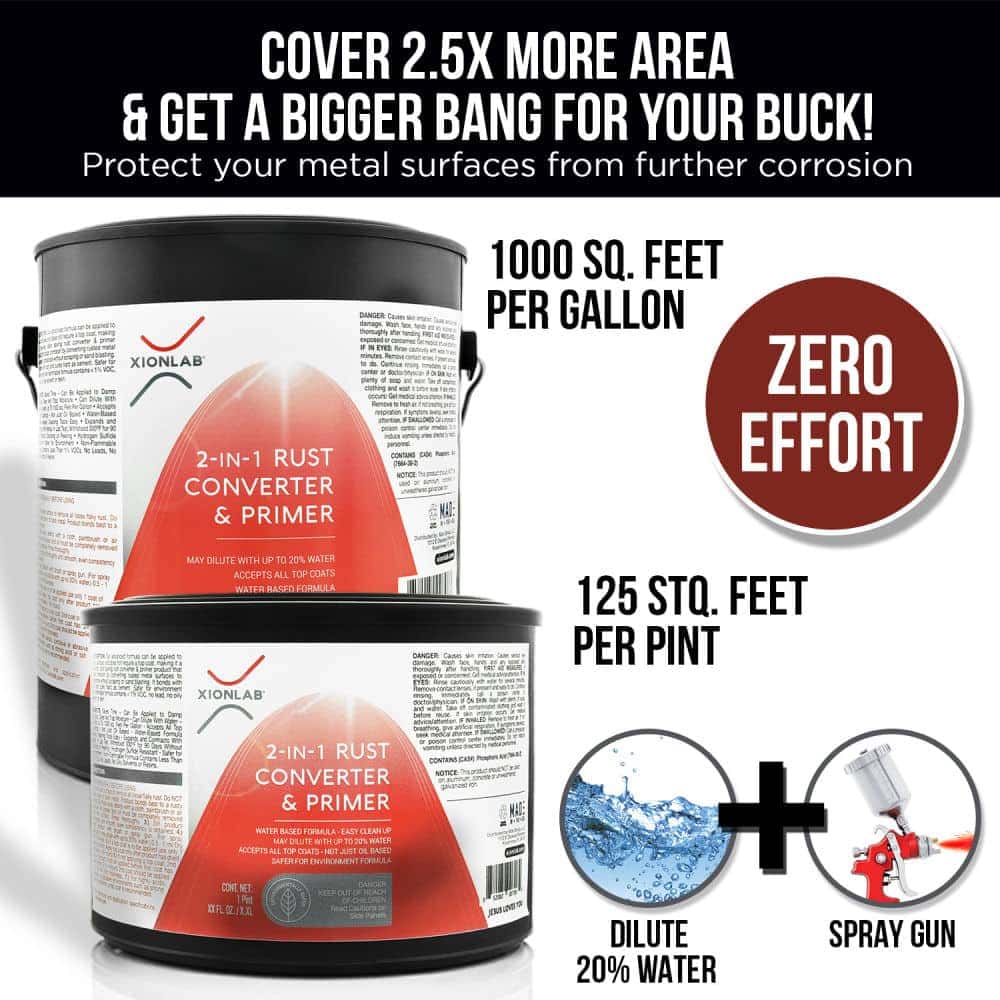
Quick Answer: A rust converter and primer works by chemically transforming iron oxide into iron tannate — a stable, dark, paintable film. Skip the grinding marathon. One product handles both conversion and priming, which is why XionLab’s 2-in-1 formula gets used from boat trailers on the Gulf Coast to combine harvesters in Nebraska.
Rust is iron oxide. A converter turns it into something else. Tannic acid grabs the iron atoms locked inside the reddish oxide and pulls them into a new compound called ferric tannate. Ferric tannate is inert. It is bluish-black. And once cured, it accepts paint like a proper primer.
Getting rid of rust does not always mean stripping metal back to bare steel. Sometimes the smarter path is chemistry. A rust converter and primer does both jobs — it stops active corrosion and leaves behind a surface ready for your topcoat.
We pulled a 30-year-old tractor disc out of a Mississippi barn last spring. The top rail had patches of rust about a quarter-inch thick, pitted like sandpaper. Wire brush, rag, one coat of the XionLab 2-in-1, done in under an hour. The rust went from orange to near-black inside 20 minutes. Salt air had been slowly chewing through the edges for years.
Skip the sanding marathon.
According to NACE International’s IMPACT study, corrosion costs the global economy roughly $2.5 trillion a year — around 3.4% of global GDP. Industrial rust alone eats equipment budgets across the salt belt and along the Gulf Coast. So the real question is not whether to treat rust — the real question is how efficiently you beat it.
These two products sound similar. They do very different things.
A rust remover dissolves the oxide. You end up with clean bare metal, and then you still need a primer before any paint goes on. A converter leaves the oxide in place and transforms it chemically. You finish with a primer-ready surface — no second product, no second trip to the hardware store.
So which one should you pick? The answer depends on the rust you are looking at.
Not all rust is equal.
For a deeper split on chemistry, our breakdown of the science of rust converters and primers covers the molecular details. Pair it with our best rust converter and rust remover guide for product selection.
Here is the short version of beating rust with a 2-in-1 product. No fluff.
Hit it with a wire brush or a coarse Scotch-Brite pad. You are removing flakes and dust, not sanding down to shiny metal. Solid rust stays — the converter wants something to react with.
Oil kills the reaction. Wipe with mineral spirits or a dedicated degreaser and let it flash off before the product touches the metal. Silicone from old polishes is the sneakiest enemy — use a prep solvent rather than a shop rag swiped across the bench.
Brush, roll, or spray on an even wet coat — think stain, not paint. Watch for the color shift from rust red to near-black within 15 to 20 minutes at normal room temperature. Spots which stay brown mean the reaction did not complete.
Some spots need two passes, especially dense black scale or rust over a prior paint failure. Apply the second coat once the first is tack-free. Twice is usually enough.
Dry conditions: 24 to 48 hours. Humid conditions on the Gulf Coast or in the Pacific Northwest: closer to 72 hours. A fingernail scratch should not leave a mark before you topcoat.
Oil-based enamels, two-part epoxies, and direct-to-metal acrylics all bond well. Latex does not — skip it. The converted surface has the profile of a bonded primer, so most industrial topcoats grab on the first coat.
Sequence is everything.
Global annual cost of corrosion, per the NACE IMPACT study — about 3.4% of world GDP.
Corrosion is expensive because it hides. A pitted brace looks fine from three feet away until the weld cracks. A trailer cross-member rots under the paint until you load a bulk bin onto it and watch the frame flex. Early treatment — meaning the first rusty hour rather than the first rusty year — is where the real savings live.
Savings achievable with corrosion-prevention best practices, per the same NACE study.
Translated to a farm or a fleet: a trailer frame treated with a rust converter and primer at year five tends to outlast an untreated frame by a decade. A disc harrow stored under a lean-to rather than dragged out every spring rusty-edge-first pays back the cost of treatment in a single season.
Corrosion budgets are stealthy. A bridge maintenance crew in Ohio once told us half their welding rod goes into patches which would have been one-time conversion jobs five years earlier. Small catches early. Big fixes late. The math is not subtle.
One coat. Done.
Back to the Mississippi barn. The implement had sat behind a stack of hay bales since the late 1990s. Orange scale covered the top rail. A thin crust coated the gang bolts. The cutting discs themselves were still largely intact — field-grade steel handles neglect surprisingly well when nothing is pulling on it.
Total prep time: about 25 minutes with a cup brush on a cordless drill. The goal was flake removal, not cosmetic shine. Any scale a fingernail could knock off came off. The rest stayed.
Application was a single coat with a 2-inch chip brush. The rail turned dusky purple within eight minutes, then deepened into the familiar blue-black by about 18 minutes. The gang bolts — deeper pitting there — needed a second pass the next morning, applied after the first had gone tack-free overnight.
Two weeks later we topcoated with an oil-based enamel. A full season of fieldwork later, the converted areas still look sharp. The untreated belly of the frame, left alone as a control, had already spotted back out with flash rust by late summer. Chemistry beats geometry.
For similar heavy-rust scenarios on tools and implements, our rust converter and primer solutions for tools writeup covers the prep variations between hand tools, power tools, and field implements.
The reaction is an old one. The Canadian Conservation Institute has used dilute tannic acid treatments on rusted iron artifacts since the 1970s, because tannic acid grabs the iron atoms locked inside the reddish oxide and pulls them into a new organo-metallic complex called ferric tannate, producing a surface which shifts from actively corroding iron oxide into a stable, paintable, dark film behaving like a bonded primer beneath most common topcoats.
Modern commercial products add organic polymers to the mix. The polymer lays down a thin film on top of the converted layer, blocking moisture and oxygen from sneaking back into the substrate. Dual action — chemical conversion plus barrier film — is what makes a 2-in-1 product work as both converter and primer.
For the full mechanism, see how rust converters work. Short version: phenol groups chelate Fe³⁺ ions, the iron pops out of the oxide lattice, and the new complex bonds to the remaining steel. The underlying chemistry is covered broadly at Wikipedia’s rust converter article, and industry standards for corrosion-protective coatings come from AMPP, the successor organization to NACE International.
Not every project suits a converter. Here are the four common paths, compared honestly.
| Method | Best For | Effort | Main Downside | Ends With |
|---|---|---|---|---|
| Rust Converter & Primer | Surface rust, sound metal | Low | Won’t help bare metal finishes | Paint-ready primer layer |
| Rust Remover (acid) | Small parts, bare metal | Medium | Needs a separate primer after | Clean exposed metal |
| Grinder / Sandblast | Heavy scale, large panels | High | Dust, noise, thin-metal warping | Bare metal |
| Electrolysis | Small detail parts | High setup | Limited to submersible items | Clean metal |
Where does XionLab pull ahead on the first row? Two places. The polymer carrier cures harder than most competitors, and the open time between coats is longer, which matters when you are treating a whole trailer frame in one afternoon. Corroseal works well for lighter surface rust. For heavier scale on structural steel, the XionLab formula has more bite.
Temperature and humidity matter more than most people think. Between 50°F and 100°F is the sweet spot. Below 50°F the acid reaction stalls — you end up with milky-white residue and patchy conversion. Above about 110°F the product flashes off before the chemistry finishes. A hazy day with 40 to 70 percent relative humidity gives you the cleanest result.
Have you ever painted a Florida garage door in August? Surface temps can hit 140°F even in the shade. Wait for morning. Or wait for a cloudy spell. A little patience beats three recoats.
Regional notes:
Salt wins every time you leave it alone.
Converter and primer in a single can — no sequencing two products, no waiting between coats of different brands.
The organic polymer film seals the converted surface against moisture and oxygen immediately after cure.
Cleanup with water. Works indoors with modest ventilation. Safer for the crew and the environment.
Automotive underbodies, marine rails, farm equipment, industrial tanks — one product covers the usual suspects.
Harder cured film than most tannic-only competitors. Survives scuffing and light wear before the topcoat lands.
Accepts oil-based enamels, two-part epoxies, direct-to-metal acrylics, and most industrial coatings.
For automotive projects, start with our rust converter for automotive protection walkthrough. For boats and docks, read the marine corrosion protection guide — salt exposure changes the prep sequence slightly.
Nothing is magic. A few honest limits on what a rust converter and primer can do:
For surface prep specifics, our surface preparation for rust treatment guide covers every common substrate and scenario.
Pair the chemistry with common sense. A converter handles the scale you can see. Drainage, sealing, and topcoat choice handle the water you cannot see. The longest-lasting treatment is the one layered into a broader plan — wash the salt off each winter, touch up annually, and topcoat every few years.
Corrosion is a marathon, not a sprint.
Converters are inexpensive compared to the alternatives. A gallon treats roughly 200 to 300 square feet depending on pitting depth, and the cost runs a small fraction of the labor saved on mechanical prep alone. Grinding and sandblasting require abrasives, power, PPE, and hours of hands-on time — and every pound of dust is metal you wanted to keep.
Acid strippers work, but they demand neutralization, runoff control, and far more PPE. For anything larger than a small hand-tool, they are rarely the economical pick. Our breakdown of rust converters and removers for metal runs the numbers across several common project sizes.
Some pros still reach for a grinder on automotive body panels because they want the bare-metal finish weld-prep. Fair trade. For anyone else — trailer frames, ag gear, railings, tank exteriors — a rust converter and primer wins on cost, time, and worker safety. Safer for you, safer for the environment.
Close but not identical. A converter chemically reacts with the rust to form ferric tannate. A primer does not react — it simply bonds mechanically. The XionLab 2-in-1 formula does both in one step, which is why the product is labeled both converter and primer.
No. Zinc and aluminum do not form ferric tannate because they do not carry the iron chemistry needed for the reaction. For galvanized or aluminum substrates, use a dedicated etch primer designed for those metals.
Think stain, not paint. A wet, even film — no puddles and no heavy drips. Too thick and the top skin seals the chemistry before it reacts with the oxide underneath, leaving unreacted rust under a pretty black shell.
24 hours in dry conditions, up to 72 hours in humid ones. A fingernail scratch should not leave a mark on the surface before you topcoat. Rushing the cure is the single most common failure mode reported by customers.
Brown means the reaction did not complete — usually because grease, dust, or glossy mill scale blocked contact with the rust. Clean those spots with solvent, scuff lightly, and recoat. Two applications handle nearly every stubborn patch.
Yes — with extra rinse and cure time because salt exposure changes the prep. Rinse the surface with fresh water, let it dry fully, then apply. Our marine corrosion protection guide walks through the full sequence for rails, trailers, and dock hardware.
Absolutely. Rust converter and primer is a mainstay of DIY undercarriage work. Scrape loose scale, degrease, and apply in thin coats. A second pass catches the spots reached only from awkward angles under the car.
Seal the can tightly and keep it above freezing. Water-based chemistry separates if frozen and will not recover. Shelf life runs about two years in most cases; a quick stir before use handles minor settling.
Both work. Spraying gives a thinner, uniform coat — ideal for large panels or trailer frames. Brushing lets the product work down into deep pitting. Many pros spray the bulk of a surface and brush the pitted edges.
Stop rust, prime the surface, and save a step with XionLab’s 2-in-1 Rust Converter & Metal Primer.