
No products in the cart.
Quick Answer: Yes, you can paint over rust converter — and you should. Oil-based enamels, two-part epoxies, and polyurethane topcoats bond beautifully to the converted iron tannate film. Latex fails. Wait a full 48 hours after the converter dries, wipe the surface with a damp cloth, then apply your topcoat.
THE DIRECT ANSWER
Paint Over Rust Converter? Yes — With the Right Chemistry
Painting over rust converter is the entire point of applying one. The converter locks iron oxide into a stable iron tannate film, and the topcoat seals the film away from moisture and oxygen. Skip the paint and the film slowly breaks down. Skip the converter and the paint bubbles within a season.
So the question is not really whether you can paint over it. The question is what you paint with and when you put it on. Get those two variables wrong and the topcoat peels in sheets within weeks. Get them right and you lock in five to seven years of protection, even in brutal coastal air.
$2.5 TRILLION
Global annual cost of corrosion — roughly 3.4% of world GDP — per AMPP/NACE IMPACT research. Proper converter-plus-topcoat systems capture 15–35% of this potential savings.
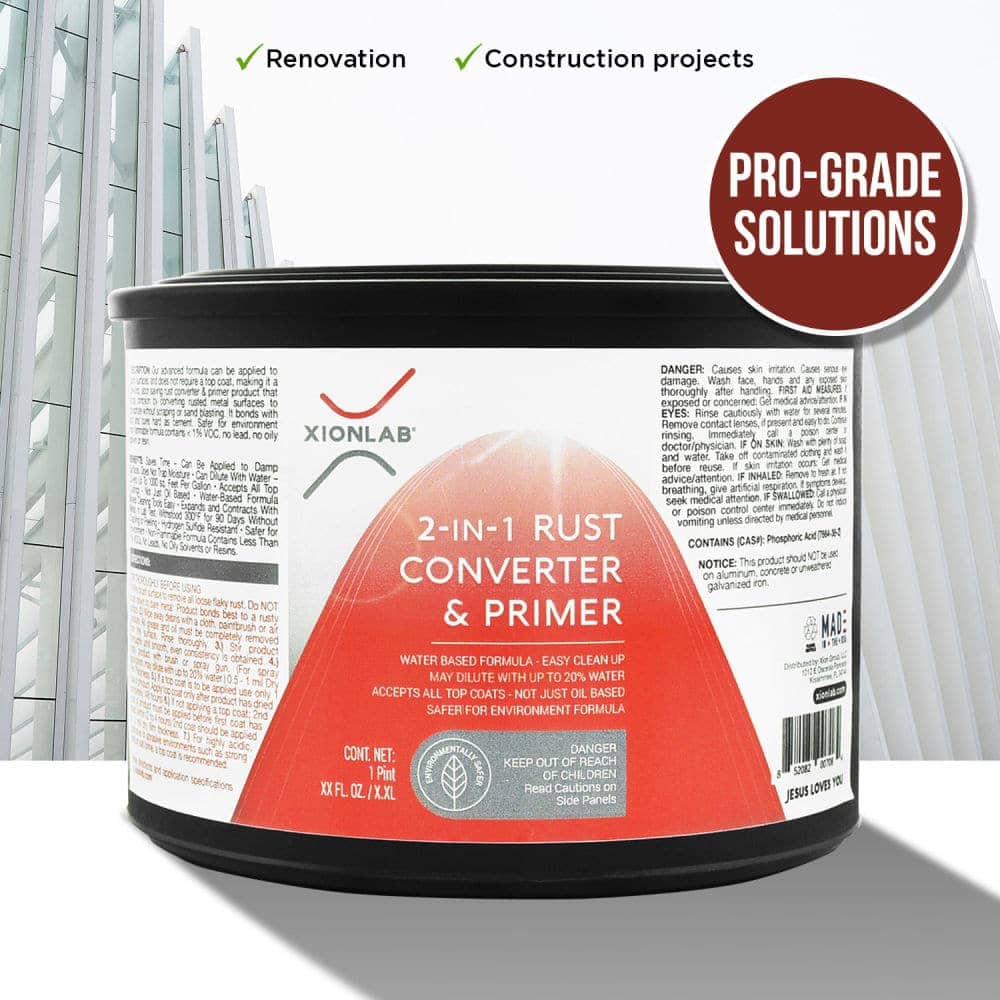
XionLab built its 2-in-1 Rust Converter & Metal Primer specifically so the chemistry plays nicely with standard topcoats. The primer side of the film is already paint-ready once it cures. No sanding, no tack coat, no wire-brush middle step. For a deeper chemical walkthrough, see our science of rust converters and primers deep-dive.
THE 48-HOUR RULE
Why Timing Beats Technique Every Time
The single biggest reason paint peels off rust converter is painting too soon. Tannic acid and phosphoric acid need time — real time — to complete the chelation reaction with iron oxide. The surface can look dry and feel dry at the four-hour mark and still be chemically active underneath.
At 70°F and 50% relative humidity, the full Fe₂O₃-to-ferric-tannate conversion takes about 48 hours. Colder air slows it. Above 90°F the converter can flash-dry before the tannic acid finishes complexing, leaving patchy dead spots. Sequence is everything.
The Clean-Dry-Cure-Paint Sequence
- Clean first. Loose flakes, grease, and surface oil have to go. A wire brush and acetone wipe is usually enough for DIY work.
- Apply thin. Two thin coats beat one thick coat. Thick pools trap uncomplexed acid and bubble later.
- Wait 48 hours. Set a phone timer. Do not eyeball it.
- Damp-wipe the film. A microfiber cloth and plain water lifts any residual acid dust.
- Paint within 72 hours of the wipe. The cured film collects dust and micro-contamination over time, so closing the window quickly matters.
And here is the part most DIY guides skip: humidity matters more than temperature. Above 75% RH the acid components can re-absorb water from the air and stay active far longer than the 48-hour baseline. Gulf Coast garages in July are especially tough. I have had converter films stay tacky for five days in a non-dehumidified shop in Pensacola. Not fun.
TOPCOAT COMPATIBILITY
Which Paints Bond and Which Ones Fail
Not all paints are equal. The ferric tannate surface is hydrophobic — it actively repels water. Paints carried in water beads up. Paints carried in solvents wet out and lock in. That single property explains almost every topcoat-compatibility chart you will ever see.
| Topcoat Type | Bond to Converter | Best Use | Notes |
|---|---|---|---|
| Oil-based enamel | Excellent | Automotive body, fencing, trailers | Dissolves slightly into the film, forms an intermolecular bond |
| Two-part epoxy | Excellent | Marine, industrial, high-wear | Amine cure cross-links with the tannate matrix |
| Polyurethane | Very good | UV-exposed surfaces, farm equipment | Apply over an epoxy mid-coat for max durability |
| Alkyd enamel | Good | Railings, brackets, garden tools | Single-part, user-friendly, 6–8 hour recoat |
| Latex (acrylic) | Poor | Avoid on rust converter | Water beads up, adhesion fails within months |
| Chlorinated rubber | Fair | Niche industrial | Solvent-heavy, limited DIY availability |
Why Latex Fails So Reliably
Latex is the odd one out. Its water carrier hits the hydrophobic tannate film and pearls up instead of wetting out. The pigment particles never form the mechanical interlock needed for adhesion. Peel tests on latex-over-converter samples show failure loads under 50 psi — a clean, dry, unpainted steel peel test pulls around 400 psi. Eight times weaker. Do not trust the label if it says “paints over rust”; test a palm-sized patch first and leave it for two weeks.
REAL-WORLD FIELD NOTES
A 1994 F-150 Bed, Salt Air, and Two Quarts of Converter
Last September a neighbor dragged a 1994 F-150 into my driveway. The bed corners were eaten through near the wheel wells — about a quarter-inch of soft oxidized steel crumbling when I poked it with a screwdriver. Pensacola salt air had done its work for two decades. Classic Gulf Coast damage.
Here is the process that actually held up after six months of daily driving in salt air:
- Wire-wheel pass. Knocked off the loose flakes until I hit hard pitted steel. Left the pitting in place — the converter handles it.
- Acetone wipe. Two passes with fresh rags. Oil residue kills adhesion faster than anything else.
- XionLab 2-in-1, thin coat. Brush on, wait four hours, second thin coat.
- 48-hour cure at 70°F. Covered the bed with a tarp to keep humidity stable.
- Damp-wipe and topcoat. Rust-Oleum professional oil enamel, two coats, 24 hours apart.
Six months later: no bubbling, no lift, no orange bleed-through at the pitted spots. The bed corners are now the most solid part of that truck. Salt wins every time — unless the film seals the metal completely.
For a similar breakdown of vehicle-specific treatment, our rust converter for automotive protection guide covers frame rails, undercarriage, and wheel-well specifics.
HONEST LIMITATIONS
What Rust Converter Will Not Fix
Brand-honest moment. No converter on earth rebuilds metal. If you poke the surface and the screwdriver goes through, you are looking at perforation — and perforation needs welded patches or a fiberglass-backed body filler repair, not a chemical treatment. Converter seals pitted steel beautifully. It does nothing for Swiss cheese.
- Perforated panels. Holes larger than a pencil eraser — weld or patch first, convert second.
- Scaling thicker than 1/8 inch. Mechanical removal first, then converter on the residual pitted surface.
- Submerged metal. Continuous water immersion defeats most converter films. Use dedicated marine coatings like the kind described in our marine corrosion protection guide.
- Chrome, aluminum, galvanized zinc. These do not have iron oxide to convert. Use an etching primer instead.
- Hot surfaces (above 200°F). Exhaust manifolds, wood-stove piping — those need high-temp ceramic coatings, not tannic acid.
Being upfront about limits is more useful than pretending a single product solves every rust problem. Our 2-in-1 wins when the substrate is rusted but structurally intact. When it is not, point the customer at a welder. For more context on when each treatment fits, see our rust converter vs rust remover comparison.
BRAND-HONEST COMPARISON
XionLab vs Corroseal vs Rust-Oleum Reformer
Corroseal works well for lighter surface rust on flat steel. Rust-Oleum Rust Reformer is widely available and decent for DIY. Where XionLab pulls ahead is the combined primer layer and the topcoat window. Most converters require an extra primer step before paint. Ours does not — the cured film is already primed.
| Feature | XionLab 2-in-1 | Corroseal | Rust-Oleum Reformer |
|---|---|---|---|
| Converter + primer in one step | Yes | No (needs separate primer) | Partial |
| Cure-to-topcoat window | 48 hours | 72 hours | 24 hours (but less durable) |
| Oil-based topcoat compatibility | Excellent | Excellent | Good |
| Epoxy compatibility | Excellent | Good | Fair |
| VOC content | Low | Very low (water-based) | Moderate |
| Coverage per gallon | ~200 sq ft | ~200 sq ft | ~180 sq ft |
| Environmental profile | Non-hazardous formula | Water-based | Solvent-based |
Corroseal and Rust-Oleum both have their place. Pick whichever fits your job. Just know that combining steps — one product instead of three — is where our formula pays back the extra dollar.
HOW XIONLAB HELPS
Six Ways the 2-in-1 Formula Earns Its Keep
⚡
One-Step Convert + Prime
Single application replaces converter plus primer. Saves a full cure cycle on every project.
🌊
Coastal-Grade Sealing
Formulated for salt-air exposure. Tested in Gulf Coast, New England, and Pacific Northwest conditions.
🎨
Universal Topcoat Friendly
Accepts oil enamels, two-part epoxies, polyurethanes, and alkyds with equal adhesion.
🌱
Low-VOC, Non-Hazardous
No chromates, no solvents that trigger respirator protocols. Safe for home garages.
🔧
Pitted-Steel Ready
Penetrates deep pitting without requiring aggressive sandblasting. Ideal for frame rails and trailer beds.
💧
Water-Resistant Cure
Fully cured film shrugs off rain, snow melt, and wash-down cycles without re-activating.
5–7 YEARS
Typical service life of a XionLab converter plus oil-based topcoat system on outdoor steel in salt-belt conditions. Longer under sheltered storage.
REGIONAL CONSIDERATIONS
Salt-Belt, Gulf Coast, and Pacific Northwest Realities
Geography changes the math. Road-salt states (Michigan, Ohio, the whole Rust Belt) hammer undercarriages with calcium chloride from November through March. Gulf Coast humidity keeps steel wet for months. Pacific Northwest drizzle attacks seams and fasteners.
For road-salt country, apply converter in late spring once the garage floor dries out, and prioritize frame rails and rocker panels. On Gulf Coast projects, dehumidify the workspace if you can — a 500-watt shop dehumidifier pays for itself in project quality. Up in the Pacific Northwest, expect longer cure times and plan around dry weather windows. Want the broader prevention playbook? Our ultimate rust prevention guide covers systems-level corrosion control.
And a final note: do not paint over rust converter outdoors on a day when rain is in the forecast. Even a cured topcoat is vulnerable to water spotting for the first 12 hours. Conservation scientists at the Canadian Conservation Institute document the same humidity-sensitivity in tannic-acid coatings used on museum artifacts.
APPLICATION TOOLS
Brush, Roller, or Spray — Which Wins for Topcoat
Application method changes the math. A brush gives you the most control on pitted steel but leaves faint brush marks you can feel with a fingernail. A foam roller lays paint flatter and works well on flat bed liners or trailer sides. Spray gun or aerosol wins on curves and complex shapes — frame rails, control arms, and wheel wells especially.
Here is the catch with sprayers: the converter film is slightly porous at the microscopic level. A spray gun held too close or loaded too heavy can cause immediate micro-blistering in the freshly converted surface. Keep the gun about eight inches away and move with steady, overlapping passes. No dwell, no pooling.
Matching Tool to Topcoat Chemistry
- Oil-based enamels. Brush, roller, or HVLP spray — all three work fine with a 24-hour recoat window.
- Two-part epoxies. HVLP or airless spray only. Brushing leaves lap marks because the pot life is so short.
- Polyurethane topcoats. Foam roller for flat panels, HVLP for vertical surfaces. Avoid cheap chip brushes — loose bristles ruin the finish.
- Aerosol cans. Great for small jobs and spot touch-ups. Warm the can in a bowl of lukewarm water first for cleaner atomization.
- Rollers with nap. 3/8-inch nap on smooth steel, 1/2-inch nap on pitted or textured areas. Skip the foam rollers for aggressive solvents — they dissolve.
One coat. Done. Well, two coats actually — but you get the idea. Thin layers beat thick every single time on converter-treated steel. Heavy coats trap vapor from the curing acid and bubble within days. The single most common rookie mistake is loading up the brush and trying to cover everything in one pass. Slow down, go thin, come back tomorrow.
8 INCHES
Recommended spray-gun distance from the converter-treated surface. Closer causes micro-blistering; farther wastes material and produces a sandy texture.
COST AND CONSUMPTION
What a Full Convert-and-Paint Job Actually Runs
Ballpark numbers for a typical DIY project. A small trailer bed (roughly 8 by 5 feet) runs about $45–$70 in materials end-to-end: one quart of XionLab 2-in-1 ($22), one quart of oil-based enamel topcoat ($18–$30), plus consumables like brushes, acetone wipes, and painter’s tape. Call it a Saturday afternoon plus 48 hours of cure time.
Scale up and the numbers scale too. A full F-150 frame rail strip-and-convert job lands around $180 in materials for two gallons of converter, two gallons of enamel, and solvents. Shops charge $800–$1,400 for the same labor. DIY wins if you have the patience and the garage space. And a dehumidifier, if you live south of Interstate 10.
According to standard industry data on rust converters, most professional-grade converters cover 150–200 square feet per gallon at the recommended 2-mil wet film thickness. Our formula sits near the top of that range because the primer layer doubles the coverage efficiency. One gallon of XionLab typically replaces one gallon of converter plus one gallon of primer — so coverage-per-dollar comes out ahead even before the time savings.
When to Call a Pro Instead
Some jobs are worth paying for. Anything requiring sandblasting, dip-tank stripping, or media-blasting of a whole chassis should probably go to a shop. So should projects involving lead-paint removal on older industrial equipment. And welded repairs to perforated panels are genuinely tricky — not DIY territory unless you already own a MIG welder and know how to grind a clean weld.
For everything else — fences, patio furniture, garden tools, trailer beds, tractor frames, classic car sheet metal — the XionLab convert-and-paint approach is well inside DIY reach. Set aside a weekend, order the materials, follow the 48-hour rule, and you are done.
FREQUENTLY ASKED QUESTIONS
Answers to the Questions We Hear Most
How long after applying rust converter can I paint?
Wait 48 hours at 70°F and 50% humidity. Cold or damp conditions extend that to 72 hours or more. Feel the surface — it should be dry, hard, and slightly chalky, not tacky.
Can I use latex or acrylic paint over rust converter?
No — and please do not try. Latex paint beads up on the hydrophobic tannate film and peels within a few months. Stick with oil-based enamels, two-part epoxies, or polyurethane.
Do I need a separate primer after the converter?
Not with the XionLab 2-in-1 formula. The cured film already acts as a primer. Most other converters do require a tie-coat primer before your color coat, so read the label.
What happens if I paint too soon?
The uncomplexed acid keeps reacting under the paint film. You will see bubbling, orange bleed-through, and eventual peeling — sometimes within two weeks, almost always within a season.
Can I spray paint over rust converter?
Yes, as long as the aerosol is oil-based or enamel. Krylon Industrial, Rust-Oleum Professional Oil Enamel, and similar solvent-carrier aerosols work fine. Avoid water-based spray paints on converter-treated surfaces.
Does rust converter work on galvanized or aluminum?
No. Tannic-acid converters need iron oxide to react with. Zinc and aluminum form different oxides entirely. Use an etch primer on those substrates.
How many coats of topcoat should I apply?
Two thin coats of oil enamel, 24 hours apart. For epoxy systems, one medium coat of the catalyzed resin is usually enough. Outdoor projects benefit from a third UV-resistant clear coat.
Will paint over rust converter hold up to pressure washing?
A fully cured oil-enamel-over-converter system handles normal car-wash pressures fine. Avoid direct 3000 psi blasts on any automotive finish. Give paint at least seven days to fully cure before any wash cycle.
Can I tint the rust converter or does it only come black?
Ferric tannate is naturally dark blue-black. Tinting the converter itself is not practical — the chemistry relies on that color-changing reaction as a visual cure indicator. Your topcoat is where color lives.
Ready to Paint Over Rust the Right Way?
XionLab’s 2-in-1 Rust Converter & Metal Primer sets the stage for a topcoat that actually lasts. One product, one step, ready for paint in 48 hours.
Questions? Call 888-306-2280
Safer For You, Safer For The Environment