No products in the cart.
Everything you need to know about water-based rust converters — how they work chemically, when to choose them over acid-based alternatives, and how to get maximum protection on metal surfaces of any size.
Quick Answer: A water-based rust converter chemically transforms iron oxide into ferric tannate — a stable, dark compound that bonds tightly to metal and primes it for paint. Unlike acid-based formulas, water-based versions produce minimal fumes, clean up with water, and perform reliably even in humid conditions. Apply directly to rusted metal, allow 24 hours to cure, and paint over the converted surface without sanding.
The Basics
What Is a Water-Based Rust Converter?
Metal rusts. Salt air speeds it up. So does standing water, road spray, and every humid summer in the Gulf Coast or Pacific Northwest. But removing rust outright — through grinding, sandblasting, or abrasives — strips metal of mass and strength. A water-based rust converter takes a different approach entirely.
Instead of removing rust, it reacts with it. The active ingredient — typically tannic acid suspended in an aqueous polymer solution — penetrates the rust layer and triggers a chemical reaction. Iron oxide (rust) becomes ferric tannate, a black-to-dark-blue compound. Ferric tannate doesn’t flake. It doesn’t crack. It bonds directly to the remaining metal and forms a surface you can paint straight over.
The “water-based” part matters more than most people realize. Earlier rust converter formulas — and many acid-based options still on shelves today — rely on concentrated phosphoric acid or solvent carriers. Those work, but they come with trade-offs: strong fumes, ventilation requirements, etching risk on clean metal adjacent to the rust, and messy cleanup. Water-based formulas sidestep most of those problems. Same chemistry goal, far more forgiving process.
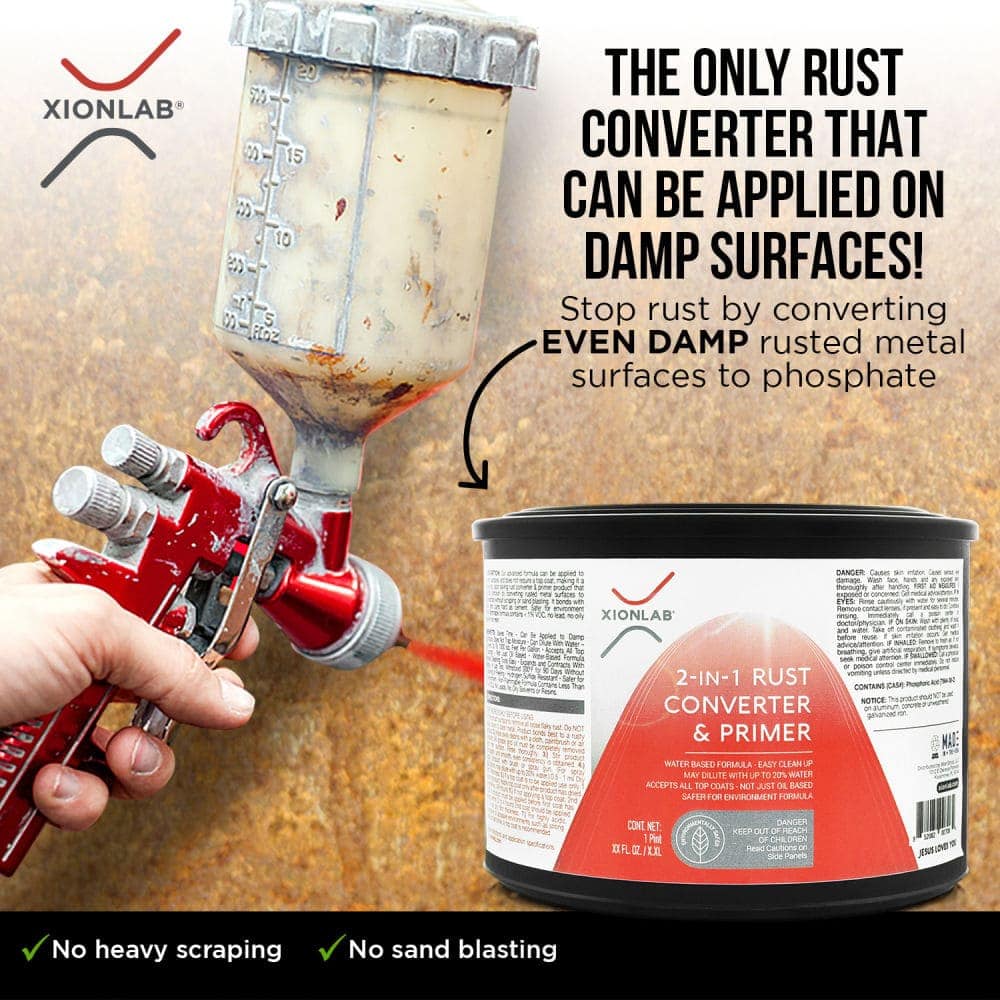
XionLab’s 2-in-1 Rust Converter and Metal Primer has been doing exactly this since 2015. One product stops active rust and primes the surface. Salt wins every time — unless you convert it first.
The Real Difference
Water-Based vs. Acid-Based Rust Converters
The choice between water-based and acid-based rust converters comes down to your conditions, your workspace, and your timeline. Both stop rust. But the mechanism and the experience differ considerably.
Acid-based converters — typically using phosphoric acid as the primary active agent — convert iron oxide into iron phosphate, a crystalline matrix. It sets fast, often within 15 to 20 minutes on light rust. But phosphoric acid has strong fumes, needs real ventilation, and can etch healthy metal if left on too long. Overspray on a painted panel nearby? That’s a problem.
Water-based converters move at a more deliberate pace, generally 30 to 60 minutes for full conversion, but there’s no fume issue, no ventilation scramble, and no risk of etching clean spots. The aqueous carrier actually handles humidity well — it’s not fighting ambient moisture the way a solvent carrier does.
| Feature | Water-Based Converter | Acid-Based Converter |
|---|---|---|
| Active Ingredient | Tannic acid in aqueous polymer | Phosphoric acid |
| Converted Compound | Ferric tannate (stable, flexible) | Iron phosphate (crystalline) |
| Conversion Time | 30–60 minutes | 15–20 minutes |
| Fumes / Ventilation | Minimal — indoor-safe | Strong — requires ventilation |
| Adjacent Clean Metal Risk | Low | Moderate (etching possible) |
| Humidity Performance | Excellent | Variable |
| Flexibility After Cure | High (ferric tannate is organic) | Lower (crystalline matrix) |
| Cleanup | Soap and water | Solvent required |
| Eco Profile | Low-VOC, biodegradable | Higher VOC, acid disposal |
Corroseal makes a solid water-based converter, particularly for lighter residential rust jobs. Where XionLab’s formula pulls ahead is in its built-in primer layer — one coat converts and primes simultaneously, so there’s no waiting between steps or buying a second product.
The Chemistry
How Water-Based Rust Converters Work
Understanding the chemistry isn’t required. But it helps you apply the product correctly and set realistic expectations for what you’ll see.
Rust — technically iron(III) oxide — forms when iron atoms lose electrons to oxygen in the presence of moisture. The iron oxidizes. What remains on the metal surface is a porous, reddish-orange layer weak enough to crumble between your fingers. Left alone, it grows inward, consuming sound metal as it expands.
Tannic acid attacks this layer directly. The acid molecules bind to the iron ions within the rust, triggering a chelation reaction. The output is ferric tannate — a dense, stable compound first documented in peer-reviewed corrosion research as far back as 2003. Ferric tannate doesn’t peel. It doesn’t bubble. Unlike rust, it’s dense enough to serve as a mechanical barrier against further oxidation. The polymer binders in the formula then cure over this converted layer, sealing it and creating the primer surface.
You’ll see the color change as it happens — rust orange going dark gray or black within the first 20 minutes. That’s ferric tannate forming. Full cure to a hard, paintable surface takes about 24 hours in normal conditions.
$2.5 Trillion
Annual global cost of corrosion, per AMPP’s IMPACT study — roughly 3.4% of global GDP. In the United States alone, corrosion runs over $450 billion per year. Proper conversion chemistry cuts that exposure dramatically.
Some hybrid formulas mix tannic and phosphoric acids — tannic to handle existing rust, phosphoric to seal any clean metal patches nearby. Both acids at once. The hybrid approach can work, but it does bring back some of the fume concerns from pure acid formulas. For most residential, automotive, and marine jobs, a straight water-based tannic acid formula is the cleaner choice.
Best Use Cases
Where Water-Based Converters Excel
Not every rust situation calls for the same tool. But water-based converters have a wider sweet spot than most people give them credit for. Here’s where they genuinely outperform alternatives.
- Automotive underbodies and frames: Road salt and splash exposure create persistent rust on car frames, control arms, and floor pans. Water-based converters reach into crevices and seams without requiring a perfectly dry work surface — a real advantage in a damp garage.
- Marine equipment and boat trailers: Salt air and water create rust faster than almost any other environment. Tannic acid handles the marine rust load well, and the low-VOC formula means you’re not fumigating a boat hull or a confined engine compartment.
- Fencing, gates, and outdoor metal structures: These rust slowly but steadily. Water-based converters are easy to brush onto irregular surfaces without protective gear beyond gloves. Cleanup with a garden hose.
- Farm and agricultural equipment: Tractors, implements, and storage tanks see heavy rust in wet seasons. The product’s flexibility after cure matters here — agricultural steel flexes and vibrates under load, and ferric tannate moves with it rather than cracking.
- HVAC equipment and rooftop metal: High-humidity environments keep rust going year-round. A water-based formula won’t introduce volatile compounds into ventilation systems the way solvent-based products can.
- Any indoor or semi-enclosed workspace: No fumes. No respiratory risk with normal ventilation. If you’re working in a garage, a shop, or even under a carport, water-based is the responsible choice.
Application Guide
How to Apply a Water-Based Rust Converter
I’ve applied XionLab to everything from a rusted-out boat trailer axle in the Florida panhandle to a salt-belt truck frame in northern Ohio — and the process holds up across conditions. Sequence is everything. Get this order right and the chemistry does the heavy work.
Step 1: Surface Prep (But Not Too Much)
Remove loose, flaking rust with a wire brush or scraper. You don’t need bare metal. You need rust firm enough to react — porous and intact, not crumbling into powder. Big flakes of loose scale won’t convert properly because there’s no stable substrate beneath them for the tannic acid to bond to.
Wipe the surface dry. Water-based converters tolerate a little ambient moisture, but pooled water dilutes the formula and slows the reaction. A rag pass is usually enough.
Step 2: Apply Generously
Brush, roll, or spray. Don’t thin the product — it’s formulated to work at label concentration. Work the product into pits and crevices with a brush rather than just surfacing across them. Pits trap rust. They need contact.
Apply a coat thick enough to look wet and stay wet for several minutes. A thin, quick-drying coat converts the surface layer but may leave deeper rust untreated. Aim for about a quarter-inch of standing wet product on heavy rust areas.
Step 3: Allow Full Conversion
Watch the color change — rust orange shifting to dark gray or black. This is the reaction occurring visibly. Let the coat stay wet and working for at least 30 minutes. Heavier rust may take up to an hour.
On boat trailer axles in Florida humidity, I’ve seen full color change in about 45 minutes — even with ambient temperatures around 88°F. The water carrier doesn’t flash off fast in heat, which actually helps dwell time.
Step 4: Second Coat on Heavy Rust
For rust deeper than about a sixteenth of an inch, a second coat after the first has dried — roughly 4 to 6 hours — drives the reaction further into the metal. One coat. Done. But for serious corrosion, two coats is better than one.
Step 5: Allow 24-Hour Cure Before Painting
The converted layer needs a full day to harden. Paint over it before it’s fully cured and adhesion suffers. After 24 hours, most topcoats — oil-based, water-based, or epoxy — bond without issue. And the XionLab formula includes the primer built in, so there’s no separate priming step.
15–35%
Potential corrosion cost reduction achievable through proper protective coatings and conversion chemistry, according to AMPP corrosion management research. On a single vehicle frame or piece of equipment, that math translates directly into extended service life.
Why XionLab
How XionLab’s Formula Handles the Hardest Rust Jobs
XionLab has been building rust converter chemistry since 2015 with one guiding principle: Safer For You, Safer For The Environment. The 2-in-1 Rust Converter and Metal Primer reflects that in every ingredient decision.
🧪
Tannic Acid Chemistry
Plant-derived tannic acid drives the ferric tannate conversion — proven chemistry with decades of peer-reviewed research behind it, not experimental formulations.
🎨
Built-In Metal Primer
Converts rust and lays a primer coat in a single application. No separate priming step, no second product, no waiting between coats before you can paint.
🌿
Low-VOC Formula
Minimal volatile organic compounds means you’re not dealing with fumes in your garage, your boat bay, or your shop. Normal ventilation is all you need.
🛥️
Marine-Grade Performance
Tested in Gulf Coast salt environments — some of the most aggressive corrosion conditions in North America. Holds up where lighter residential-grade formulas fall short.
🚗
Automotive Ready
Flexible cure film moves with vibrating, flexing metal. Automotive underbodies, frame rails, and wheel wells stay protected through temperature cycling and road stress. See our full automotive rust converter guide for more.
🧹
Easy Cleanup
Soap and water — that’s it. No solvents, no hazardous waste, no acetone-soaked rags. Brushes and rollers rinse clean under a tap.
Regional Conditions
Where Water-Based Converters Matter Most
Rust isn’t equally distributed across the country. Geography drives corrosion rate more than most people expect — and certain regions push metal hard enough to justify a more aggressive maintenance routine.
Gulf Coast and Florida: Salt air, high humidity, and warm temperatures year-round create a relentless oxidation environment. Metal left unprotected in coastal Florida or along the Texas Gulf Coast can show surface rust within weeks. Water-based converters are especially practical here — they tolerate the ambient moisture without the formula fighting the humidity to cure.
Salt Belt States (Ohio, Michigan, Pennsylvania, New York): Road salt application from November through March creates a chemical soup in wheel wells and under frames. Salt belt rust is often deep pitting. A thorough water-based converter application — with a second coat on heavy sections — stops the active corrosion front and gives topcoats something stable to hold.
Pacific Northwest: Rain-driven surface rust is a constant presence on fencing, outbuildings, and older vehicles. But the Pacific Northwest is drier than the Gulf Coast in terms of salt exposure, so surface rust here tends to be shallower — an easier job for a single-coat water-based application.
For a detailed breakdown of rust’s behavior in high-corrosion environments, the XionLab rust converter selection guide covers both regional conditions and metal types in more depth.
Honest Limitations
What a Water-Based Rust Converter Won’t Fix
No rust product does everything. Being honest about limitations saves you from a frustrated outcome.
- Perforated or structurally failed metal: A rust converter stabilizes existing metal. It cannot rebuild missing metal. If rust has eaten completely through a panel, a frame section, or a tank wall, you need welding or replacement — not chemistry.
- Active standing water exposure: Converted metal and its primer coat are not a waterproof barrier on their own. They need a topcoat — paint, epoxy, or a specialized protective coating — to hold up against prolonged immersion or standing water. Skip the topcoat and you’ll see rust return within a season.
- Loose, flaking scale: Powdery or flaking rust doesn’t have enough surface integrity for tannic acid to convert properly. Remove loose scale with a brush first. The converter works on rust bonded to metal — not dust.
- Very thick corrosion layers: On deeply pitted metal with corrosion layers thicker than a quarter inch or so, even two coats of converter may not reach all the way through. Heavy industrial corrosion sometimes requires mechanical removal down to a stable rust layer before conversion.
- Non-ferrous metals: Tannic acid reacts with iron oxide specifically. Aluminum, copper, brass, or stainless steel don’t rust in the same way and won’t respond to standard rust converters. Wrong product for the metal.
For larger industrial projects — structural steel, pipeline sections, heavy equipment — XionLab’s industrial rust converter guide covers high-volume application and surface preparation at scale.
Common Questions
Frequently Asked Questions
Is a water-based rust converter as effective as an acid-based one?
Yes — for most applications, water-based and acid-based converters deliver comparable rust conversion results. The chemistry differs (tannic acid vs. phosphoric acid), but both produce stable, paintable surfaces. Water-based formulas take slightly longer to act but are safer to apply, handle humidity better, and eliminate ventilation concerns. For indoor work or humid environments, water-based is the stronger practical choice.
Can I paint directly over a water-based rust converter?
Yes. After the full 24-hour cure, most topcoats — latex, oil-based, epoxy, and automotive finishes — adhere well to the converted surface. XionLab’s formula includes a built-in primer, so no separate priming step is needed. Let the surface cure fully before painting; adhesion drops noticeably on partially cured surfaces.
Do I need to remove all rust before applying a water-based converter?
No. Loose, flaking scale should be wire-brushed away first — it doesn’t give tannic acid enough contact area to convert properly. But you don’t need to reach bare metal. The converter is designed to react with stable, bonded rust. Heavy-handed removal through sandblasting or grinding is usually unnecessary and removes sound metal unnecessarily.
How long does a water-based rust converter last?
The converted ferric tannate layer itself is quite stable — resistant to further oxidation and capable of lasting years when protected with a topcoat. Without paint or an overcoat, the converted surface will eventually show new surface rust, especially in salt-air environments. Apply a topcoat within a week of conversion for lasting protection.
Is a water-based rust converter safe for use around children and pets?
Water-based formulas with low-VOC profiles — like XionLab’s — are significantly safer than solvent-based or high-acid alternatives. Keep children and pets away from the work area during application and while the product is wet. Once fully cured, the surface poses no particular hazard. Always store products securely in original containers away from children.
Can I use a water-based rust converter on car brake components or rotors?
No. Brake components — rotors, calipers, drums — operate at high heat under friction. Rust converter chemistry and primer layers are not rated for brake system temperatures. Surface rust on new rotors wears off naturally. For cosmetic rust on calipers, use a heat-rated paint specifically designed for that application.
What’s the difference between a rust converter and a rust remover?
A rust remover dissolves or strips iron oxide away from the metal, typically through an acid or chelating agent, leaving bare metal behind. A rust converter transforms the iron oxide into a new stable compound — ferric tannate — that stays bonded to the metal and acts as a primer. Converters preserve more metal mass. Removers are sometimes needed when rust is too thick or contaminated to convert cleanly. The full comparison is covered in XionLab’s rust converter vs. rust remover guide.
Will a water-based rust converter work in high humidity?
Better than most alternatives. The water carrier doesn’t compete with ambient moisture the way solvent-based formulas do. Temperatures above 50°F and below 90°F with reasonable air movement give the best results. Gulf Coast conditions — summer heat, salt air, near-constant humidity — are actually a favorable environment for water-based chemistry compared to acid-based or solvent-based options.
Ready to Stop Rust for Good?
XionLab’s 2-in-1 Rust Converter and Metal Primer converts rust and primes metal in a single step — no harsh fumes, no solvent cleanup, no second product. Safer For You, Safer For The Environment.
Call us: 888-306-2280
Safer For You, Safer For The Environment — XionLab, Est. 2015