No products in the cart.
Advanced Rust Converter: Applications, Chemistry & Field-Tested Pro Tips (2026 Guide)
May 7, 2026
By Xion Lab
Free Shipping
easy returns
secure paymentS
FAQ | MY ACCOUNT | SUPPORT
May 7, 2026
By Xion Lab
A practical playbook on advanced rust converter chemistry, where modern formulas shine, and how seasoned pros pick the right product for automotive, marine, industrial, and farm rust jobs.
Quick Answer: An advanced rust converter is a modern formulation built around tannic acid, phosphoric acid, and a polymer binder. It chemically transforms loose red rust into a stable black ferric tannate-and-phosphate film, then seals the film with a paint-ready primer in one pass. Pick a converter when the metal is solid underneath the rust and you want to skip blasting.
Why It Matters
Rust is the slowest emergency on Earth. You ignore a brown bloom on a trailer hitch for two seasons, and one Saturday a bolt head shears off in your hand. Multiply that by every truck fleet, oil platform, water tank, and bridge deck on the planet, and the bill reads like a small country’s GDP.
The figure is huge. NACE International’s landmark IMPACT study pegged global corrosion losses at roughly $2.5 trillion a year, or about 3.4% of global GDP. Proven prevention practices, the same study estimated, could claw back $375 to $875 billion annually. None of it gets recovered without coatings doing the unglamorous work at the metal surface.
Estimated annual global cost of corrosion, per the NACE IMPACT study — about 3.4% of global GDP.
An advanced rust converter sits inside this prevention picture as a high-impact repair tool. Instead of chasing every speck of rust with a wire wheel, you brush a thin coat of converter onto stable rust, let chemistry do the heavy lifting, then top-coat the next day. Hours saved. Money saved. Less metal sent to scrap.
Salt wins every time it’s left alone. The job is to interrupt the cycle.
The Chemistry
An advanced rust converter combines two acids and a sealing polymer into a single liquid. Each part has a job. Get any one wrong and the film fails inside a season.
The reaction sequence on a freshly brushed surface unfolds in roughly three stages.
Researchers at Corrosion Doctors note the most effective lab formulas use roughly 3% tannic acid and 10% phosphoric acid in combination. Single-acid formulas tend to underperform on weathered rust grades.
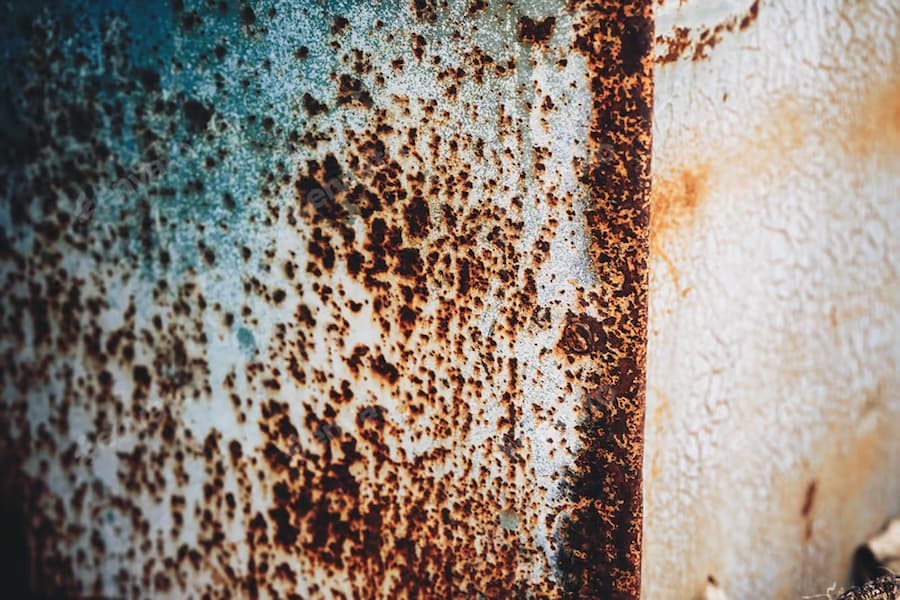
The visible cue is the color change. Red flips to charcoal black. If a patch stays orange after 24 hours, the metal under it is too pitted, the rust was too thick, or oily contamination blocked the reaction.
Key Insight: A converter does not remove rust. It reformulates the surface chemistry so the rust becomes inert, paintable, and bonded to the steel below.
Match the Method
Not every rusty surface deserves a converter. Sequence is everything. The Swedish Sa standards (Sa 1 through Sa 3) and the ISO 8501 rust grades A through D give pros a shared vocabulary for what they see in front of them.
| Rust Grade | What You See | Best Approach |
|---|---|---|
| Grade A | Mill scale, no visible rust | Skip the converter, prime directly |
| Grade B | Mill scale flaking, light rust | Wire-brush, then converter |
| Grade C | Mill scale gone, surface rust | Ideal converter target |
| Grade D | Pitted rust, deep texture | Converter works but expect uneven cure |
| Beyond D | Perforated, scaling, flaking off | Cut and replace — converter cannot save it |
Most weekend jobs — trailer frames, fence posts, garden tools, mower decks — sit in Grade C territory. Industrial assets like water tank shells and structural steel usually fall between B and D depending on age and exposure. XionLab’s breakdown of converter chemistry walks through the matching exercise in more depth.
One quick check tells you nearly everything: tap the rust with a screwdriver. If the metal underneath rings solid and the rust flakes a small chip off, an advanced rust converter will hold. When the screwdriver punches through, no converter on the market can rebuild the metal.
Real Applications
The chemistry is general. The use cases are not. A converter built for an oil-rig deck plate may waste your weekend on a vintage Mustang quarter panel. So pros segment by environment.
Classic-car floor pans, wheel wells, trunk pans, and frame rails are the textbook converter job. Surface rust mixed with solid metal is exactly the chemistry’s sweet spot. Restorers in the salt belt — Michigan, Ohio, upstate New York — use converters to stabilize floor pans before topcoating with epoxy primer and seam sealer. Skipping the converter here usually means rust bleed-through within 18 months. More on the automotive workflow here.
Saltwater is the meanest oxidizer in the toolbox. Along the Gulf Coast and the Pacific Northwest, salt mist accelerates corrosion 10 to 100 times faster than inland air. Cleats, davits, trailer fenders, dock pilings, and outboard mounting brackets all benefit from converter treatment between full recoat cycles. The trick is full rinsing first — chloride salts left under the converter sabotage the bond.
Warehouses, mezzanines, refinery walkways, pole barns, and exposed I-beams collect condensation rust at every temperature swing. Taking the structure offline isn’t always an option. Converter products let crews spot-treat localized corrosion and recoat the next shift, extending the topcoat’s service life by years rather than months.
Tractor decks, plow blades, livestock waterers, hay racks, and hand-tool heads. These items sit outside year-round, and most owners don’t want to disassemble them for media blasting. A quart of converter and a chip brush gets a season’s worth of rust under control in an afternoon.
Salt mist accelerates corrosion roughly an order of magnitude faster than inland air, which is why coastal applicators rebuild their treatment intervals around it.
Application
The single biggest reason converter jobs fail is rushed prep. Field crews and weekend restorers blow through the same five steps if they want the bond to last. Here’s the workflow most pros follow on automotive and light-industrial jobs.
Sequence is everything. Skip the degrease and the converter beads up. Miss the wire-brush step and you’re sealing flakes in place — they pop loose under the topcoat. Blow past the recoat window and you start over.
For surface prep deeper than the basics, XionLab’s surface preparation guide covers the edge cases (mill scale, weld seams, galvanized substrates).
Pro Tip: Temperature matters more than people think. Below 50°F the cure stalls. Above 95°F the acids flash off before they finish reacting. Aim for 60–85°F and shade if you can.
Compared
Converters are one tool of several. Knowing where each one wins keeps you from forcing the wrong product onto the wrong job.
| Method | Best For | Speed | Cost / sq ft | Limit |
|---|---|---|---|---|
| Advanced Rust Converter | Stable surface rust, prep-limited jobs | Same-day topcoat | $0.20–$0.60 | Won’t fix perforated metal |
| Wire-Wheel + Primer | Light rust, cosmetic jobs | Hours | $0.10–$0.30 | Misses pit-bottom rust |
| Sandblasting / Media Blast | Show-quality restorations | Days, plus rental | $3–$8 | Equipment, mess, warpage risk |
| Acid Pickling Tank | Small parts, batch work | Hours | Lab/shop only | Hazardous, off-site |
| Replace Metal | Perforated, structural | Days | Variable | Welding, fitting |
Brand-honest read on the converter category: Corroseal water-based formula does a clean job on lighter surface rust and stays user-friendly. Where XionLab pulls ahead is on the 2-in-1 side — the converter and primer cure into a single film, so you avoid the topcoat-window scramble catching a lot of weekend painters off guard.
For a deeper category breakdown, see our converter vs. remover comparison and the full converter buyer’s guide.
How XionLab Helps
Most converters force a choice: water-based and easy on the user, or solvent-based and tougher on the cure. The XionLab 2-in-1 Rust Converter & Metal Primer was built so you don’t have to pick. Here’s what shows up in the field across the four big use categories:
Converter and primer in one liquid. Skip the second product, skip the recoat-window scramble, skip a buying trip.
Water-based, low VOC, safe for use in barns, garages, and indoor maintenance bays. Cleanup with soap and water.
Bonds to surrounding substrates, useful around mixed-material repairs like fence posts set in concrete.
A single brush coat handles light to moderate surface rust. Pitted areas get a second pass — quick and easy.
Accepts oil, latex, urethane, and epoxy topcoats once cured. No exotic primers required.
The cured film holds up under direct sun and humid coastal exposure between full recoat cycles.
One field anecdote tells the story better than a spec sheet. A boatyard owner outside Mobile, Alabama, called us about a 22-foot trailer parked under a leaky carport for two summers. The frame rails had a quarter-inch of crusty surface rust over solid metal. He rinsed the salt off, knocked down the loose flakes with a stiff brush, and brushed on one coat of XionLab. By the next morning the rust had turned dark gray. Six months later, with the trailer back in saltwater service, the converted patches were still locked down. He skipped the blasting bill entirely.
Avoid These
The chemistry is forgiving. User errors are not. Shop techs see the same handful of failure modes again and again. Here’s how each one goes wrong, and what to do instead.
But first, a quick reality check — most of these errors trace back to skipping prep, not a bad product.
One coat. Done. That’s the goal on a clean surface, but only if the prep work is real.
Go Deeper
Want to keep reading? These companion guides cover specific corners of the rust treatment world.
And if you want a 30,000-foot view, the Wikipedia entry on rust converters is a decent quick refresher on category basics.
FAQ
It’s a brush-on liquid using tannic and phosphoric acids plus a polymer binder to chemically transform red surface rust into a stable black film, then seal it in primer-ready form. One product, two jobs.
Most modern formulas give you a 24 to 72 hour topcoat window. Inside that window the chemistry is fresh and adhesion is strong. Wait longer and surface oxidation creeps in, weakening the bond.
Indoors and out of direct sun, a converter alone will hold for years. Outdoors, UV slowly chalks the surface. A topcoat doubles or triples the service life on exterior jobs.
No, and any product claiming otherwise is overpromising. Converters reformulate the chemistry of rust on solid metal. Once the steel is perforated, the only fix is to cut, weld, or replace the section.
Converters are made for ferrous metals — iron and carbon steel. Aluminum, galvanized, and stainless corrode through different chemistries (oxide layers, white rust, pitting), and a converter does little for them.
Aim for 60 to 85°F with low humidity. Below 50°F the cure stalls. Above 95°F the acids flash off before reacting. Shade is your friend on hot summer afternoons.
Color change. Red flips to charcoal black inside a few hours. Patches staying orange usually mean leftover oil, salt contamination, or rust thicker than the converter could penetrate.
For most repair jobs, yes — fewer steps, fewer mistakes, no topcoat-window panic. For full restorations where you want a specific epoxy or urethane primer underneath your topcoat, separate products give more control.
Only if the paint is solid and the rust has bled through. The converter needs to reach exposed iron oxide. Sand or wire-brush to expose the rust first, then brush converter onto the bare metal patches.
Skip the blasting bill. Convert, prime, and seal in one coat.