
No products in the cart.
Quick answer — Yes, you can paint over rust converter, and most of the time you should. The converter turns active rust into a stable, paint-ready primer layer. Let it cure first, match the topcoat to the chemistry, and the finish holds for years.
The Straight Answer
Can You Paint Over Rust Converter? Yes, With One Catch
You found rust. You treated it. Now a question hangs over the whole project. Can you paint over rust converter without the whole thing flaking off in six months? The answer is a confident yes. A rust converter exists to be painted. Its entire job is to halt corrosion and leave behind a bonded surface your topcoat can grip.
The catch sits in the timing and the pairing. Rush the cure, and adhesion suffers. Pair the wrong topcoat with the wrong converter, and you get fish-eye, lifting, or a dull patchy sheen. Get both right, though, and the coating outlasts the metal under it. We have watched XionLab-treated panels hold paint through a decade of Florida humidity. Patience pays here.
So this guide walks the full path. Cure windows. Topcoat compatibility. A clean step-by-step. The honest limits nobody tells you about. And where a 2-in-1 product like XionLab changes the math entirely.
The Chemistry
Why Rust Converter Becomes a Paintable Surface
Rust is iron oxide, the flaky orange stuff. A converter contains tannic acid and a polymer base. The acid reacts with the oxide and forms iron tannate, a stable blue-black compound. The polymer dries into a thin film over the top. Two jobs, one coat.
What does the topcoat actually stick to? Not rust. It bonds to the polymer film and the converted layer beneath it. The science of rust converters and primers shows why a clean reaction matters so much for adhesion. Skip the cure, and the topcoat sinks into a film still off-gassing moisture. Bubbles follow. Sequence is everything.
$2.5 Trillion
The estimated global cost of corrosion each year, roughly 3.4% of world GDP, per NACE International’s IMPACT study. A converter plus a sound topcoat is the cheapest defense most surfaces will ever get.
There is a reason engineers obsess over coatings. Corrosion never quits. The moment bare iron meets oxygen and water, the clock restarts. A converted, painted surface buys you a sealed barrier, and the barrier is what stops the cycle cold. The figure above traces back to the industry group AMPP, the association formed when NACE merged with SSPC, the people who write the corrosion-control standards most coatings follow. Want the deeper mechanics? Our breakdown of how rust converters work covers the reaction step by step.
Surface Prep
Prep Decides Whether the Paint Sticks
Every coating failure I have torn apart traces back to one thing. Bad prep. The converter and the topcoat can both be perfect, and the finish still peels if the surface underneath was dirty, greasy, or loaded with loose scale. Good prep is unglamorous. It is also the difference between a five-year finish and a five-month one.
Start mechanical. A wire wheel, a flap disc, or plain sandpaper knocks off the flaking rust and any old paint with no grip left. You are not chasing bare shiny metal here, only a sound, tightly-bonded surface. Solid rust can stay, since the converter feeds on it. Powdery, lifting rust has to go, because nothing sticks to dust.
Then go chemical. Grease and road salt are invisible adhesion killers, and they sit on everything pulled off a vehicle. A wipe-down with a wax-and-grease remover or a simple degreaser lifts the film your eyes miss. Salt belt trucks and Pacific Northwest tools need a second pass. Rinse, dry, and only then reach for the converter. Our full guide to surface preparation for rust treatment walks the grit choices and cleaners in depth.
One last prep truth. Humidity creeps back fast on freshly cleaned steel. Work the converter on within an hour or two of prepping, before flash rust gets a fresh start. Bare metal does not wait around.
Timing
How Long to Wait Before You Paint
Here is where most projects go sideways. A converter feels dry to the touch in about 20 minutes. Tempting. But surface-dry is not cured, and painting too early is the number one reason a topcoat fails over converted rust.
Give it a full cure. Most products want 24 to 48 hours before a finish coat, and oil-based topcoats sit at the longer end. Cooler, damper air stretches the window further. The reaction needs time to finish converting, and the film needs time to harden underneath.
| Condition | Touch-Dry | Ready for Topcoat | Notes |
|---|---|---|---|
| Warm & dry (70–85°F, <50% RH) | ~20 min | 24 hours | Ideal cure window |
| Average garage (60–70°F) | ~30 min | 24–48 hours | Most common scenario |
| Cool & humid (<60°F, >70% RH) | 45+ min | 48–72 hours | Gulf Coast summers, garages near the water |
| Second converter coat applied | Add per coat | +24 hours | Two thin coats beat one thick one |
The sweet spot lives between 60°F and 85°F with humidity under 70%. Outside it, wait longer. A cheap hygrometer settles the guesswork for a few dollars. Do not trust a calendar over your eyes, though. A fully converted surface looks uniform, matte, and blue-black, with no orange bleeding through. See orange? It needs another coat and another wait.
Compatibility
Which Paints Work Over Rust Converter?
Not all topcoats play nice. The classic rule for traditional acid-based converters is simple. Use oil-based or epoxy paints, and skip latex or water-based finishes, because the water in those can reactivate flash rust under the film. A 2-in-1 product changes the rule, which we will get to.
Here is how the common topcoats stack up over a cured converter.
| Topcoat Type | Works Over Converter? | Best Use | Watch Out For |
|---|---|---|---|
| Oil-based enamel | Yes, excellent | Tools, gates, trailers, equipment | Longer dry, strong fumes |
| Epoxy primer/paint | Yes, best durability | Marine, industrial, high-wear | Two-part mixing, pot life |
| Spray enamel (oil-based) | Yes, with light coats | Patio furniture, railings | Runs if rushed |
| Latex / acrylic (water-based) | Risky on acid converters | Only over a sealed primer | Can reactivate flash rust |
| Powder coat | Generally no | Bare or media-blasted metal | Oven heat disrupts the film |
One detail trips people up constantly. A rust converter is not always a finished primer. Some leave a film fit only for an oil-based topcoat. Others, the better ones, dry into a true primer you can finish with almost anything. Read the label, then test a hidden corner before you commit the whole panel. Curious whether priming changes the steps? We cover it in detail in priming over rust converter.
Step By Step
How to Paint Over Rust Converter the Right Way
Six steps, in order. Sequence matters more than speed.
- 1. Knock off the loose stuff. Wire-brush or scrape away flaking rust and old peeling paint. Solid rust stays. Loose rust goes. The converter needs to reach actual oxide, not powder.
- 2. Degrease and dry. Wipe oil, grease, and salt off with a solvent or degreaser. Salt belt cars need extra attention here. Let it dry fully.
- 3. Apply the converter. Brush or spray a thin, even coat. Watch it turn from orange to blue-black over the next hour or two. Thin beats thick.
- 4. Add a second coat if needed. Heavy rust drinks the first coat. A second pass seals any spots still showing orange.
- 5. Wait for the real cure. 24 to 48 hours, longer in damp air. Touch-dry does not count. Patience here saves a redo.
- 6. Topcoat in thin layers. Two or three light coats out-perform one heavy flood coat. Let each flash off before the next.
Field note — Last spring I treated a rusted trailer tongue at a buddy’s place down near Galveston, maybe a quarter-inch of crusty surface rust along the welds. One coat of XionLab, a second on the worst seams, then a full day’s wait in the salt air before two coats of oil enamel. A year of Gulf Coast humidity later, the finish hasn’t budged. The salt off the bay is brutal, and it still held.
How XionLab Helps
Why a 2-in-1 Converter Changes the Painting Game
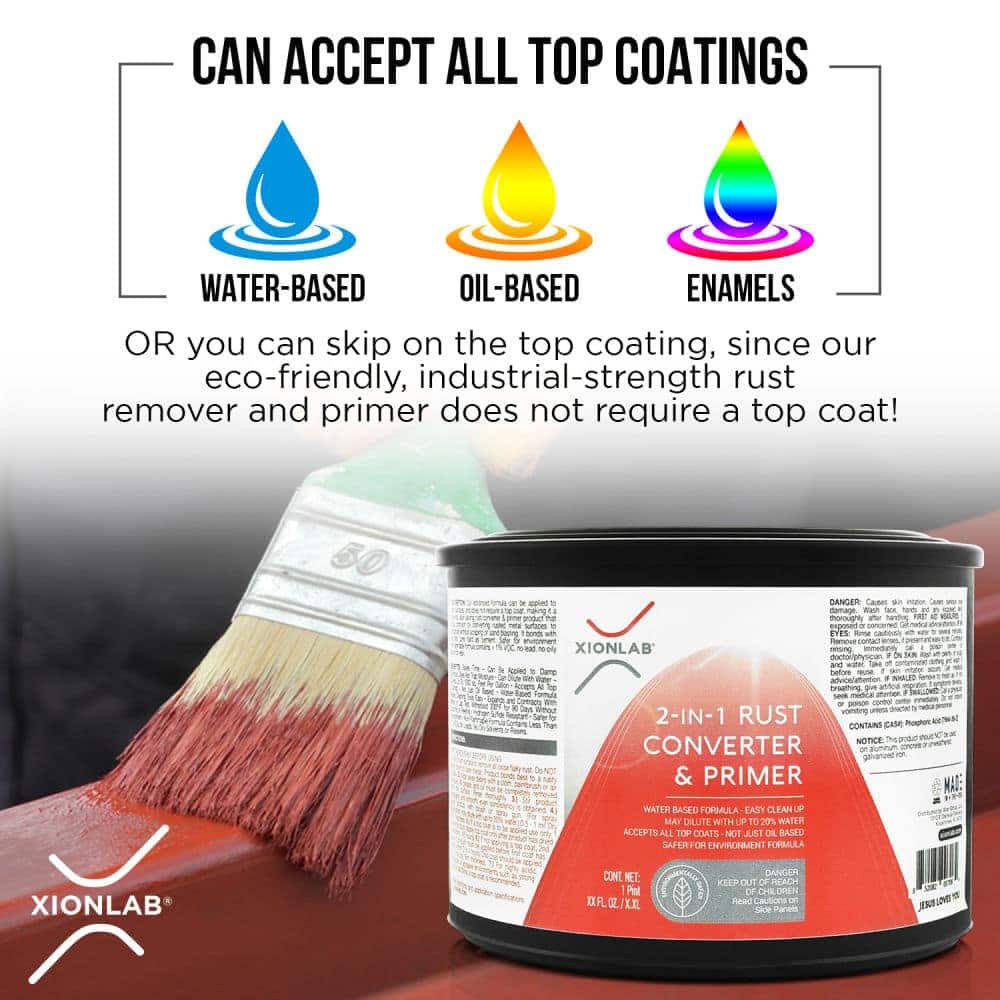
Most converters force a choice. Acid-based, oil-topcoat-only, and fussy about water-based paint. XionLab’s 2-in-1 rust converter and metal primer was built to remove the headache. It converts the rust and cures into a real, paintable primer in a single product. Less guesswork, fewer steps, broader topcoat options.
●
Converter + Primer
One application stops rust and leaves a primed surface ready for your finish coat.
●
Water-Based, Low Odor
No harsh solvent fumes. Safer for you and gentler on the environment, by design.
●
Broad Topcoat Range
The cured primer accepts most quality topcoats, so you are not locked into oil enamel.
●
Flexible Film
It moves with the metal through heat and cold instead of cracking at the first temperature swing.
●
Brush, Roll, or Spray
Apply it however the job demands, from tight welds to broad flat panels.
●
Proven Since 2015
A decade of real-world use on trailers, marine hardware, and shop equipment.
XionLab also pulls its weight in tougher arenas. For boat trailers and dock hardware, our notes on marine corrosion protection show how the same chemistry survives constant salt exposure. Restoring a vehicle? The walkthrough on rust converter for automotive protection covers frames, floor pans, and panels.
15–35%
The share of corrosion damage cost preventable through proper coatings and maintenance, by NACE estimates, between $375 and $875 billion globally. Good prep is not busywork. It is the whole game.
Honest Limits
What Rust Converter Will Not Fix
Time for the part the marketing skips. A converter is not magic, and pretending otherwise wastes your money. It treats surface and moderate rust. It does not rebuild metal.
Got holes? A converter will not fix perforated metal. If you can push a screwdriver through a rusted floor pan, the section needs cutting out and welding, not a coat of liquid. The converter seals what remains. It cannot replace what already rotted away. Be straight with yourself about the damage before you start.
A few more honest caveats are worth knowing before you start.
- Heavy scale must come off first. Thick, flaking layers block the chemistry from reaching live rust underneath.
- It is not a structural repair. Rust-weakened brackets and frame rails still need real metalwork.
- Bare, rust-free steel needs a primer, not a converter. Converters react with oxide. No rust, nothing to convert.
- Constant submersion is its own challenge. Underwater hardware needs a coating system rated for it.
None of these are dealbreakers. They are just the line between a job that lasts and one that disappoints. Corrosionpedia keeps a solid plain-language reference on how rust converters function and where they fit if you want a second opinion before buying.
Honest Comparison
XionLab vs Other Rust Converters
Let me be fair to the competition. Corroseal works well on lighter surface rust and has a loyal following. Rust-Oleum’s converter is everywhere and cheap. Both convert rust. Both have their place. So where does XionLab pull ahead?
Two areas. First, the all-in-one primer step means broader topcoat freedom and one less product to buy. Second, the water-based, low-odor formula fits the company tagline, safer for you and safer for the environment, without the solvent stink of older converters. For a quick comparison of treatment types, our piece on rust converter vs rust remover clears up which approach your project actually needs.
| Factor | XionLab 2-in-1 | Typical Acid Converter |
|---|---|---|
| Primer included | Yes, built in | Often no, primer sold separately |
| Topcoat options | Broad range | Usually oil-based only |
| Odor & safety | Low odor, water-based | Sharp solvent fumes common |
| Application | Brush, roll, or spray | Varies by brand |
| Best for | Surface to moderate rust, then paint | Light surface rust |
Regional reality matters too. Salt belt states from Ohio to Maine chew through truck frames every winter. Pacific Northwest damp keeps tools and gates perpetually moist. Gulf Coast salt air does its own slow damage. A flexible, water-based system handles all three without cracking when the seasons swing.
Cost deserves an honest word as well. Cheaper converters win on the shelf price, no argument. Run the math over the life of the job, though, and the picture flips. A separate converter, then a separate primer, then a topcoat, adds up in dollars and in afternoons. A 2-in-1 product collapses two of those steps into one can and one wait. Fewer trips to the store. Less time bent over a fender. And when the all-in-one primer lets you skip the oil-enamel-only restriction, you paint with whatever finish the job actually calls for. Value is not the sticker. Value is what survives three winters of road salt and still looks painted.
None of the brands here are bad products. Match the tool to the damage, prep like you mean it, and respect the cure window. Do those three, and the converter you choose matters less than the patience you bring. Skip them, and no label saves the finish.
Common Questions
Painting Over Rust Converter FAQ
How long after rust converter can I paint?
Wait 24 to 48 hours for a full cure, longer in cool or humid air. The surface dries to the touch in about 20 minutes, but the film is not cured yet. Painting too soon is the most common cause of a failed topcoat.
Do I have to paint over rust converter?
For anything exposed to weather or UV, yes. Most converters need a topcoat for long-term protection and to shield the film from sunlight. A 2-in-1 primer still benefits from a finish coat outdoors. Indoors and dry, some products can stand alone for a while.
Can I use water-based or latex paint over rust converter?
Over a traditional acid converter, it is risky, since the water can wake up flash rust under the film. Over a cured 2-in-1 primer like XionLab, water-based topcoats are far safer. Always spot-test a hidden area first.
Can you paint over rust converter without primer?
It depends on the product. Some converters leave only a film and still want a separate primer. Others, like XionLab’s 2-in-1, cure into a primer themselves, so you can topcoat directly. Check the label.
What happens if I paint too soon?
The trapped moisture and unfinished reaction cause bubbling, poor adhesion, and peeling. The topcoat may look fine for a week, then lift. A redo costs more time than waiting ever would.
Will rust converter fix rusted-through metal?
No. It stabilizes surface and moderate rust, but it cannot rebuild metal lost to corrosion. Holes and perforated panels need cutting and welding. The converter seals what is left, nothing more.
How many coats of converter before painting?
One coat handles light rust. Heavy or pitted rust usually needs two thin coats, with the first fully reacted before the second. Look for a uniform blue-black finish with no orange bleeding through.
Can you spray paint over rust converter?
Yes, once it is cured. Use light, even passes to avoid runs, and confirm the spray paint chemistry matches your converter. Oil-based aerosol enamel is a safe default over most converters.
Stop the Rust. Paint With Confidence.
XionLab’s 2-in-1 Rust Converter & Metal Primer converts rust and primes in one step, so your topcoat goes on cleaner and lasts longer. Water-based, low odor, made in the USA since 2015.
Safer For You, Safer For The Environment