No products in the cart.
Rust Converter Spray Paint: The Complete 2026 Guide to Stopping Automotive Corrosion
March 18, 2026
By Xion Lab
Free Shipping
easy returns
secure paymentS
FAQ | MY ACCOUNT | SUPPORT
March 18, 2026
By Xion Lab
How to choose, apply, and get the most from rust converter spray paint on cars, trucks, trailers, and equipment — plus an honest look at how XionLab stacks up against the competition.
Quick Answer: Rust converter spray paint works by triggering a chemical reaction between tannic or phosphoric acid and iron oxide, turning active rust into a stable, paintable black coating. Applied correctly to clean, dry metal with loose rust removed, a single coat stops corrosion and acts as a metal primer — no sandblasting required. XionLab’s 2-in-1 formula completes both steps in one pass, cutting prep time without cutting corners.
The Basics
Rust converter spray paint is not a coating you slap over rust and hope for the best. It is a reactive formula — one designed to chemically neutralize iron oxide rather than simply hide it. The active ingredient (usually tannic acid, phosphoric acid, or a combination of both) binds to the rust molecules and converts them into ferric tannate or iron phosphate, stable compounds that hold up under paint without continuing to corrode underneath.
Standard spray paint sits on top of rust. Given enough moisture and time, the rust continues spreading beneath the film until the coating bubbles, peels, and fails. Rust converter spray paint eliminates the source. Salt wins every time over standard coatings alone.
Three terms get mixed up constantly, so it is worth separating them:
Most quality products — including XionLab’s 2-in-1 Rust Converter & Metal Primer — combine converter and inhibitor properties into a single formula. You convert the existing rust and block new growth at the same time. One application. Done.
How It Works
Understanding the reaction helps you apply the product correctly. Rust — chemically Fe₂O₃, or iron oxide — forms when iron atoms lose electrons to oxygen and water. The resulting compound is porous, brittle, and keeps expanding as moisture penetrates deeper into the metal.
Tannic acid, the primary active compound in most water-based converters, reacts with Fe₂O₃ to produce ferric tannate — a dense, dark polymer layer. This layer is chemically inert. It does not continue oxidizing. And it bonds mechanically to the metal surface, giving paint something to grip that won’t collapse three seasons later.
Phosphoric acid-based formulas work differently. They convert iron oxide into iron phosphate, which is similarly stable. Some formulas blend both acids for broader coverage across surface rust depths. For a deeper breakdown of the underlying chemistry, the science of rust converters and primers is covered in full detail on XionLab’s site.
Estimated annual global cost of corrosion, according to AMPP (formerly NACE International) — roughly 3.4% of world GDP. The automotive sector alone accounts for more than $23 billion annually in the U.S.
One practical note from the research at AMPP.org: corrosion-related losses are preventable at the 15–35% range with proper treatment. For vehicle owners and fleet managers, rust converter spray paint is often the most cost-effective tool in that prevention stack.
Before You Spray
Rust converter spray paint does not require a bare-metal surface — but it does require a clean one. Skip prep and you are not converting rust. You are just covering dirt, oil, and loose scale with a reactive liquid that has nothing solid to bond to.
I learned this the hard way on a 2009 F-250 Super Duty in Corpus Christi, Texas. The frame rails looked solid from a distance. Up close, they had about a quarter-inch of loose, flaky scale layered over the structural metal. I applied converter directly to the flake layer — and about six months later, the coating was lifting at the seams because the scale beneath it had never adhered. The second pass, done right, has held for three years. Preparation is not optional.
For a full prep protocol, the surface preparation guide for rust treatment covers wire brushing, grinding, and degreasing in detail. The short version:
Application
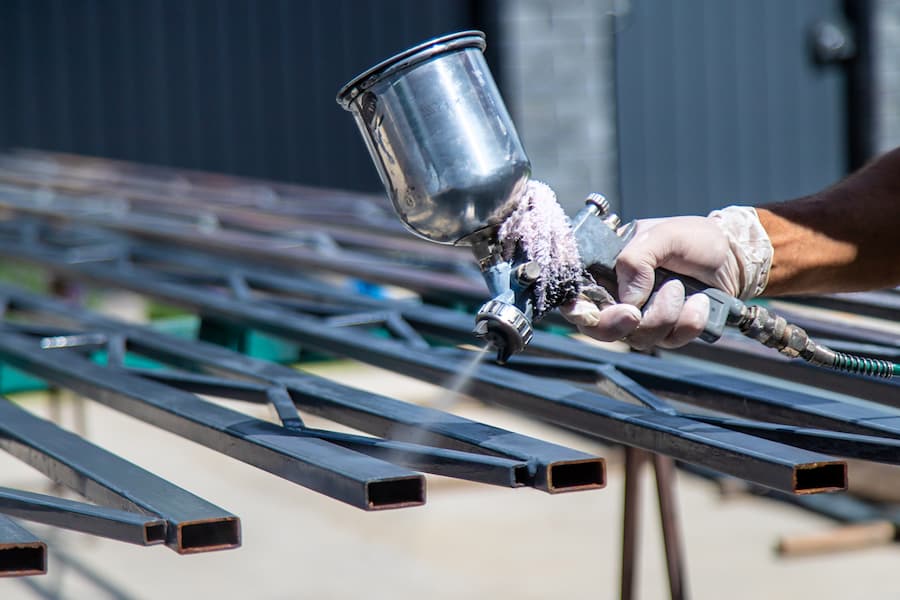
Application is where most DIYers underperform. The instinct is to apply a light, even coat — the way you’d spray automotive paint. Rust converter spray paint works the opposite way. Thin coats fail. You need the surface saturated, not damp, so there is enough reactive agent to drive full conversion through the rust layer.
Cover anything you do not want teal-black: rubber seals, brake lines, aluminum components. Rust converter does not react with non-ferrous metals, but it will stain them. Tape and plastic sheeting cost less than regret.
Two full minutes. Not twenty seconds. The tannic acid suspension separates in the can and an under-mixed formula delivers inconsistent coverage. Sequence is everything.
Hold the can 10–12 inches from the surface and spray in slow, overlapping passes. The surface should look visibly wet — not foamy, not dry. Within 15–20 minutes, you will see dark conversion beginning. That black discoloration is ferric tannate forming. Good sign.
Twenty-four to forty-eight hours for full curing, depending on temperature and humidity. Do not rush this. Applying topcoat over an incompletely cured converter layer traps solvents and leads to bubbling later.
On deep scale — structural members, wheel arches in northern Michigan, underframes from salt belt states like Ohio and Pennsylvania — a second coat after the first has dried ensures complete conversion. One coat on light rust. Two on the heavy stuff.
Most rust converter products are compatible with oil-based and water-based topcoats. XionLab’s formula is also a metal primer, so you skip the separate priming step entirely. Apply your topcoat, let cure, and you’re done.
Typical time for a trained technician to treat a full pickup truck frame from wheel arch to wheel arch using rust converter spray paint — the standard workflow for fleet undercoating in salt belt states, per industry practice.
Product Comparison
Rust converter and standard primer are not interchangeable. Each plays a different role. Using the wrong one at the wrong stage costs money and time. Here is how they compare:
| Feature | Rust Converter Spray Paint | Standard Rust-Inhibiting Primer |
|---|---|---|
| Works on active rust? | Yes — converts iron oxide chemically | No — must be applied over clean metal |
| Requires bare metal? | No — works over surface rust | Yes — full removal required first |
| Also serves as primer? | Yes (in 2-in-1 formulas like XionLab) | Yes, but only on rust-free metal |
| Prep time required | Wire brush + degrease (~30 min) | Sandblast or grind to bare metal (hours) |
| Works on aluminum/fiberglass? | No — iron and steel only | Yes — material-specific formulas exist |
| Ideal for | Existing rust on frames, underbodies, tools | New metal or fully stripped surfaces |
| Cost efficiency | High — eliminates sandblasting cost | Moderate — high prep labor required |
Fleet managers running 40 or 50 vehicles a year have known this calculus for decades. Sandblasting every frame before priming is simply not practical — rust converter spray paint plus topcoat is the standard workflow for commercial undercoating across the rust belt. See the automotive rust protection overview for how this plays out in full fleet settings.
Brand Comparison
Not all formulas are equal. Product choice matters — particularly for applications where failure means structural damage, not just cosmetic issues. Here is an honest comparison of the leading options:
| Product | Active Ingredient | Also a Primer? | Best For | Limitations |
|---|---|---|---|---|
| XionLab 2-in-1 | Tannic acid blend | Yes | Full-surface automotive + industrial use; heavy rust | Iron/steel only; won’t fix perforated metal |
| VHT SP229 | Phosphoric acid | Partial | Targeted automotive spot treatment | Aerosol can limits volume for large jobs |
| Corroseal Water-Based | Phosphoric acid | Yes | Light to moderate surface rust | Thinner formula; less effective on deep scale |
| Eastwood Rust Converter | Acid-based blend | Partial | Panel and part restoration | Separate topcoat often needed |
| Rust-Oleum Rust Reformer | Tannic acid | No | General DIY rust treatment | Requires separate primer before topcoating |
Corroseal works well for lighter surface rust — the water-based formula is easy to clean up and low-odor. Where XionLab pulls ahead is in coverage depth. The thicker tannic acid formulation penetrates deeper into porous rust layers, which matters on frames and structural members where a shallow conversion leaves active rust below the treated zone.
VHT SP229 is a solid option for spot-treating specific rust patches on body panels. But an aerosol can running dry halfway through a truck frame replacement is not anyone’s idea of efficiency.
For more on how different rust treatment products perform in commercial settings, see the rust converter and primer solutions comparison on XionLab’s site.
Regional Context
Rust does not hit every region equally. The threat profile changes dramatically depending on where a vehicle spends its life, and so does the treatment strategy.
Ohio, Michigan, Pennsylvania, New York, Wisconsin — road salt is applied from November through March, sometimes April. Chloride ions accelerate oxidation at a rate two to three times faster than ordinary humidity. Frames on vehicles from these states can show structural rust in under five years without treatment. Annual undercoating with rust converter spray paint is the minimum standard for fleet operators in these markets.
Salt spray from the Gulf of Mexico is a year-round problem — no winter break. A truck parked near the coast in Louisiana or coastal Texas deals with constant airborne chloride. The rust forms in hard-to-reach crevices first: seams, overlapping panels, anywhere moisture pools. XionLab was founded in 2015 partly out of frustration with products that couldn’t keep pace with Gulf Coast corrosion rates.
Rain and humidity are the primary drivers here rather than salt. Extended wet seasons keep metal surfaces perpetually damp. Rust forms slowly but penetrates deeply in steel with any surface imperfections. Rust converter applied at the first sign of surface rust stops the deep-penetration cycle before it reaches structural metal.
Less corrosion risk, but not zero. Vehicles driven on desert roads pick up dust and grit abrading protective coatings over time. Any scratch through the clearcoat or primer is an entry point. Spot-treating with rust converter spray paint at the first sign of surface rust is far cheaper than ignoring it until the damage spreads.
Why XionLab
XionLab converts active rust and lays down a metal primer simultaneously. No second product, no waiting between steps. One coat handles both jobs.
The tannic acid formulation is thick enough to saturate porous rust layers up to several millimeters deep — not just the surface. Conversion happens all the way through, not just on top.
Water-based formula — low VOC, no aromatic solvents, minimal fumes. Safer for enclosed shop environments and fully consistent with XionLab’s founding principle: Safer For You, Safer For The Environment.
Full cure within 24 hours at standard temperatures. Compatible with oil-based and water-based topcoats, making it an easy fit into any existing paint workflow.
Available in volumes suitable for large jobs — not just aerosol cans. Shop managers treating full fleets can work efficiently without running out mid-job.
Wire brush, degrease, and spray. XionLab eliminates the most expensive and time-consuming step in rust treatment for the majority of real-world applications.
Honest Limitations
Every product has limits. XionLab included. Being clear about those limits is more useful than overselling.
Frequently Asked Questions
Can I spray paint directly over rust converter without a separate primer?
With XionLab’s 2-in-1 formula, yes. The product functions as both a rust converter and a metal primer, so a compatible topcoat goes directly on top after the 24-hour cure period. With converter-only products, check the manufacturer’s specs — many require a separate primer layer before topcoating.
How much rust is too much for a converter to handle?
Surface rust and moderate scale — up to a few millimeters deep — is well within range for rust converter spray paint. But once the metal is perforated or structurally compromised, no converter can help. The test: if you can push a screwdriver through the rusted area with light pressure, that section needs to be cut out and replaced, not treated.
Does rust converter spray paint work on cast iron?
Yes. Cast iron is an iron alloy and rust converter reacts with iron oxide, so the chemistry works the same way. Surface prep is the same: remove loose scale, degrease, and apply a saturating coat. Cast iron surfaces tend to be rougher and more porous, so a second coat on heavy rust areas is often worth the extra time.
How long does the converted surface last before re-treating?
Converted and topcoated surfaces typically hold for 3–7 years depending on exposure. Vehicles in high-salt or high-humidity environments (Gulf Coast, salt belt states) sit at the lower end of that range without annual inspection. Bare converted surfaces — without topcoat — need re-treatment or topcoating within a season.
Is rust converter spray paint safe to use indoors or in a garage?
Water-based formulas like XionLab’s are significantly safer than solvent-based alternatives — low VOC and minimal fumes. That said, keep the space ventilated. Open the garage door, run a fan, and avoid enclosed spaces without airflow. Gloves are always a good idea regardless of formula type.
Why does rust converter spray paint turn black?
The black color is ferric tannate — the stable compound formed when tannic acid reacts with iron oxide. It is a visible signal the conversion is working. Dark patches appearing within 15–20 minutes of application mean the chemistry is active. Areas that stay reddish-brown after drying did not get full coverage and need a second pass.
Can rust converter spray paint be used on a vehicle still in regular use?
Yes, with timing. Apply when the vehicle will sit for at least 24 hours — ideally 48 in cold or humid conditions. Driving on a partially cured converter layer can cause the coating to lift at high-flex points like door hinges or suspension components. Give it time. The protection is worth the wait.
What is the shelf life of rust converter spray paint after opening?
Typically 1–2 years in a sealed container stored away from heat and direct sunlight. Water-based formulas can degrade faster once opened if exposed to air. Transfer unused product to a smaller airtight container to extend shelf life, or note the date on the can and plan accordingly for your next application.
XionLab’s 2-in-1 Rust Converter & Metal Primer converts existing rust and primes for topcoat in a single application. No sandblasting. No separate primer. Just lasting protection — Safer For You, Safer For The Environment.