
No products in the cart.
Marine Corrosion Protection: Best Rust Converter for Boats & Marine Equipment (2026 Guide)
April 27, 2026
By Xion Lab
Free Shipping
easy returns
secure paymentS
FAQ | MY ACCOUNT | SUPPORT
April 27, 2026
By Xion Lab
Quick Answer: Marine corrosion protection works best when a rust converter neutralizes existing iron oxide before any topcoat goes on. The right product chemically locks rust into a stable polymer, blocks oxygen and chloride ions, and creates a paint-ready surface — all in one step. For boats and marine equipment exposed to salt spray, splash zones, and bilges, XionLab’s 2-in-1 rust converter and metal primer is engineered to handle the chloride load that breaks ordinary primers down.
Rust on a freshwater bass boat behaves nothing like rust on a Gulf Coast charter. Saltwater is roughly 50 times more conductive than tap water, and chloride ions slip past iron’s protective oxide layer like a key sliding into a lock. The result is corrosion rates four to five times faster than inland exposure, sometimes climbing higher when humidity, heat, and trapped moisture join the party.
According to NACE International’s IMPACT study, the global cost of corrosion sits near $2.5 trillion a year, and marine and offshore assets carry an outsized share. Salt wins every time. Untreated steel left at a coastal slip can lose visible thickness in a single season — a fender bracket, a trailer crossmember, an outdrive bolt — anywhere brine can wick in and stay put.
So why does saltwater corrosion accelerate so violently? Three forces team up against your boat:
Typical corrosion rate of carbon steel in marine atmospheres versus inland exposure (NACE/AMPP corrosion category C5-M).
That extra speed is why a generic hardware-store rust paint flakes off a transom plate within months. Marine metal needs a converter formulated for chloride pressure, not just dry barn rust. Salt wins every time.
A rust converter is part chemist, part bodyguard. The active ingredient — usually tannic acid or a phosphoric acid blend — reacts with red iron oxide (Fe₂O₃) and turns it into a stable black ferric tannate or iron phosphate complex. That black layer is no longer reactive. It bonds tightly to the underlying steel and refuses to keep oxidizing.
Modern formulas like XionLab’s go further. They pair the converter chemistry with a polymer carrier, so the same coat that neutralizes rust also leaves behind a primer film. One coat. Done. No need to scrub off the cured converter and start over with a separate primer.
For a deeper read on the chemistry, our guide to the science of rust converters and primers walks through the reaction step by step. The short version below covers what matters for boats.
The black color shift is your signal. When it stops turning black, you have hit either bare metal or already-converted rust, and a second coat will not do much. Boaters often miss this cue and waste material. Watch for the shift.
Not all rust converters are equal. A product designed for a Wisconsin pontoon trailer often fails on a Gulf Coast offshore rig because the chloride pressure and UV load are entirely different beasts. BoatUS classifies marine corrosion into general, galvanic, crevice, and stray-current categories — each one demands a coating with different characteristics.
| Exposure | Chloride Load | Coating Demand | Best Fit |
|---|---|---|---|
| Freshwater inland | Low | Basic converter + topcoat | Most water-based gels |
| Brackish estuary | Moderate | Marine-rated converter | 2-in-1 polymer formulas |
| Saltwater coastal | High | Chloride-resistant primer film | XionLab 2-in-1, marine epoxy systems |
| Offshore / splash zone | Severe | Multi-coat system with topcoat | 2-in-1 base + marine urethane topcoat |
| Bilge / standing water | Severe + immersion | Immersion-rated coating | Two-part epoxy after converter base |
This is where buyers go wrong. They grab the cheapest gel at the marine store, slap it on a transom, and find rust bleeding through the gelcoat by mid-season. A marine-grade converter costs slightly more and lasts dramatically longer. Not all converters are equal.
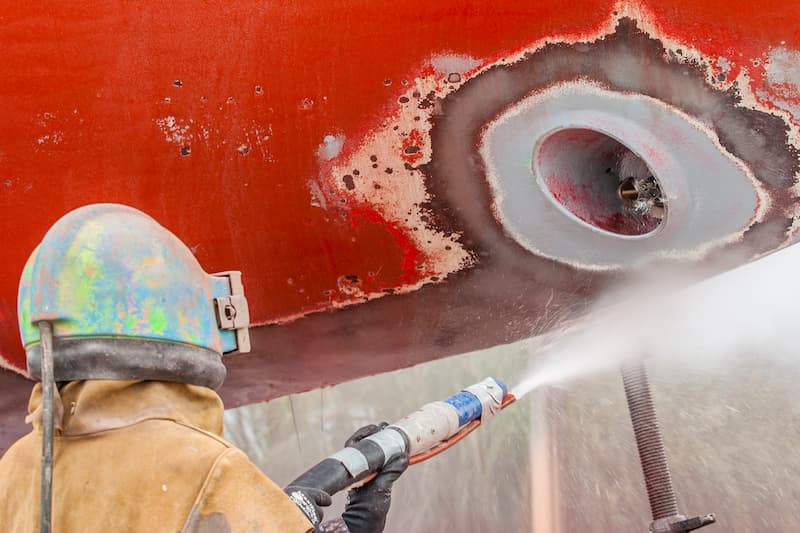
Surface prep is everything. A converter only works on rust it can physically reach, so any layer of grease, salt crust, or loose scale blocks the chemistry from contacting the iron oxide underneath. Skip prep and even the best formula peels in weeks.
Here is the prep sequence we recommend for marine surfaces:
One reminder. The converter does not need a perfectly polished surface. It actually performs better on tightly bonded rust than on bare steel, since the chemistry needs Fe₂O₃ to react with. Our surface preparation guide covers the exact tools and grit choices for each metal type.
Pro tip: If you can pressure-wash, do it the day before. Marine surfaces hold trapped chloride deep in pits, and a single rinse rarely flushes it all out.
Sequence is everything. Follow these steps in order and the coating will outlast a careless rush job by years.
Use a chip brush or a foam pad and work the converter into the rust like you mean it. Brushing forces the liquid into pits and crevices a sprayer would skip across. Apply a thin, even coat — about as thick as a credit card — across the rusted area plus a half-inch onto sound metal.
Within 15 to 30 minutes, the rusted area shifts from orange-brown to deep black or charcoal. That is the iron tannate forming. Areas with no color change either had no active rust or were sealed by old paint, and they need either more prep or a different product.
Most marine converters cure in 24 to 48 hours at 70°F and 50% humidity. Salt air, lower temperatures, and shaded slips slow the cure. Wait the full window before any topcoat goes on. Rushing this step traps solvent and softens adhesion.
Deep pits and pock-marked steel benefit from a second pass after the first cures. The second coat fills micro-voids and builds film thickness where chloride attack was most aggressive.
For above-waterline parts, a marine enamel or polyurethane locks in UV resistance and color. For below-waterline or splash-zone components, a two-part marine epoxy is the right call. The XionLab base accepts both — no sanding between coats if applied within the 7-day overcoat window.
Maximum overcoat window for XionLab 2-in-1 before light scuff sanding is recommended for adhesion.
Let me share a job we walked through with a Pensacola owner last spring. His 28-foot center console had spent four seasons in a covered slip on the Gulf, and the aluminum trailer’s crossmembers had developed scaly orange rust about a quarter-inch thick along every weld. He had tried two off-the-shelf rust paints already. Both peeled within a season.
We pressure-washed first, hit the welds with an 80-grit flap disc, and brushed XionLab 2-in-1 along every joint. The black conversion happened in about 20 minutes. He came back the next morning expecting wet paint and instead found a hard, paint-ready film. After one more coat on the worst pits and a marine urethane topcoat, the trailer rolled back into salt-spray service.
Eighteen months later, those welds are still black under the topcoat. No bleed-through, no flake, no soft spots. That is a useful baseline for what a properly applied marine converter buys you in real Gulf conditions — not a lab number.
Compare this to repainting the trailer entirely or replacing welded crossmembers. The math is not subtle. Prep matters more than product.
After hundreds of conversations with boat owners, these are the top errors we see again and again. Each one shortens coating life by months or kills it outright.
And one last error worth calling out. Some owners reach for a converter on stainless steel pitting. Stainless rusts differently — it suffers chloride pitting and crevice corrosion that a tannic-acid converter cannot reverse. For stainless fittings, polish, passivate, and replace as needed.
XionLab’s 2-in-1 rust converter and metal primer was formulated with chloride exposure in mind. The polymer carrier is engineered to keep oxygen and salt water away from the converted layer, even in coastal humidity. It is water-based, low-VOC, and safe to apply in confined spaces like a bilge or a livewell compartment.
The film blocks Cl⁻ migration so converted rust stays stable under salt spray.
Converter and primer in a single coat — saves prep hours and material costs.
Application choice fits whatever access angle your boat hardware demands.
Safer for closed marine spaces and gentler on gelcoat than solvent-heavy products.
Accepts marine enamels, urethanes, and two-part epoxies after full cure.
Manufactured stateside since 2015 to consistent quality standards.
We respect the competition. Corroseal works well for lighter surface rust on inland equipment. Rust Bullet is a strong choice when a thick film build is the goal. Where XionLab pulls ahead is the chloride load it tolerates and the single-coat workflow on heavily pitted marine steel. For a 14-foot aluminum jon boat trailer in Louisiana, you need a converter built for that climate, not a generic product.
You can read more about our automotive and trailer applications in this rust converter for automotive protection guide, which covers similar metallurgy under different exposure conditions.
A great coating job buys time, not immortality. Marine metal still needs care to stretch the protection out for years. So what should the maintenance rhythm look like?
A rust converter handles general oxidation. But galvanic corrosion is a separate beast — it happens when dissimilar metals touch in seawater and one corrodes to protect the other. Sacrificial anodes (typically zinc for saltwater, aluminum for brackish, magnesium for freshwater) are the right defense, not a converter coating.
For aluminum hulls especially, the BoatUS galvanic corrosion guide explains anode sizing and replacement intervals in plain language. Pair anode discipline with a chloride-resistant converter coating and you get the full defense.
Estimated savings on global corrosion costs achievable through proven prevention practices, per the NACE IMPACT report.
Can I use a regular rust converter on a saltwater boat?
You can apply a generic converter and it will neutralize the rust chemistry. But the resulting film is rarely engineered for chloride pressure and tends to fail within a single season in coastal use. A marine-rated formula handles the salt load far better.
How long does XionLab 2-in-1 last on marine metal?
When applied over properly prepped steel and topped with a marine urethane or epoxy, owners regularly report 3 to 5 years of service before any touch-up is needed on splash-zone hardware. Submerged hull components depend more on the topcoat system than the converter.
Will it stop rust that has already eaten through metal?
No, and any product claiming so is overselling. Once steel is perforated, the structure is gone. Patch, weld, or replace the affected piece, and treat the surrounding metal to stop further spread.
Is rust converter safe to use in a bilge or enclosed compartment?
Water-based, low-VOC formulas like XionLab are designed for confined-space application. Open ventilation, wear gloves, and avoid prolonged skin contact. Solvent-heavy converters belong outdoors only.
Can I apply it directly over old marine paint?
Only if the paint is firmly bonded. Loose, flaky, or chalky paint must come off first because the converter has to physically reach the rust below it. Light scuff sanding helps the polymer film grab.
Does temperature affect application?
Yes. Below 50°F or above 90°F the chemistry slows or skins over too fast. Aim for a calm morning between 60 and 80°F with humidity under 70%, and watch the dew point on coastal jobs.
What about aluminum boats and outboards?
XionLab’s 2-in-1 is formulated for ferrous metal — steel and iron. Aluminum oxidizes differently and benefits from dedicated aluminum primers and sacrificial anodes rather than a tannic-acid converter.
Do I still need zinc anodes if I use a rust converter?
Absolutely. Anodes protect against galvanic corrosion between dissimilar metals in seawater, which is a separate mechanism from general oxidation. The two defenses work together, not as substitutes.
XionLab’s 2-in-1 Rust Converter and Metal Primer is formulated for the chloride pressure your boat actually faces. One coat. Done.