No products in the cart.
Water-Based Rust Converter (2026 Guide): Low-VOC Chemistry, Proper Use, and Salt-Belt Results
April 21, 2026
By Xion Lab
Free Shipping
easy returns
secure paymentS
FAQ | MY ACCOUNT | SUPPORT
April 21, 2026
By Xion Lab
A practical field guide to modern water-based rust converter products — how tannic-acid chemistry stops corrosion, where low-VOC formulas beat solvent-based rivals, and the exact application sequence for lasting rust treatment.
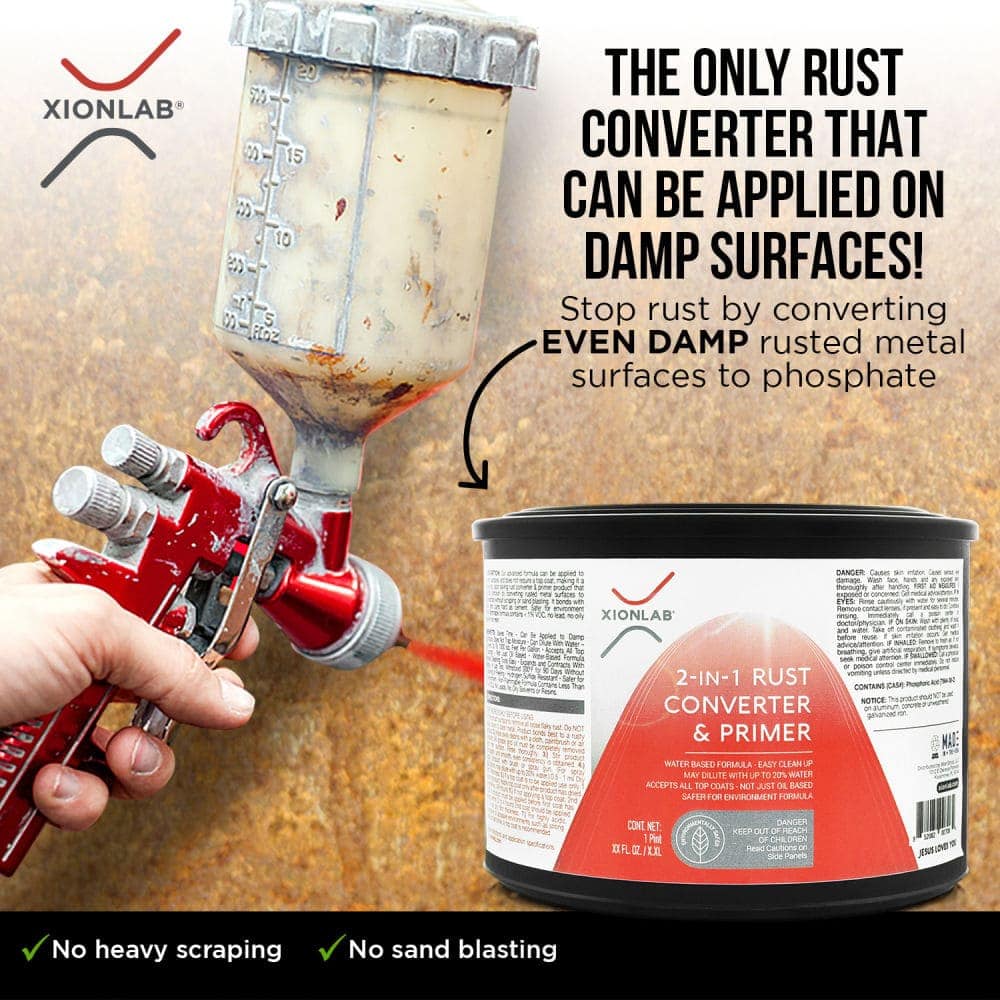
Quick Answer: A water-based rust converter uses tannic acid and a water-carrier polymer to transform rust (iron oxide) into stable ferric tannate, sealing the metal and leaving a paintable black film. Low-VOC formulas like XionLab’s 2-in-1 clean up with tap water, meet the EPA 2025 aerosol-coating limits, and penetrate salt-contaminated steel better than solvent-based competitors. Use on tight, surface-scaled rust — not on rusted-through metal.
A water-based rust converter is a brush-or-spray liquid that chemically changes active rust into a passive, paintable compound. The carrier is water rather than mineral spirits or xylene. And the reactive chemistry is almost always tannic acid, sometimes paired with a phosphate booster. Once the formula contacts iron oxide, the color shifts from reddish-brown to deep blue-black within 15 to 20 minutes on a warm surface.
XionLab’s 2-in-1 Rust Converter & Metal Primer is a good reference formula. It sits in the water-based camp, carries a latex-polymer primer in the same coat, and dries matte black for direct topcoating. No grinding down to bare steel. No solvent fumes. Just a clean conversion step followed by paint.
Want the deeper chemistry? Our write-up on the science of rust converters and primers walks through every electron transfer. For now, here is the short version: rust is unstable and loves to keep growing. Ferric tannate is stable and does not. The converter swaps the first for the second.
The annual global cost of corrosion, per AMPP (formerly NACE) — roughly 3.4% of world GDP. Better corrosion control could save $375–$875 billion a year.
Salt wins every time, though — if you ignore it. Any steel left untreated in the Salt Belt will keep cycling through wet–dry oxidation until the substrate vanishes. A water-based converter buys years of service from parts already showing surface rust, and the water carrier actually penetrates salt residues better than oil-based carriers do.
Here is the reaction sequence in plain language. Iron oxide (Fe₂O₃) is a brittle, porous lattice. Drop tannic acid (C₇₆H₅₂O₄₆, a polyphenol) onto it and the phenolic hydroxyl groups grab hold of the Fe³⁺ ions trapped inside the oxide. The iron pops out. A new organo-metallic complex — ferric tannate — forms in its place.
Ferric tannate is dark blue-black, mechanically tough, and hydrophobic. Not just stable. Bonded. Unlike loose rust, this layer stays locked to the parent steel instead of flaking off. The Canadian Conservation Institute has used the same chemistry on museum iron artifacts since the 1970s.
So why water-based? Three reasons:
And one more practical win: cleanup. Brush, roller, or sprayer — all rinse clean in a minute under tap water. Solvent-based converters demand mineral spirits and a dedicated rag pile.
Fe₂O₃ + tannic acid → Fe-tannate complex + H₂O. Reddish-brown to blue-black in 15 to 20 minutes. Full chemical conversion in 24 to 48 hours. The rust converter Wikipedia article lays out the same sequence if you want a second source.
Both chemistries work. But they behave differently in the field, and the trade-offs matter when you are picking a product for a real job.
| Attribute | Water-Based | Solvent-Based |
|---|---|---|
| Primary Acid | Tannic acid | Phosphoric acid |
| Carrier | Water + acrylic/latex polymer | Xylene, toluene, or mineral spirits |
| VOC Level | Low (EPA-compliant) | Moderate to high |
| Odor | Mild, like latex paint | Strong, fume-heavy |
| Cleanup | Tap water | Mineral spirits |
| Salt-Belt Penetration | Excellent on contaminated steel | Beads off hygroscopic residue |
| Cold-Weather Cure | Slows below 50°F | Handles 40°F more gracefully |
| Topcoat Compatibility | Latex, oil, epoxy — all work | Best with oil/epoxy |
| Indoor Use | Yes, with ventilation | Limited; fume risk |
One coat. Done. That is what the brand promise sounds like, and the 2-in-1 concept leans that way by combining conversion and priming. Still, solvent-based products are not dead — they shine in very cold shops and on oily contaminated parts where water beads up. Our piece on rust converter vs. rust remover explains when each tool belongs in the rotation.
Corroseal works well for lighter surface rust in stable climates. Where XionLab pulls ahead is on crusty, salt-contaminated steel — the kind you scrape off a 2012 Silverado frame in Ohio after eight winters. The tannic-acid/latex combo bites into what is there and skips the grind-to-bare-metal step most phosphoric products still require.
In January 2025 the EPA finalized amendments to the National VOC Emission Standards for Aerosol Coatings. For the first time, “Rust Converter” got its own emissions category, capped at 1.10 reactivity-weighted grams of ozone per gram of product (g O₃/g). All regulated manufacturers had to comply by July 17, 2025.
The practical effect? Most high-solvent phosphoric products were already hugging that limit. Water-based tannic formulas sit comfortably below it. So if you pick up a converter in a California or Northeast hardware aisle today, odds are very high that it is water-based — and the reason is regulatory, not marketing.
Maximum reactivity-weighted VOC (g O₃/g) for rust-converter aerosols under the EPA’s 2025 rule. XionLab’s water-based formula measures well under this ceiling.
Tightening VOC rules also mean fewer headaches for body-shop owners and industrial painters. Ventilation requirements drop. Worker-protection paperwork shrinks. And the product behaves better in a residential driveway, where neighbors notice fumes in a heartbeat.
Sequence is everything. A water-based converter forgives a lot of sloppy prep, but it does not forgive grease, paint, or loose flakes sitting between it and the metal. Here is how we run it in the shop.
Scrape or wire-brush off anything loose. Flakes, peeling paint, mill scale — all gone. Then wipe the surface with a degreaser and let it dry. You are not trying to reach bare steel. You are trying to leave a stable rust layer for the chemistry to convert. A red-Scotch-Brite pad is enough for most jobs.
Stir the converter thoroughly. Brush or roll on a wet, uniform coat — about a quarter-inch thick over heavy rust, thinner on light surface oxidation. Spray works too, but you want the film saturated, not misted. Dry spots equal unconverted rust.
Within 15 to 20 minutes on a 70°F day, the surface shifts from rust-red to dark purple and then to deep black. That color shift is the reaction completing. If you see any reddish-brown still bleeding through after 30 minutes, the coat was too thin. Hit it again.
For pitted or scaled metal, two coats beat one every time. Wait about 40 minutes between coats. The second pass fills micro-pores the first coat missed and builds a thicker ferric-tannate film.
The converter is dry to the touch in about 20 minutes. But full chemical cure takes 24 hours, and some shops wait 48. Do not rush this step. Apply your topcoat (latex, enamel, or epoxy) after the cure window. And yes, you can topcoat straight onto the converted surface — that is the whole point of a 2-in-1 formula.
Pro tip: If you are working outdoors in the Gulf Coast summer, start early. Humidity above 85% slows the water-based carrier’s evaporation and stretches cure times. Cool mornings in the Pacific Northwest? Same story, just with cold instead of moisture.
Let me share a specific job. Last October a buddy brought over his 2014 Toyota Tundra — 134,000 miles, ten Ohio winters, salt-crusted frame rails that looked like corn flakes. We scraped off the loose material with a wire wheel, blew the dust off, and rolled on XionLab 2-in-1 with a cheap chip brush. Two coats, about 40 minutes apart. The rails turned jet black within half an hour of the first pass.
A week later I crawled under to check. The surface felt hard, not chalky. We topcoated with a cheap black enamel and called it done. Six months and one winter later? Still tight. No bleed-through. No fresh orange. Is it a forever fix? No. But it bought the truck another five-to-seven years of frame life for under forty bucks in materials.
The takeaway: on mid-stage rust, a water-based converter plus a cheap topcoat outperforms a $200 professional rust-proofing job nine times out of ten. The chemistry does the heavy lifting. Our deeper write-up on rust converter for automotive protection walks through more vehicle-specific scenarios.
Not every rust job is a good match. But a few scenarios make water-based the obvious pick.
If your project touches any of these, a water-based rust converter is likely the right tool. See our industrial rust converter guide for heavy-duty applications.
XionLab built the 2-in-1 Rust Converter & Metal Primer for the jobs other converters dodge. Six features matter most.
Polyphenolic conversion locks Fe³⁺ ions into stable, non-porous ferric tannate. No residual acid left to attack fresh topcoats.
One application. Converter plus primer in the same coat. The primer cross-links with the tannate film for a unified surface.
Well under the EPA 2025 cap. Indoor-safe. Neighbor-friendly. No solvent fume cloud drifting across the yard.
Proven on boat trailers, davits, and below-deck ironwork. The water carrier cuts through salt residue solvent products cannot touch.
Frame rails, subframes, rocker panels. Brush or spray directly over scaled rust. Topcoat with any enamel or epoxy.
Tap water. Not mineral spirits. Brushes last longer. Rags go in the regular laundry — no fire-hazard pile.
Every tool has a job it cannot do. Being upfront about limits beats overselling every time.
For the edge cases — heavy perforation, chemical stripping, or specialized fasteners — see our surface preparation for rust treatment guide. Good prep is the single biggest predictor of converter performance, and most botched jobs come back to shortcuts at the wire-brush step.
Does a water-based rust converter really stop rust permanently?
It stops the conversion reaction permanently on the converted layer — the ferric tannate is stable and does not oxidize further. But new, uncoated metal behind it can still rust if moisture reaches it. Topcoat every job and you get decades of protection, not months.
Can I apply it over paint?
No. Converter needs direct contact with iron oxide. Scrape or sand back the paint first, then apply to the exposed rust. Topcoat afterward.
How long before I can paint over it?
Twenty-four hours minimum for full chemical cure. Forty-eight is better if you are in a humid or cool environment. The surface feels dry in twenty minutes — but dry is not cured.
Is it safe for indoor use?
Yes, with normal ventilation. Water-based converters emit far fewer VOCs than solvent products. Open a window or run a fan and the odor clears in minutes. Keep kids and pets out of the room during cure.
Will it work on a rust-through hole?
No. Converter treats surface rust on intact metal. A hole needs a weld, panel bond, or fiberglass patch. You can use converter on the surrounding metal before the patch goes on.
What makes XionLab different from Corroseal or Rust-Oleum Rust Reformer?
All three use tannic-acid chemistry. XionLab’s edge is the built-in latex primer and a formulation tuned for heavy Salt-Belt contamination — where the other two tend to underperform. Corroseal is a solid pick for clean surface rust. Rust-Oleum Rust Reformer is fine for light aerosol-touch-up jobs. For crusty frame rails and marine hardware, pick XionLab.
Does temperature affect cure time?
Yes, heavily. At 70°F you get the full conversion in a day. At 50°F, double it. Below 40°F, the water carrier stalls and the reaction barely starts. Warm the part or wait for better weather.
Can I spray it through a standard HVLP gun?
Yes. Thin only if the manufacturer says so — XionLab sprays well straight from the can with a 1.4 to 1.8 mm tip. Clean the gun with water immediately after use.
How does it handle rust on weld seams?
Very well. Tannic acid penetrates the micro-porosity of weld slag and converts whatever iron oxide sits there. Wire-brush the seam first, then apply a slightly heavier coat. Weld seams love the 2-in-1 treatment.
Put XionLab 2-in-1 Rust Converter & Metal Primer to work on your next project — from Salt-Belt frame rails to marine railings. Water-based, low-VOC, and backed by tannic-acid chemistry that turns active rust into a paintable black film.