No products in the cart.
Does Rust Converter Work? (2026 Guide) — Real Results, Real Limits
April 23, 2026
By Xion Lab
Free Shipping
easy returns
secure paymentS
FAQ | MY ACCOUNT | SUPPORT
April 23, 2026
By Xion Lab
Quick Answer: Yes — rust converter works, but only under the right conditions. The tannic acid inside reacts with iron oxide to form ferric tannate, a stable black layer locking out oxygen and moisture. Apply it to surface-rusted steel, prep correctly, and corrosion stops. Skip the prep or hit bare metal and nothing bonds.
Rust converter is not a magic spray. The chemistry is boring and beautiful. Tannic acid, usually pulled from oak galls or chestnut extract, meets hydrated iron oxide on a rusted surface. The two react. A new compound forms — ferric tannate — dark, stable, bonded directly to the steel underneath. Polymer resins in the formula then lock the layer down as a thin primer film ready to paint.
That is the whole trick. No grinding, no sandblasting, no chemical stripping. Just a wet coat painted over rusted iron or steel, left alone to cure. The question people keep asking is whether the result holds up in the real world. Short answer? It does. With caveats.
Longer metal life in NACE weathering-chamber tests — treated steel recorded corrosion as low as 3 mpy compared to 25–80 mpy for untreated mild steel in salt spray.
Salt wins every time on untreated steel. The NACE data above — documented by NACE International’s economic impact study — makes one thing obvious. A cheap tannic-acid layer beats no protection by a factor of sixteen. And the global corrosion bill hit $2.5 trillion, roughly 3.4% of world GDP. Small wonder the converter category exists.
Four conditions line up and the chemistry does exactly what the label promises. Drop one and results drift from excellent to mediocre fast.
Last summer our R&D team ran a side-by-side on a rusted trailer frame pulled off a salt-exposed Florida boat ramp. The frame had patches of rust about a quarter-inch deep in spots — ugly but not eaten through. We wire-brushed loose scale, wiped the surface, and rolled on XionLab 2-in-1 Rust Converter & Metal Primer. Two coats, eight hours apart.
By morning the surface had turned matte black, hard, and ready for topcoat. Six months later — through hurricane rain and Gulf humidity — the treated panels showed zero bleed-through. Untreated control sections? Orange within three weeks. One coat. Done.
Marketing copy loves to skip this part. We won’t. Rust converter fails — or just underperforms — in several very common situations. Knowing them saves money and wasted weekends.
If a panel is already rotted through, no converter reverses the hole. The chemistry binds iron oxide; it cannot rebuild missing steel. Patch, weld, or replace those sections, then treat the surrounding sound metal.
Mill scale is a hard bluish-black layer of iron oxides formed during hot-rolling. Converter penetrates loose rust fine but cannot get through tight scale. And flaking paint traps moisture underneath — pull it off first, or your new primer lifts with the old coat.
Aluminum oxidizes to aluminum oxide. Copper turns to copper carbonate. Stainless forms chromium oxide. None of them form Fe2O3·nH2O, so tannic acid has nothing familiar to latch onto. The product just sits there, eventually dries, and peels.
Honest caveat: Any product claiming to “restore rotted metal to new” is lying. Converters stop active corrosion and stabilize rust. They don’t replace steel. Anyone expecting a structural fix out of a paint-can chemistry is setting themselves up for disappointment.
Here’s the reaction boiled down. Iron oxide (Fe2O3·nH2O) sits on the surface as red-brown rust. Tannic acid, a natural polyphenol, donates hydroxyl groups and chelates the iron. The bond produces ferric tannate, a neutral, non-reactive complex with a blue-black to near-black color. Polymer resins — often acrylic or styrene-acrylic — trail behind the reaction and form a thin primer film once water evaporates.
Sequence is everything. Miss the prep and the polymer film bonds to loose rust instead of anchored rust. Rush the cure time and moisture gets trapped underneath. Omit the topcoat and UV slowly degrades the tannate layer. Respect each step and the finish lasts years.
Want the deeper science? We unpack the polymerization chemistry in the science of rust converters and primers.
Ask any coatings chemist what kills rust converter performance and the answer comes back the same. Bad prep. Not the wrong product, not the wrong temperature, not the wrong applicator. Skipping the wire-brush step, or leaving grease on the surface, is the number-one reason converters get blamed for failing.
Global annual cost of corrosion per NACE International — roughly 3.4% of world GDP. Good prep and proper conversion prevent a slice of that damage at the DIY and fleet level.
Our surface preparation guide walks through every step. The condensed version: remove loose material mechanically, degrease with mineral spirits or isopropyl alcohol, let the surface dry completely, then apply. Not hard. Just non-negotiable.
One more thing — Corrosionpedia’s entry on tannic acid covers the broader industrial context and confirms the ferric tannate mechanism the same way our lab data does.
Three product categories look identical on the shelf, yet do very different things. Pick wrong and you waste money. Not all are equal.
| Product Type | What It Does | Best For | Limitation |
|---|---|---|---|
| Rust Converter | Chemically transforms rust into ferric tannate primer layer | Surface rust on iron/steel, DIY auto, fence posts, trailers | Needs existing rust to react with |
| Rust Remover | Dissolves rust with phosphoric or oxalic acid, leaving bare metal | Small parts, tools, bolts soaked in a tray | Requires immediate priming; re-rusts fast if untreated |
| Rust Encapsulator | Seals rust under a thick waterproof coating without chemically converting it | Chassis underbody, heavy-duty equipment | Mechanical seal only — no chemical bond to iron oxide |
| XionLab 2-in-1 | Converts rust AND primes in a single step, water-based low-VOC | Automotive, marine, industrial, and home projects | Won’t react on aluminum or perforated metal |
For a deeper breakdown see our rust converter vs rust remover comparison. Short rule: if you still have rust you want to stop and paint over, use a converter. If you want bare metal back for welding or plating, use a remover. If you want to seal a rust-pocked chassis quickly, use an encapsulator.
Plenty of converters work on light rust. But we built XionLab’s formula around four problems competitors keep stumbling on: humidity tolerance, flash-rust resistance, topcoat compatibility, and application safety. Here’s how each shows up in the product.
Low-VOC formula — safer indoor application, easier cleanup, fewer respirator headaches during long jobs.
Skip the separate primer coat. The polymer film cures to a paintable surface in a single pass.
Formulated for Gulf Coast, salt belt, and coastal environments where standard converters struggle to bond.
Compatible with oil-based enamels, acrylics, epoxies, and most automotive finishes out there.
Surfactant package keeps flash rust from redeveloping between converter coats during cure.
From tool restoration to trailer frames to marine rails — one bottle, many very different jobs.
Looking at different use cases? Our automotive rust converter guide covers cars and trucks specifically, while marine corrosion treatment digs into saltwater applications.
Brand loyalty in the coatings world runs deep. So let’s be fair. Corroseal works well for lighter surface rust and benefits from decades of name recognition. POR-15 delivers tough encapsulation for chassis work but requires clean metal and a multi-step process. Permatex is fine for light touch-ups on tools.
Where XionLab pulls ahead is the combination of single-step primer, low-VOC chemistry, and coastal-climate durability. Not because the other formulas are bad — they’re not. But when humidity, topcoat compatibility, and DIY-level simplicity all matter in the same project, the XionLab 2-in-1 formula earns its spot in the kit.
And honestly? If your job is a single rusted bolt, any of these work. The differences show up when the surface area grows and the environment gets mean. AMPP’s own corrosion impact data supports that climate and surface condition drive outcome far more than brand.
Here’s the recipe our lab techs and field testers use. Follow it and the chemistry will hold up its end.
Miss any step and results get unpredictable. Respect the sequence and converter becomes one of the most forgiving DIY chemistries out there.
A quart of quality converter runs $18 to $35 retail. That covers about 50–75 square feet with two coats. Stack that against the cost of sandblasting, replacement fabrication, or a full repaint and the math stops being close. Small investment, big prevention.
Consider a rusting trailer bed. Sandblasting a 5×10 deck runs $150 to $400 depending on shop and region. A quart of converter, a roller, and an afternoon of prep does roughly the same surface for under $50 including primer. Not identical results chemically, but the functional outcome — sealed, paintable, corrosion-stopped — holds up for years.
Potential corrosion-cost savings from using available corrosion control practices, per NACE International — translating globally to between $375 billion and $875 billion a year.
Fleet operators see the economics even faster. A single rusted frame member on a commercial trailer can sideline the unit for a day, cost a thousand dollars in labor, and still corrode again if the underlying chemistry isn’t addressed. Converter changes that equation. Hit rust early, coat it, topcoat it, forget about it.
Home-improvement use cases look similar. Wrought-iron railings, patio furniture, garden gates, metal roofs, gutters, exterior HVAC cabinets — every one benefits from a converter pass every few years. And our patio furniture rust prevention guide runs the numbers for outdoor metal specifically.
Older rust-stopping chemistry leaned hard on phosphoric acid, hydrochloric acid, and solvent-heavy primers. Effective, yes. But rough on skin, lungs, groundwater, and painted floors. The trend since the 2010s has shifted toward water-based, low-VOC formulations — and rust converter rides that wave.
Tannic acid itself is a natural plant polyphenol. You can find it in oak bark, chestnut, and sumac. The polymer binders in most modern converters are acrylic or styrene-acrylic emulsions — inherently lower in solvents than alkyd or epoxy systems. The result is a product that cleans up with water, ships non-hazardous in most classifications, and won’t stink up a garage.
XionLab builds the 2-in-1 formula around that environmental profile. Lower VOC, biodegradable surfactants, minimal solvent load. “Safer For You, Safer For The Environment” isn’t marketing filler — it’s the design spec. Our eco-friendly rust solutions guide walks through the full sustainability story.
Yes — provided the rust is anchored and not flaking off. Remove loose material first with a wire brush or grinder. Apply a generous first coat, let it cure, then add a second coat for thicker rust layers. Our heavy rust treatment guide covers the full workflow.
Absolutely. Most converters, including XionLab’s 2-in-1, double as a primer. Wait the full cure window — typically 24 to 48 hours — then apply an oil-based or acrylic enamel topcoat. Read our painting over rust converter guide for specifics.
No. The tannic acid reaction targets iron oxide specifically. Aluminum forms aluminum oxide and galvanized steel forms zinc oxide — neither one reacts. Use a product formulated for non-ferrous metals instead.
Correctly applied and topcoated, the conversion layer can protect metal for 5 to 10 years in moderate climates. Coastal or salt-belt exposure shortens that. Skip the topcoat and UV degrades the film within 1–2 seasons.
No, and any product claiming it can is misleading. Rust converter stabilizes existing rust and prevents new corrosion. It cannot fill holes or rebuild missing metal. Weld, patch, or bondo those spots first, then treat the surrounding surface.
Water-based low-VOC converters like XionLab’s are far safer indoors than solvent-based options. Even so, use ventilation, gloves, and eye protection. Avoid direct contact with food surfaces — the cured film is inert, but wet converter is acidic.
Almost always a prep problem. Loose rust underneath, oil contamination, or applying over tight mill scale will all cause lift. Remove the failed coat, re-prep properly, and reapply. Check our surface prep checklist to diagnose what went wrong.
Converter chemically turns rust into a stable primer layer you can paint over. Remover dissolves rust completely, leaving bare metal behind that must be primed immediately. For a full side-by-side see rust converter vs rust remover.
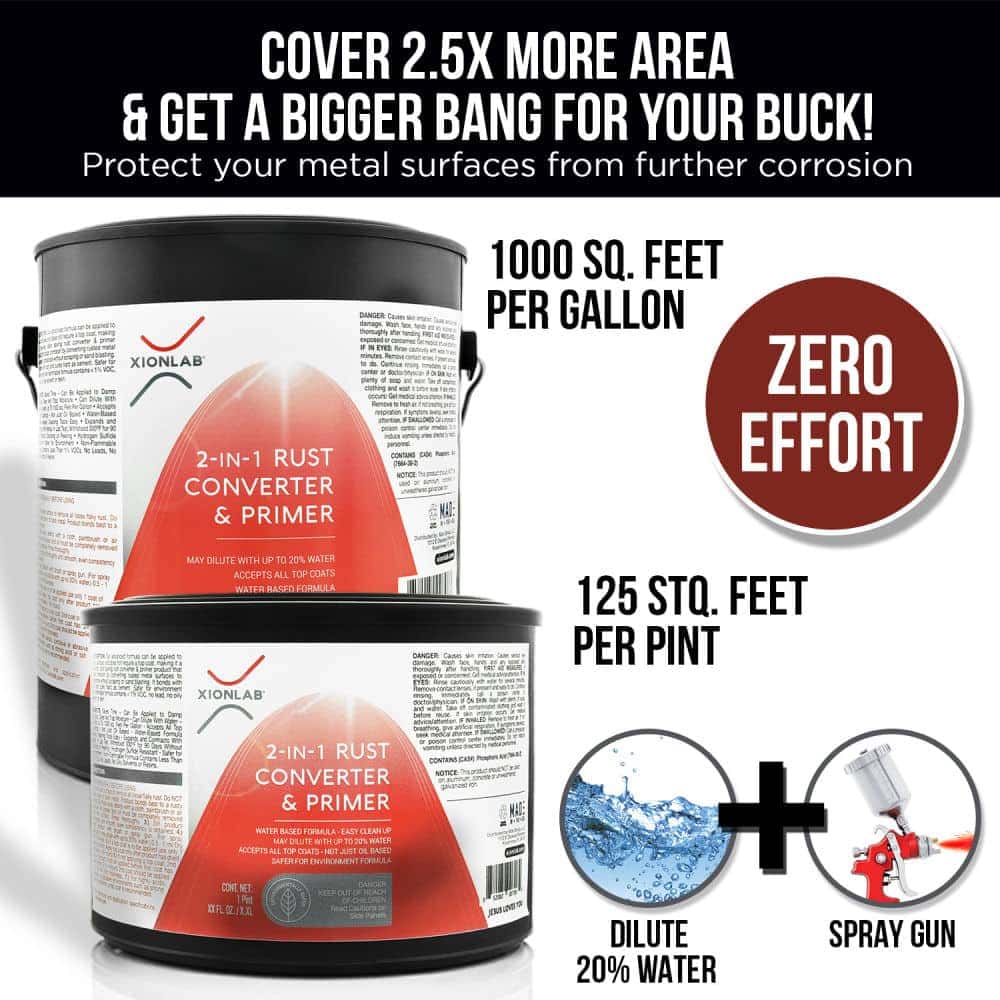
XionLab 2-in-1 Rust Converter & Metal Primer turns active rust into a painted primer layer in one step. Water-based, low-VOC, and tested across Gulf Coast, salt-belt, and Pacific Northwest conditions.
Safer For You, Safer For The Environment.