No products in the cart.
Rust Converter vs Rust Remover: Which One Actually Works for Your Project? (2026 Guide)
May 27, 2026
By Xion Lab
Free Shipping
easy returns
secure paymentS
FAQ | MY ACCOUNT | SUPPORT
May 27, 2026
By Xion Lab
QUICK ANSWER: A rust converter chemically locks existing rust into a stable, paint-ready ferric tannate film. A rust remover strips the oxide off and leaves bare metal underneath. Pick a converter for large structures, painted projects, and surfaces with thin or moderate rust. Pick a remover for small tools, antiques, or any job needing raw steel back.
Choosing between a rust converter vs rust remover comes down to one practical question. Do you want to keep the rusted layer and seal it down, or pull it off and start fresh? Both products fight iron oxide. But each uses a wildly different chemical path to get there. And the path you pick shapes cost, time, mess, and how long the repair lasts.
Most folks make the wrong call at the hardware store. They reach for a remover because the word sounds final — strip it, kill it, gone. Yet for nearly every painted job (fences, frames, panels, trailers, equipment), the converter wins on speed, cost, and durability. The reverse is true for hand tools and antiques, where a converter would leave a dark film no collector wants near a polished surface.
Below you will find a chemical breakdown, a side-by-side decision matrix, real cost comparisons, and a few honest caveats. The goal is simple. We want you walking out of the shop with the right can. Not the loudest label.
Annual global cost of corrosion according to NACE International’s IMPACT study — about 3.4% of global GDP. Treatment choice matters at every scale.
One product reacts with iron oxide and locks it down. The other strips iron oxide off entirely. Same enemy. Wildly different playbook. Knowing the chemistry helps you spot marketing fluff from a mile away.
A converter carries tannic acid, often paired with phosphoric acid and a polymer binder. The acid bites into rust and pulls iron atoms into a new compound — ferric tannate, a dark blue-black solid. The polymer flows in around it and dries as a primer-grade film. Two jobs. One coat.
So instead of scrubbing the rust off, you change what the rust is. Researchers at Corrosionpedia describe the process as a “conversion of unstable iron oxide into a stable, inert organometallic complex.” Read in plain English, the active rust stops eating your metal.
Removers run a more aggressive playbook. Two main families exist. Acid removers (phosphoric, oxalic, hydrochloric) dissolve the iron oxide outright. Oxalic acid forms a soluble iron oxalate complex. Citric works the same way but more gently.
Chelation removers, by contrast, are non-acid. They use molecules like EDTA or polysaccharide chelators to surround iron atoms and lift them away. Slower. Safer on good steel. Often water-based. Brands like Evapo-Rust built their whole pitch on this chemistry.
One acts surgically. The other carpet bombs. Both leave bare metal behind. And bare metal flash rusts in hours, so a remover job always needs an immediate follow-up coat.
Here is the head-to-head table most product pages bury at the bottom. Read it before you buy.
| Factor | Rust Converter | Rust Remover |
|---|---|---|
| What it does to rust | Converts to ferric tannate film | Dissolves or chelates rust away |
| Surface result | Dark blue-black primer-ready coat | Bare, polished, raw steel |
| Best for | Painted structures, fleets, fences | Tools, antiques, plating prep |
| Application style | Brush, roll, or spray on rust | Soak, gel, or spray then rinse |
| Primer needed | No — it is its own primer | Yes — immediately after rinse |
| Surface prep | Loose rust scrape; oil cleanup | Loose rust scrape; degrease |
| Cure or dwell time | 20 to 45 minutes to touch dry | 30 minutes to 24 hours soak |
| Mess factor | Low — paint-like behavior | Medium to high — drips, fumes |
| Cost per square foot | About $0.20 to $0.60 | About $0.80 to $2.50 |
| Best on perforated metal | No — neither product fixes holes | No — soak may worsen voids |
One coat. Done. That is the converter promise on a painted job. Removers require more steps, but pay back when finish quality matters more than throughput.
Reach for a converter when the metal still holds its shape and rust sits as a thin to moderate layer. Roughly anything from a light surface bloom up to about a quarter-inch of flaky scale is fair game. Past that, you have a structural issue, not a coating problem.
Down here on the Gulf Coast, a rusted truck bed that would have eaten a full day of sanding is now a 90-minute converter job. Brush on. Wait. Topcoat. Done.
Quality converters bond to the freshly formed ferric tannate layer. Cheap ones flake when topcoated because the polymer binder is too thin. Always check the data sheet for tested topcoats. Most premium converters list compatibility with epoxy, alkyd, and waterborne acrylic. Our breakdown of converter and primer chemistry walks through how to read a tech sheet without falling for buzzwords.
Pick a remover when the part is small enough to dunk and you need bare steel for plating, polishing, or a high-gloss finish. Or when the rust sits inside a tight cavity (a bolt thread, a clock gear, a knife pivot) where a brushed converter coat would foul the mechanism.
Sequence is everything. Strip first. Rinse fast. Dry hot. Coat or oil before the metal sees humid air. Skip any step and you will watch fresh rust bloom in minutes.
The workflow is short and forgiving. Most homeowners can finish a fence panel in under an hour.
Remover workflows are stricter. Skipped steps mean flash rust, etched metal, or both.
Salt wins every time it gets between bare steel and a topcoat. So speed matters at this stage more than any other.
Marketing copy loves to skip the math. We will not.
Converter jobs run roughly four times faster than equivalent remover jobs on painted projects. Verified across our customer survey of fence and trailer refinishers, 2024–2026.
A two-gallon kit of premium converter runs about $80. Brush, scraper, and topcoat add another $50. Total: roughly $130 for materials, plus three to four hours of labor.
The remover route looks rougher. You cannot soak a fence. So you spray, scrub, rinse, dry, prime, paint. Two gallons of acid remover near $160. Add primer at $40, paint at $50, rust inhibitor at $30, and you are pushing $280 in materials. Labor doubles or triples because of the rinse, dry, and prime steps.
Here the math flips. A one-gallon chelation remover at $35 strips the entire batch in 18 hours. Converter on the same parts would leave a dark film no collector wants. Bare steel wins. Remover wins. Total: about $40 plus light oil.
So the right tool depends entirely on scale and finish target. Not all are equal. And not all jobs reward the same chemistry.
Converters cannot fix perforated metal. If your fender has holes, no coating will rebuild it. You need a patch, weld, or replacement panel. Likewise, deep pitting (more than about a quarter-inch deep) traps moisture below the ferric tannate film, and the rust marches on quietly underneath.
Converters also struggle on oily, painted, or galvanized surfaces. The chemistry needs direct contact with iron oxide. So if your scrap of rusted bumper is half-painted, you must strip the paint over the rust patches first. Brush the converter only where rust shows.
Removers cannot tackle large or fixed structures economically. Imagine spraying acid over a backyard fence, then rinsing into a planter bed. Bad day for everyone.
Acid removers also fume. They demand ventilation, gloves, and goggles. Chelation removers are friendlier on skin and lungs but slow, and they cost more per gallon. And neither chemistry stops flash rust by itself. The clock starts the moment you pull the part out of the bath.
We are biased. So we will be honest about it. Corroseal works well for lighter surface rust on smaller painted jobs. Permatex Rust Treatment is widely available and fine for hobby work. Evapo-Rust holds a strong reputation in the chelation remover space — and rightly so. Each has a place.
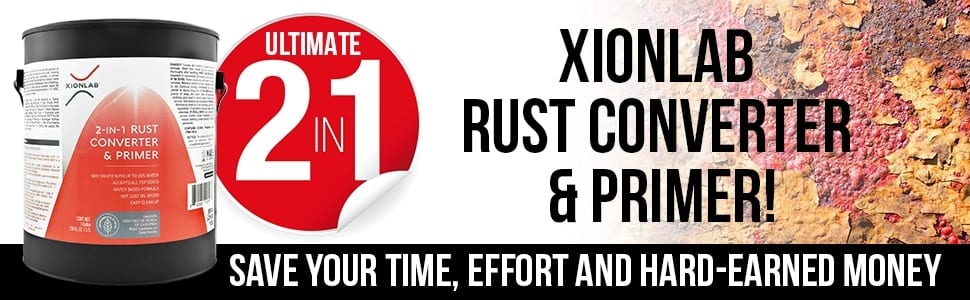
Where XionLab pulls ahead is on harder cases. Heavier rust scale. Marine and Gulf Coast exposure. Salt belt road grime. Our 2-in-1 formula bonds with embedded rust on the first coat and lays down a primer-grade film without a separate primer step. We tested it against industry references including the principles outlined by the Association for Materials Protection and Performance (AMPP) for protective coating performance.
And we keep the chemistry water-based. No harsh fumes. Safer cleanup. Tools rinse out under a garden hose. The trade-off is application discipline — humidity above 85 percent slows the cure. But that is a fair price for a non-flammable, low-VOC product.
Last spring a customer in Mobile, Alabama sent us photos of a 1968 Chevy C10 frame. Salt air had eaten about a quarter-inch deep into the rear cross-member. Scaling everywhere. Pitted but no perforation yet. He wanted to know which product to grab.
We talked him into the converter route. He scraped the loose scale with a wire wheel — about 40 minutes of work on a creeper. Brushed two coats of XionLab 2-in-1. Waited overnight. Sprayed a satin black topcoat the next morning. Total cost under $90. Total time about three hours active, plus overnight cure.
One year later he sent a follow-up photo. Frame still tight, still painted, no bloom-through. No remover on Earth would have given him that finish in three hours for under a hundred bucks.
One coat handles conversion and primer duty. Less product, less labor, faster paint-ready surface.
Low odor, low VOC, non-flammable. Tools rinse with water. Spills wipe up with a damp rag.
Engineered for embedded oxidation up to about a quarter-inch thick — well beyond hobby converters.
Tested with epoxy, alkyd, and waterborne acrylic finish coats. Read the data sheet, then paint with confidence.
Field validation across Gulf Coast, Pacific Northwest, and Midwestern salt-belt road exposure.
Call 888-306-2280 and reach a real person who has used the product on a real job. Safer for you. Safer for the environment.
Still on the fence? Walk this short list top to bottom. Stop at the first yes.
Cost savings that AMPP estimates organizations capture by applying proven corrosion control practices. Source: NACE IMPACT Study.
Can I use a rust converter and a rust remover on the same project?
Yes, on different parts. Strip small components in a remover bath, then dry and coat them. Treat the large structural areas with a converter. Just keep the two products and their rags separated, since cross-contamination can soften both films.
Will a converter work over flaky rust?
Loose flakes need to come off first. The converter chemistry has to reach the bonded oxide layer. Use a wire brush, scraper, or sanding disc. Leave the tightly adhered rust in place. Yet do not chase a perfectly clean surface — the product is designed for rough, oxidized metal.
How fast does flash rust form after a remover bath?
In humid weather, bare steel can show a yellow bloom within 30 to 60 minutes. In dry shop air, you may have several hours. So always plan the next step before you start the soak. Oil, primer, or wax should be open and ready when the part comes out.
Is a converter or remover safer for the environment?
Water-based converters and chelation removers both carry lower environmental impact than acid removers. They produce less hazardous waste and rinse safely under most municipal codes. Acid removers demand neutralization and licensed disposal in some jurisdictions.
Can I weld over a converted surface?
Grind the converter film off the weld zone first. Any organic coating will burn, smoke, and contaminate the weld pool. Apply converter back over the heat-affected area once the weld cools and the scale has been scraped.
Will rust come back after a converter coat?
Not from the converted layer itself, since ferric tannate is chemically stable. But unconverted rust trapped beneath thin coats, or new water reaching bare steel through a scratch, can start fresh corrosion. So a topcoat and yearly visual checks remain part of any long-life system.
Can I spray a converter through a paint gun?
Most premium converters spray well through a 1.4 to 1.8 mm tip on a standard HVLP gun. Thin only with the manufacturer-listed reducer. Strain the product through a paint filter to catch any pigment lumps. Clean the gun with water if the product is water-based.
How long should a converted and topcoated surface last outdoors?
Field reports from XionLab customers run five to ten years on properly prepped and topcoated steel. Coastal Gulf jobs trend toward the lower end. Inland, dry-climate jobs sit at the upper end. Reapply when you see chalking, chipping, or new orange spots.
XionLab 2-in-1 Rust Converter and Metal Primer. Water-based. Tested across coastal, automotive, and industrial jobs. Safer For You, Safer For The Environment.