No products in the cart.
What Is the Best Rust Converter? (2026 Guide) — Pick the Right Formula and Stop Corrosion Cold
May 27, 2026
By Xion Lab
Free Shipping
easy returns
secure paymentS
FAQ | MY ACCOUNT | SUPPORT
May 27, 2026
By Xion Lab
A field-tested comparison of tannic acid, phosphoric acid, and dual-chemistry rust converters for metal — plus how to pick the one a real corrosion pro would use on your project.
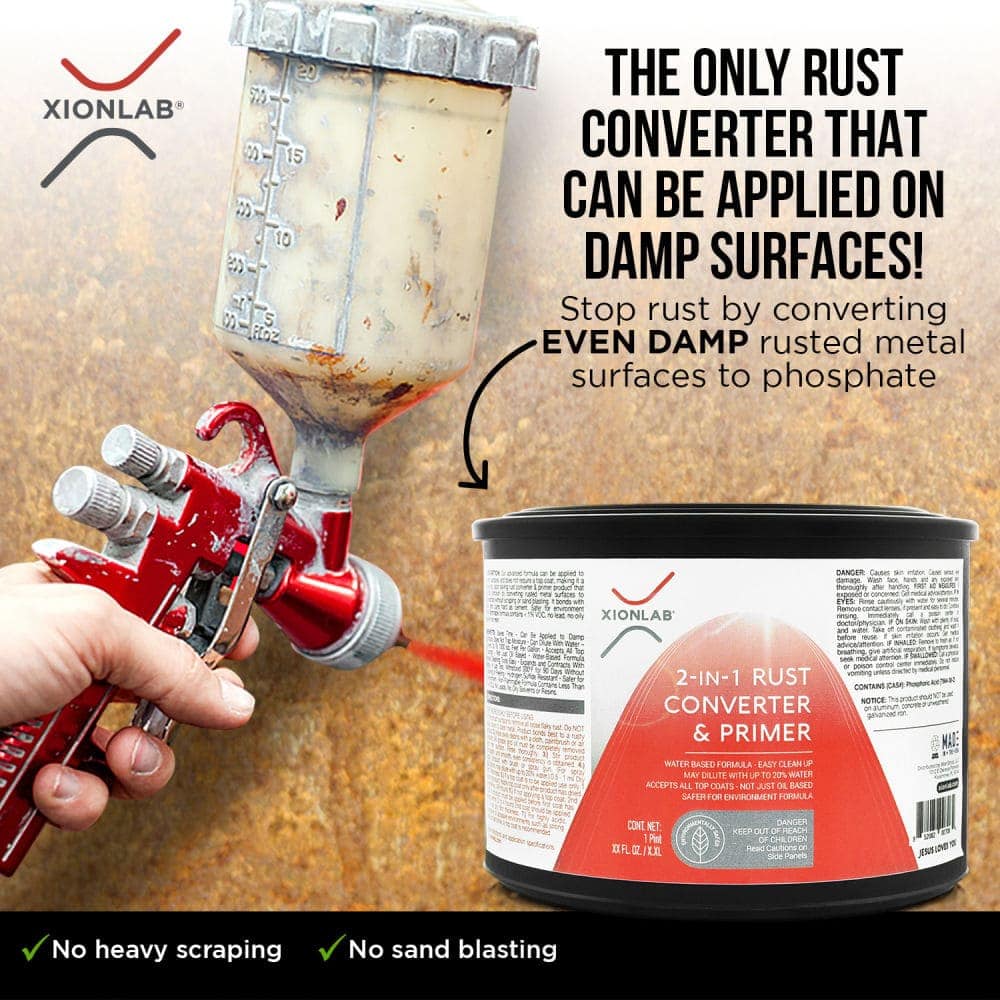
Quick Answer. The best rust converter is a dual-chemistry, water-based formula combining tannic acid and a polymer film, applied to a wire-brushed surface in two thin coats. For most weekend projects on weathered metal, XionLab 2-in-1 Rust Converter and Metal Primer wins because it locks the iron oxide into a ferric-tannate film and primes the panel in one pass.
Walk into any hardware aisle. You see ten cans with nearly identical labels. All promise to kill rust. None of them explain how. The difference between a fence rail still solid in 2031 and one flaking off in eighteen months sits inside those bottles — and most buyers never look past the label.
And here is the trap. Cheap rust converters rely on phosphoric acid alone, which leaves a chalky iron phosphate crust easy to chip off. Premium formulas pair tannic acid with a polymer binder. The tannic acid chelates ferric iron into stable ferric tannate. The polymer locks it down. Two reactions. One thin film. Far more durable.
So the real question is not which brand. The real question is which chemistry suits your metal, your climate, and your topcoat plan. According to NACE International's IMPACT study, corrosion costs the global economy roughly $2.5 trillion a year — about 3.4% of global GDP. Most of that loss is preventable with the right surface treatment.
Picking a rust converter feels like a small decision. The downstream impact is large. A wrong pick wastes a Saturday afternoon, a topcoat layer, and roughly the same amount of money. A right pick adds five to seven years of service life to fence rails, trailer beds, equipment frames, garden furniture, and tool boxes. Same active ingredient. Same brush. Different outcome — entirely chemistry-driven.
Annual global cost of corrosion, per the NACE IMPACT study — roughly 3.4% of global GDP.
Last spring my brother-in-law parked his open utility trailer behind his shop in Mobile, Alabama, about a mile from the bay. Salt air. Humidity in the high eighties most afternoons. Within six months the deck rails grew a fuzz of orange oxide about a quarter-inch deep in the worst pockets. He wanted a rust converter on a Saturday afternoon. No sandblaster. No budget for re-fabrication.
We wire-brushed the loose flakes off with a cup wheel and a respirator. Took maybe ninety minutes. Then I rolled on two thin coats of XionLab 2-in-1 with a foam roller — about an inch of overlap on each pass. By Sunday morning the orange was gone. In its place, a uniform deep blue-black film, slightly satin, ready for topcoat. Eighteen months later that trailer still hauls bait coolers up the Gulf Coast, and the rails look the same as the day we finished.
The lesson? Sequence is everything. Brush. Convert. Topcoat. Skip any step and salt finds the gap.
Not every job ends that clean. On a 1968 truck frame with perforation around the spring hangers, the same product slowed corrosion but could not rebuild missing steel. Honest admission: no rust converter can. If the metal has holes, you weld first and convert second.
Iron oxide forms because iron atoms shed electrons to oxygen in the presence of water. The resulting Fe₂O₃ has roughly seven times the volume of the original steel — which is why rust flakes, blisters, and spreads. A rust converter does not remove this oxide. It transforms the chemistry of the oxide so corrosion cannot continue underneath.
Tannic acid comes from oak bark, chestnut hulls, and grape skins. Each molecule carries phenolic hydroxyl groups arranged like tiny claws. Those claws grab Fe³⁺ ions inside the rust lattice and pull them into a fresh molecule: ferric tannate. Deep blue-black. Hydrophobic. Mechanically stable enough so moisture cannot push through it the way moisture pushes through loose oxide. Peer-reviewed corrosion science shows ferric tannate films deliver substantially better long-term protection than phosphate-only conversions on real-world steel substrates.
Phosphoric acid attacks loose oxide and deposits iron phosphate crystals on the steel beneath. The phosphate layer has dramatically lower ionic conductivity than the rust it replaced. By itself, phosphoric chemistry leaves a chalky white crust easy to wipe off with a thumb. Useful as a pre-treatment. Not a finish.
The best formulas — including the science behind XionLab's primer — combine both acids and bind them inside an acrylic polymer film. You get conversion, passivation, and a paintable surface in one coat. Twenty-four hours later, ready for topcoat.
Pricing varies by region and pack size. The matrix below ranks formulas by chemistry depth, not brand loyalty. Salt-belt drivers and Gulf Coast homeowners typically want the dual-chemistry row. Light surface rust on a patio chair? The phosphoric row may do.
| Formula Type | Active Chemistry | Topcoat Needed? | Best Use Case | Typical Cure |
|---|---|---|---|---|
| Phosphoric Only | H₃PO₄ | Yes — required | Light surface oxidation, garage tools | 30–60 min |
| Tannic Only | Tannic acid | Recommended | Decorative metal, ornamental work | 4–8 hours |
| Dual-Chem Water Base | Tannic + Phosphoric + Polymer | Optional — primer included | Automotive, marine, trailers | 24 hours |
| Solvent-Based Converter | Acid + xylene carrier | Yes | Industrial, low-temp jobs | 2–4 hours |
| Aerosol Spray | Varies | Yes | Touch-up only, small spots | Quick |
Honest take. Corroseal works well on lighter surface rust. Where XionLab pulls ahead is on heavily oxidized panels, in marine air, and on substrates needing a paintable surface without a separate primer.
Most weekend buyers grab whichever can sits at eye level. Bad move. Flip the bottle. Read the back panel. A serious rust converter declares its active acid, its solvent base, and its dry-to-recoat window.
Estimated savings achievable through proper corrosion control, per NACE — between $375 billion and $875 billion annually worldwide.
No rust converter, however premium, can bond to loose flakes. Sequence is everything. Brush first. Convert second. Topcoat third. Skip the brush and you trap powder under the polymer film. Two months later the topcoat lifts in sheets.
Use a knotted wire wheel on a 4.5-inch grinder for heavy oxidation. For lighter rust, a hand brush or 80-grit pad does fine. Knock off any chunks of flake larger than a fingernail. The surface does not need to be bare. A thin orange dust is acceptable — the acid will eat that layer in seconds.
Wipe the panel with denatured alcohol. Skip mineral spirits or kerosene. Oily carriers leave a residue blocking tannic acid from contacting the iron. Let the alcohol flash off for ten minutes before applying the converter.
Apply between 50°F and 90°F. Relative humidity below 75% is ideal. In Gulf Coast or Pacific Northwest conditions, work in the morning before the dew burns off the metal — or wait until the panel feels warm and dry to the touch. Salt wins every time you ignore the weather.
Tannic acid plus phosphoric acid, balanced in a single can — no mixing, no two-part chaos in the garage.
Acrylic polymer binder leaves a paintable surface. Skip the separate primer step and save a working day.
Safer for you and the environment. No solvent smell. Cleans up with soap and water. Indoor-shop friendly.
Tested on Gulf Coast trailers and salt-belt vehicles. Holds through humid summers and brine-soaked winters.
Topcoat with oil-based enamel, latex, or epoxy. Flexible chemistry. No exotic primer required to lock it in.
Manufactured stateside since 2015. Family-run formulation lab. Real chemists answer the support line.
One coat. Done. Almost true. Two thin coats beat one heavy coat — better penetration, more uniform color change, fewer holidays. The goal is wet contact with the oxide, not a thick puddle.
For automotive frames, see our guide to rust converter for automotive protection. For boats, trailers, and dock hardware, the marine corrosion playbook walks through salt-air-specific prep.
Real talk. No rust converter rebuilds missing metal. If you can push a screwdriver through the panel, weld first or replace the part. Conversion buys time on thinned steel. Conversion does not restore structural integrity. Trailer tongues, frame rails, and load-bearing brackets need a welder, not a brush.
Other situations where conversion underperforms:
For a deeper read on conversion versus removal, see rust converter vs rust remover — the two products solve different problems, and mixing them up wastes both.
Material cost is the easy number to compare. Total job cost matters more. Factor in primer skipped, sandblasting avoided, and topcoat compatibility. The cheap can on the bottom shelf almost always costs more by the time you finish.
| Approach | Material Cost | Labor Hours | Effective $/sq ft | Lifespan |
|---|---|---|---|---|
| Sandblast + Primer + Paint | $1.20 | 3.0 | $8.40 | 5–8 yr |
| Wire-brush + Cheap Converter + Primer + Paint | $0.85 | 2.0 | $5.65 | 2–3 yr |
| Wire-brush + Dual-Chem 2-in-1 + Paint | $0.95 | 1.5 | $4.55 | 5–7 yr |
| Encapsulation Coating Only | $1.40 | 1.0 | $5.40 | 4–6 yr |
Numbers above assume DIY labor at $20/hour. Shop labor pushes every line item higher. So the cheaper material picks save pennies and waste hours. Our chemistry deep-dive covers why the dual-chem approach pulls labor out of the equation.
Pickup-truck restorers, trailer fleet managers, and fence contractors run the math constantly. Three years of weather can turn a fresh paint job into peeling chaos if surface prep used the wrong product. A converter on the front end pays back across the topcoat lifecycle. Brand-honest competitor note: Permatex 81849 and Loctite Naval Jelly remain decent picks for tiny touch-ups, yet neither offers the polymer film build needed for an exterior topcoat sequence on a full panel.
Salt-belt residents in Michigan, Ohio, and upstate New York routinely report converter-treated frames outliving the rest of the chassis. Gulf Coast boat owners get similar results on trailer tongues and outriggers. Pacific Northwest gardeners use the same chemistry on wrought-iron gates. One converter. Different climates. Same blue-black film.
For automotive frames exposed to road salt, pick a dual-chemistry water-based converter with built-in primer. XionLab 2-in-1 handles thick rust on undercarriages and accepts oil-based topcoat. Solvent-based aerosols can work on small spots but lack the film build needed for full-frame protection.
A converted surface holds up exposed for roughly 30 days before UV degradation begins. Apply a topcoat within that window for full warranty performance. Indoors and out of sunlight, the ferric tannate film can sit longer — but airborne contaminants still settle on it.
No. Scrape and sand back to bare oxide before applying. The acid needs direct contact with iron rust. Painting over an old finish blocks the chemistry. Spot-treat exposed rust areas only, then feather the topcoat back into the surrounding paint.
Yes, but with limits. The acid penetrates pits and converts surface oxide inside them. Voids and perforations still need welding or filler. Pitted steel below about 50% original thickness is a structural concern — convert and topcoat for cosmetic preservation, but plan for replacement.
Modern water-based formulas like XionLab match or exceed solvent versions on corrosion resistance. Polymer technology closed the gap a decade ago. Solvent products still win on cold-weather application below 50°F and faster flash times in industrial settings.
Both work. Use an HVLP gun with a 1.4mm tip for water-based formulas. Reduce viscosity with about 5% distilled water if the spray pattern shows orange peel. Brush and foam roller still deliver the best film build on rough, pitted steel.
Deep blue-black, almost like graphite. A purplish-charcoal tint also appears. If the surface stays orange, the acid did not contact enough oxide — clean the area, sand lightly, and reapply. Color change is your built-in indicator the chemistry worked.
Let the can dry out fully, then dispose with regular trash. Cured tannic-acid film is inert. Liquid converter can go to municipal hazardous waste days. Do not pour it down drains — the polymer can clog plumbing, and the acid carrier upsets septic systems.
Yes, if it touches them. Mask chrome, brass, polished aluminum, and glass with painter's tape. Overspray on chrome leaves a haze etching that buffs out but takes effort. Better to mask once than to polish twice.
Tannic-acid chemistry. Built-in primer. Marine-grade hold. Made in the USA since 2015.