Uncategorized
Rust Converter for Farm Equipment: Protect Tractors, Implements & Grain Machinery (2026 Guide)

Quick Answer — A rust converter for farm equipment chemically transforms iron oxide on tractor frames, attachment hitches, and tillage blades into a stable, paintable compound — no sandblasting required. Apply it after mechanically descaling detached laminations, let it polymerize for 24–48 hours, and topcoat. A 2-in-1 converter and metal primer handles both steps in a single pass, cutting field downtime during planting and harvest seasons.
Farm Equipment Rusts Faster Than Almost Anything Else You Own
Tractors, combines, disc harrows, feed augers — they live outside for months at a stretch. Morning dew coats clean steel by 6 AM. Fertilizer dust settles into crevices and draws dampness in. Manure splatter is acidic enough to chew through OEM primer in a single growing cycle if nobody washes it off. And in the Midwest, where humidity lingers above 70% from May through September, unshielded iron doesn’t just oxidize. It scales. Fast.
The financial hit is real. According to NACE International (now AMPP), global corrosion costs exceed $2.5 trillion per annum — roughly 3.4% of global GDP. Agriculture absorbs a outsized share because equipment operates in wet, chemically hostile environments with minimal climate control. Mississippi State Extension estimates maintenance expenditures at 2–4% of purchase price per year for tractors, and corrosion intensifies those costs considerably when left untreated.
But here’s what most agricultural publications skip: a $30 gallon of rust converter, brushed onto susceptible spots during pre-season prep or autumn sheltering, can stave off thousands in structural damage. No welding rig. No body shop. Just chemistry deployed on your behalf.
Estimated annual global cost of corrosion — agriculture absorbs a disproportionate share due to outdoor exposure, chemical contact, and minimal climate protection (NACE/AMPP Cost of Corrosion Study)
Where Farm Equipment Rusts First — and Why It Matters
Rust doesn’t attack evenly. Certain zones on agricultural machinery fail years before the rest of the machine shows any wear. Knowing where to look saves you from discovering a crumbling crossmember during planting week.
Tractor Chassis and Loader Mounts
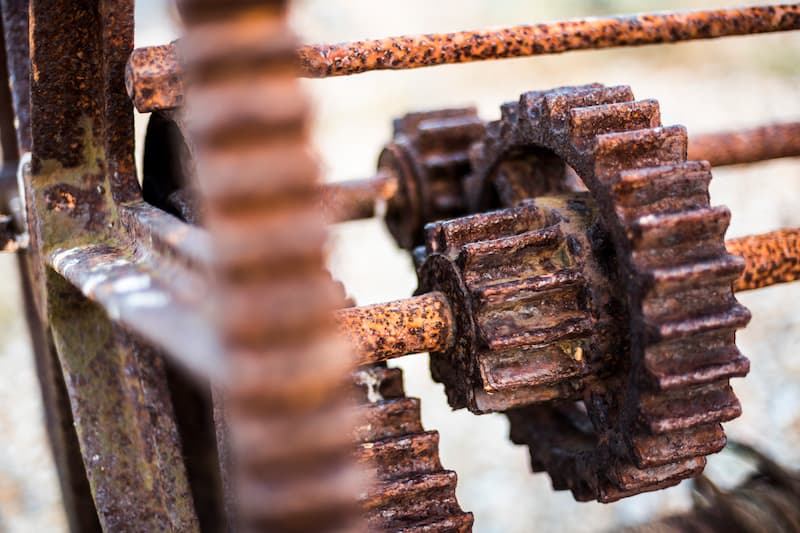
The main longitudinal rails on a mid-range tractor sit low. They catch mud, manure, and standing water after every downpour. Loader mount brackets take relentless stress, and any crack in the paint becomes a corrosion ingress point. Once oxidation takes hold behind a bracket, it creeps underneath — invisible until the weld fractures. Dangerous territory.
Three-Point Hitch Arms and Drawbars
Hitches get scraped every time you hook up an implement. Raw steel exposed by scratches starts oxidizing within hours in humid air. Most operators never repaint these surfaces — they just accept the orange and move on. Risky gamble. A hitch arm undermined by deep oxidation can snap under load. Catastrophic failure.
Disc Blades, Cultivator Sweeps, and Tillage Points
Soil is abrasive. Every pass through a field strips coating from working edges. High-high-carbon alloy blades develop pitting rust fast, especially in acidic clay soils common across the Southeast. Some of this is expected attrition. But pitted blades drag harder, burn more diesel, and break sooner.
Grain Auger Tubes and Hopper Bottoms
Moisture trapped inside crop-handling equipment is treacherous. A combine hopper left with residual grain after harvest holds moisture all winter. By spring, the bottom panels look like Swiss cheese. Prevention is uncomplicated. A fall cleanup routine and a layer of converter pays for itself ten times over. Neglect runs pricier.
Hydraulic Line Brackets and Wiring Harness Clips
Small, easy to overlook. But corroded brackets loosen, hydraulic lines abrade against sharp rust edges, and a ruptured line during haying window means a $400 repair and a squandered afternoon. Five minutes with a stiff bristle brush and converter during winter service forestalls all of it.
- Frame rails and crossmembers — mud traps moisture against bare steel for days at a time
- Hitch points and PTO shields — constant mechanical scraping exposes fresh iron
- Implement blade edges — soil abrasion strips factory coatings within one season
- Grain-handling interiors — residual moisture creates hidden corrosion during storage
- Battery trays and electrical mounts — acid spills and galvanic reactions accelerate rust
- Exhaust systems and heat shields — thermal cycling cracks paint and accelerates oxidation
Rust Converter Chemistry — What Happens on the Molecular Level
A rust converter contains tannic compound and a polymeric binding agent in a water or solvent carrier. When the tannic acid contacts iron oxide (Fe₂O₃), it reacts to form ferric tannate — a dark, chemically stable compound bonded directly to the remaining viable metal. The polymeric binder then cross-links over the converted matrix, creating a moisture barrier and a surface ready to accept topcoat.
The interchange is exothermic. You’ll see the surface darken within 15–20 minutes on a warm day. Full conversion takes longer — 24 hours minimum, 48 in cold or damp conditions. Rushing it traps unreacted oxide underneath and the coating over time blisters. Patience matters here more than brand selection. Don’t rush this part.
What a converter won’t do: rebuild metal eaten all the way through. If a disc blade has lost material thickness or a frame member flexes when you push on it, no chemical treatment restores load-bearing capacity. You’re looking at replacement, not conversion. Honest limitation. Worth knowing before you buy.
For a deeper explanation of the tannic acid reaction and how primer bonding works at each stage, see our guide on the science of rust converters and primers.
Choosing a Rust Converter for Agricultural Use
Not every converter handles agricultural conditions. Fertilizer residue, manure acids, and prolonged UV exposure demand more from a formula than treating a backyard gate. Here’s how the main product categories stack up for agricultural applications.
| Product Type | Best For | Limitations | Farm Suitability |
|---|---|---|---|
| Water-based converter | Light surface rust on tool handles, fencing | Poor penetration on heavy scale; not ideal for reagent exposure | Low — fine for hand tools only |
| Phosphoric acid converter | Moderate rust on frames, brackets, hitches | Creates iron phosphate (slightly less stable); needs separate primer | Medium — requires two-step process |
| 2-in-1 converter + primer | Heavy scale on tractor chassis, implements, trailers, grain machinery | Costs more per gallon; overkill for surface-only rust | High — one-step, handles punishing exposure |
| Spray-can converter | Quick touch-ups on brackets, bolts, small areas | Low film build; not economical for large surfaces | Supplemental only |
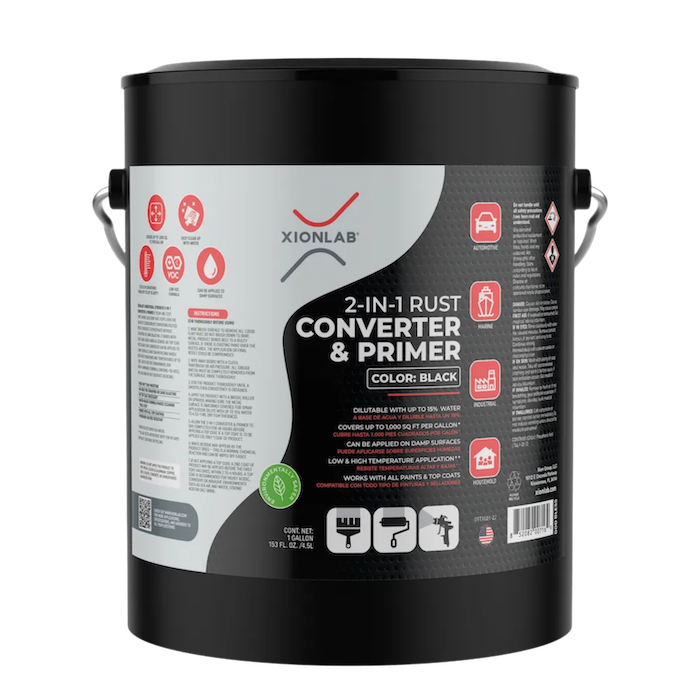

XionLab 2-in-1 Rust Converter & Metal Primer — available in Black and Red formulas. One gallon covers 200–250 sq ft on heavy rust.
Corroseal and Ospho both handle moderate rust reliably — Corroseal applies thick and covers well on flat panels, while Ospho’s thinner formula penetrates crevices better. Where XionLab’s 2-in-1 Rust Converter and Metal Primer pulls ahead is the combined conversion-and-priming stage. On a 40-foot attachment frame with maybe 200 square feet of surface area, eliminating the distinct primer coat saves two to three hours of elbow grease and a full day of reaction window. During early-season fieldwork, those hours matter. Efficiency wins.
How to Apply Rust Converter on Farm Equipment — Step by Step

The workflow is straightforward, but the sequence is non-negotiable. Skip a step and the formula either won’t bond or won’t cure correctly.
- Step 1 — Pressure wash the equipment. Strip mud, manure, nutrient residue, and grease. A 2,500 PSI washer handles most of it. Let the machine dry for at least roughly four hours minimum — overnight works better. Trapped moisture under a converter coat causes blistering.
- Step 2 — Mechanically remove loose scale. A wire wheel on an rotary grinder is the fastest approach for tractor frames. Use a knotted abrasive cup disc for confined nooks around brackets and weld seams. Needle scalers work well on hopper interiors. Don’t grind to virgin metal — the converter needs rust to react with. Leave the tenaciously bonded oxide layer intact.
- Step 3 — Degrease every surface. Acetone, brake cleaner, or a robust citrus degreaser. Farm equipment collects hydraulic oil mist, diesel soot, and chain grease in places you wouldn’t expect. Grease blocks the tannic acid reaction altogether. No exceptions.
- Step 4 — Apply the initial coat generously. Brush or roll on large flat areas. Use an airless sprayer for complex geometry like implement skeletons, auger housings, and undercarriages. One gallon covers roughly 200–250 square feet on profoundly corroded surfaces. Watch the color shift from rust orange to dark brown or black within 20 minutes.
- Step 5 — Apply a successive layer on severely scaled areas. Wait until the first coat is tacky but not entirely polymerized — usually 1–3 hours depending on temperature. Heavy scale on belly pan sections and hitch tongues almost always needs two passes.
- Step 6 — Cure for 24–48 hours before topcoating. Temperature matters. Below 50°F, the reaction slows dramatically. Plan converter work for a warm, dry stretch. In the upper Midwest, late April or early October usually gives you the best window.
- Step 7 — Topcoat with solvent-borne or epoxy paint. Latex and water-based paints don’t bond well to ferric tannate. Chassis paint, machinery enamel, or rubberized undercoating all work. For equipment exposed to fertilizer and chemical splash, epoxy overcoat is worth the extra cost.
Average annual repair cost as a percentage of purchase price for farm tractors — corrosion damage drives these costs higher when frame and structural components go untreated (Mississippi State Extension)
When to Treat — Spring Prep vs. Fall Storage
Timing a rust converter deployment around the farming calendar is half the battle. Do it wrong and you’re either delaying fieldwork or losing the weather window entirely.
Spring: Pre-Season Inspection and Spot Treatment
After winter sheltering, walk every machine with a flashlight and a pick. Probe any rust you find. If the pick digs in more than an eighth of an inch, you’re past surface rust — plan for two converter coats and budget extra cure time. Focus on hitch points, loader arms, and any frame area where snow melt pooled inside a shed. Quick spot treatment takes an afternoon. Beats discovering a fractured chassis rail halfway through corn planting. Prevention wins every time.
Fall: Full-Coverage Storage Protection
This is the real opportunity. After harvest, before equipment enters its winter storage, is the ideal window for a full converter application. Machines are still warm from use — the molecular changeover runs faster on warm metal. You have weeks instead of days. And a suitably converted and overcoated surface endures five to six months of winter storage without fresh oxidation.
Kansas wheat farmers and Minnesota corn growers both face the same arithmetic: three to four hours of converter work in October prevents three to four days of emergency rust repair in April. And crisis interventions during planting season always cost more — parts on expedited shipment, technicians booked solid, acreage accumulating.
For guidance on preparing metal surfaces before any treatment, see our surface preparation for anti-corrosion care guide.
What We Saw on a Central Illinois Grain Operation

Last fall, a grain farmer outside Champaign, Illinois asked us about treating the undercarriage on a 15-year-old Case IH combine header cart. The tube-steel chassis had maybe a sixteenth-inch of scale on the bottom rails — not perforated, but well past the orange-film stage. Road salt from highway transport between fields had accelerated the damage.
Previous attempt: two cans of a spray-on converter from the hardware retailer. Covered maybe 30 square feet before depleted. The treated spots looked okay for a couple months, then started flaking. Too thin. Not enough product reaching the pitted areas.
Second attempt with XionLab’s dual-action formula: power-brushed the frame, degreased with acetone, brushed on two generous coats over a Saturday span. Total material consumed — about three quarts for the entire cart understructure and tongue assembly. Cured over a warm October stretch. Topcoated Monday morning with implement enamel.
Result after one complete harvest campaign plus winter storage: converted surface still solid. No flaking, no fresh orange showing through. Total cost for product and paint — under $80. The quote from a local fabrication shop to sandblast and repaint the same assembly? Over $900.
How XionLab Protects Farm Equipment
XionLab has built rust conversion chemistry since 2015 around a guiding philosophy: one product, one application, real protection in brutal conditions. Agricultural use is one of the harshest evaluations for any converter formula — and the areas where our 2-in-1 approach matters most. For industrial and large-scale applications, also see our industrial rust converter guide.
Built for Heavy Scale
Penetrates deep pitting and layered oxide on implement assemblys, auger tubes, and undercarriages on tractors — where milder aqueous converters fall short.
One-Step Conversion + Primer
Converts rust and leaves a primer-ready surface in a single coat. Skip the separate primer step — save two to three hours per machine during spring prep or autumn storage.
Low VOC, Safer Formula
Water-based carrier with minimal volatile organic compounds. Safe for use inside equipment sheds without heavy-duty respiratory protection. Safer for you, safer for the environment.
Chemical Resistance
The ferric tannate layer resists agrichemical splash, manure acid, and diesel fuel contact better than unconverted or bare-metal primer surfaces.
Wide Temperature Range
Works from 50°F to 100°F ambient — covers the spring and fall treatment windows in most U.S. farming regions without special conditioning.
Coverage Economy
One gallon covers 200–250 sq ft on heavy rust. Most machinery frames need a gallon or less, making full-machine treatment a $30–60 material cost.
Five Errors That Wreck Converter Results on Farm Machines
1. Skipping the power wash
Fertilizer salt residue on a tractor frame is invisible after it dries. But it’s hygroscopic — it pulls moisture right through a converter coat. Always pressure wash and let dry entirely before treatment. Zero shortcuts here.
2. Applying converter to greasy metal
Hydraulic oil mist coats equipment surfaces over a season of fieldwork. One fingerprint of grease is enough to block the tannic acid reaction in a two-inch circle. Degreasing takes ten minutes. Redoing a botched application devours an entire day.
3. Treating in cold weather
Below 50°F, the chemical reaction barely progresses. We’ve seen farmers try to squeeze in a treatment on a 40-degree November morning in South Dakota. Surface turned patchy gray instead of dark black. Had to strip and redo it the following spring. Monitor the forecast. Warmth is mandatory.
4. Using latex topcoat
Latex paint peels off ferric tannate within a few months. Oil-based enamel, alkyd, or epoxy bonds to the converted surface and flexes with thermal cycling. So does rubberized undercoating for belly pans and underbody panels. Latex is fine for barn walls. Terrible for iron.
5. Expecting miracles on perforated steel
A converter stabilizes existing rust. It does not rebuild missing metal. If a disc harrow frame has rusted through — light shining through the tube wall — you need a welder and new steel, not a bottle of converter. Being candid about boundaries saves both time and dollars.
Rust Converter for Farm Equipment — FAQ
Can I use rust converter on a tractor frame without sandblasting first?
Yes — a converter is designed to react with the rust already on the metal. Wire-brush loose scale and flakes so the product reaches the solid oxide layer underneath. You don’t need to grind down to bare steel. Sandblasting is overkill for converter application and actually self-defeating, since the product needs iron oxide to bond with.
How much rust converter do I need for a full-size tractor?
A mid-range workhorse typically has 80–150 square feet of treatable area. At roughly 200–250 sq ft per gallon (on heavy rust), one gallon handles most tractors with formula to spare. A combine header cart or large implement superstructure may take two gallons for thorough two-coat coverage.
Will fertilizer or manure damage a converted surface?
The ferric tannate layer resists mild chemical exposure better than bare metal or plain primer. But prolonged contact with ammonium nitrate or acidic slurry will eventually degrade any coating. Apply a premium overcoat over the converted surface, and wash equipment after fertilizer or manure contact whenever practical.
Is rust converter safe to use inside an equipment shed?
Water-based formulas produce minimal fumes. Open the shed doors, run a fan for adequate draft, and wear nitrile gloves plus safety glasses. XionLab’s formula is low-emission and doesn’t require a respirator in a ventilated space. Acid-based converters demand more caution — check the label for specific PPE requirements.
Should I treat new equipment or only older machinery?
New equipment with intact factory coatings doesn’t need a converter. But watch scratch points — loader mount areas, hitch contact zones, and any spot where an attachment scrapes the paint. Touch up exposed metal without delay with converter or paint. Preventing rust from starting is always cheaper than treating it later.
How long does rust converter protection last on farm equipment?
With a proper oil-based or epoxy topcoat, expect three to five years of solid protection in typical agrarian service. Equipment stored indoors over winter and washed after chemical exposure lasts longer. Machines left outdoors year-round in Gulf Coast or Pacific Northwest humidity may need touch-up every two to three years.
Can I spray rust converter on disc blades and tillage points?
You can, but soil abrasion will strip any coating from cutting edges within a few passes through the field. Converter is most effective on non-contact members — blade hubs, support arms, and chassis members. Treat the structure, not the cutting edge. Blades are consumable parts; frames aren’t.
What’s better for farm equipment — rust converter or rust remover?
Converter wins for almost every agricultural application. Removers require full submersion or heavy application to strip rust to bare metal — unpragmatic on a 20-foot implement frame. Converters work in place, don’t require bare-metal results, and leave a protective barrier. Removers are better suited for small parts like bolts, chains, and hardware you can soak in a bucket. For a full comparison, see our rust converter vs. rust remover guide.
Does XionLab work on galvanized surfaces with failed zinc coating?
Where the zinc layer has worn through and bare steel is exposed and rusting — yes. The converter reacts with the iron oxide in those patches. Intact galvanized surfaces don’t need treatment, and the converter won’t bond to them (zinc isn’t iron). Focus application on the rusted spots only.
Protect Your Equipment Before the Next Season Starts
XionLab’s 2-in-1 Rust Converter and Metal Primer converts active rust and builds a primer substrate in a single session — less downtime, less labor, and protection built for the field conditions your equipment actually faces. Formulated since 2015 for serious rust on serious surfaces.
Safer For You, Safer For The Environment