
No products in the cart.
Can You Paint Over Rust Converter? (2026 Guide)
The honest answer on topcoating rust converter safely — compatible paints, cure windows, and the sequence actually holding up outdoors across every climate zone.
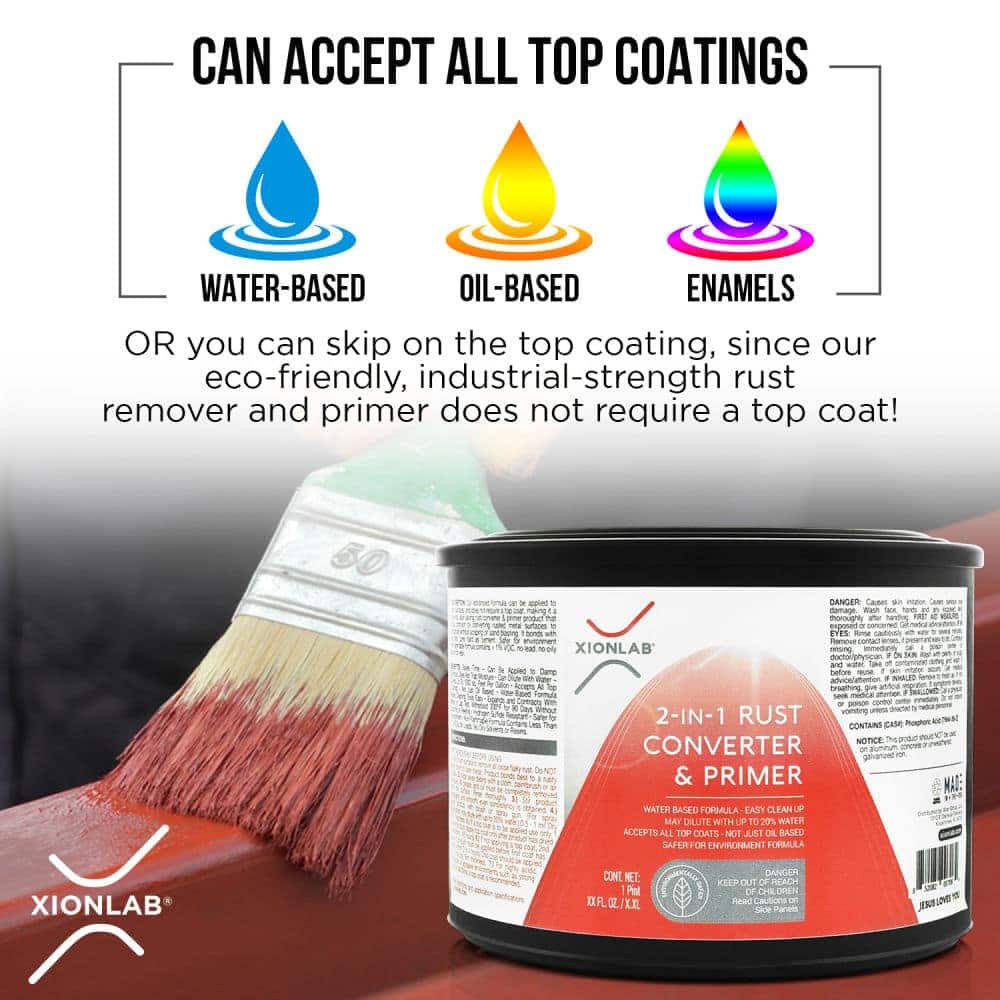
QUICK ANSWER: Yes, you can paint over rust converter — once it fully cures. Oil-based and epoxy topcoats bond beautifully. Latex and water-based paints fail fast. Wait a full 48 hours after the final converter coat, wipe the surface with a damp cloth, then apply your topcoat.
The Short Answer
Yes — But the Sequence Decides Whether It Holds
You can paint over rust converter. So why do so many projects peel within a season? Sequence.
Rust converter turns iron oxide into iron tannate — a stable, inert black layer sometimes called the phosphate-tannate complex. But iron tannate alone is not truly waterproof. Leave the converted surface exposed on a Gulf Coast dock piling or a Midwest salt-belt undercarriage and moisture eventually finds a pathway through microscopic gaps. A proper topcoat locks the converted layer in, shielding it from UV, humidity, chlorides, and road salt.
And here’s the part most DIY folks miss. The type of paint and the timing both matter. Skip either step and the topcoat blisters, peels, or fails adhesion tests before the first summer ends.
Sequence is everything.
Our XionLab 2-in-1 Rust Converter & Metal Primer was engineered specifically around this exact sequence. The polymer carrier doubles as a primer, so an oil-based or epoxy topcoat can go right over the cured film without a separate primer step. That means fewer layers, shorter project timelines, and better adhesion because fewer transition zones fail.
The Chemistry
How Rust Converter Creates a Paint-Ready Surface
To understand why you can paint over rust converter, and why certain paints stick while others slide off, look at what happens at the molecular level.
Rust is iron oxide — loose, porous, and hungry for more oxygen. Converter products contain tannic acid (or phosphoric acid in some formulations) plus a polymer carrier, usually a styrene-acrylic or a proprietary resin blend. When the liquid hits rust, the acid reacts with iron oxide molecules. Out comes iron tannate — black, stable, chemically inert, and far less reactive than what it replaced.
The polymer carrier then cures into a thin protective film right on top. Under a scanning electron microscope the film looks like a sealed mat of interlocking chains with the tannate complex woven in. For a deeper chemistry breakdown, see our guide to the science of rust converters and primers.
$2.5T
Annual global cost of corrosion, per the NACE IMPACT study — roughly 3.4% of global GDP. Proper topcoating over converter products is one of the cheapest prevention steps available.
Here’s why this matters for topcoating. The polymer film ends up mildly hydrophobic and chemically similar to an alkyd or oil-based primer. An oil-based topcoat, which also builds on alkyd chemistry, dissolves slightly into the polymer surface on application and creates an intermolecular bond — not just a mechanical grip. Epoxies cross-link through a different pathway, but the polymer layer accepts the amine cure just fine. Latex is the odd one out. Its water carrier beads on the hydrophobic film and never forms the same chemical handshake. So it fails adhesion.
Cure Windows
The 48-Hour Cure Window Most People Get Wrong
Want to know the single biggest reason paint peels off rust converter? Painting too soon.
The surface turns black within about 20 minutes. Looks done, right? Not quite. The full chemical conversion of iron oxide to iron tannate takes a full 48 hours at 70°F and 50% relative humidity. Drop the temperature or spike the humidity and the window stretches even longer.
- Touch dry: around 20 minutes — do not paint yet
- Second converter coat (if needed): wait 24 hours from the first
- Full chemical cure: 48 hours minimum before oil-based or epoxy topcoats
- Cold-weather extension: add 24 hours for every 10°F below 70°F — this is non-negotiable in the Pacific Northwest or Upper Midwest
- High-humidity caution: above 85% RH, stop work altogether — the tannic acid can’t react efficiently in saturated air
I learned this one the hard way a few years back on a trailer frame project in coastal Georgia. I rolled on a fresh coat of rust converter, waited about 24 hours — felt dry, looked fully black — and slapped oil-based enamel over it. Six weeks later, driving through some Atlantic splash zones, the topcoat came off in flakes about a quarter-inch thick in places. The converter underneath had never finished curing because the humidity ran in the mid-80s the entire time I worked. Since then, 48 hours minimum, and I actually check a weather app before starting.
Patience pays.
FIELD TEST: Before topcoating, press a piece of clear packing tape firmly onto the cured converter and pull it off sharply. If any black residue transfers to the tape, the surface is not ready. Wait another 12 hours and try again.
Paint Compatibility
Which Paints Bond and Which Ones Fail
Not all paints are equal. The right topcoat over rust converter looks simple in principle but gets technical in practice. Here’s a field-tested breakdown.
| Paint Type | Bond Quality | Best Use Case | Notes |
|---|---|---|---|
| Oil-based enamel | Excellent | Outdoor metal, trailers, railings | Gold standard — dries to a hard, flexible film |
| Alkyd industrial enamel | Excellent | Machinery, agricultural equipment | Heavy-duty version of oil-based |
| Two-part epoxy | Very good | Marine, industrial, chemical exposure | Slight bond reduction vs. bare steel — still strong |
| Direct-to-metal (DTM) acrylic | Fair to poor | Indoor, dry environments only | Skip this for outdoor work |
| Latex house paint | Poor — will fail | Not recommended | Water-based formulas bead on the polymer film |
| Water-based acrylic | Poor — will fail | Not recommended | Same issue as latex |
| Polyurethane (oil-based) | Very good | High-wear surfaces, flooring | Needs the full 48-hour cure below it |
| Rust-Oleum Protective Enamel | Excellent | Most exterior metal | Consumer favorite — dries hard and flexes well |
Why does oil-based enamel top the chart? Because its carrier solvent softens the polymer surface just enough to create an intermolecular bond. Latex doesn’t do this. The water in the carrier actually repels from the hydrophobic polymer, and the paint ends up sitting on top like a sticker — peeling the first time moisture gets under an edge.
One coat. Done. That’s the goal with quality oil-based enamel over a properly cured XionLab base layer.
Compare this to competitor approaches. Corroseal works reasonably well for lighter surface rust in mild conditions — it’s a solid budget option. Where XionLab pulls ahead is in the primer-ready polymer layer, which eliminates the separate primer step. Permatex Rust Treatment converts well but requires a dedicated primer before topcoating, adding a day and another product to your project. Fertan uses tannic acid chemistry similar to ours but tends to need a longer cure window in cold climates.
Step-by-Step
The Complete Paint-Over Workflow
Here is the workflow I follow on every rust converter project, regardless of substrate or climate. Nothing fancy — just proven steps in the right order.
Step 1 — Mechanical Rust Removal First
Before the converter ever touches metal, knock off all loose scale, flaking rust, and oil contamination. A wire brush, sandpaper (80–120 grit for most work), or a flap disc on an angle grinder gets this done. Aim for a surface where the remaining rust is tightly bonded — you should not be able to scrape it off with a fingernail. Skipping this step is the second most common failure mode after skipping cure time. For a deeper dive, see our surface preparation for rust treatment guide.
Step 2 — Degrease Thoroughly
Any oil, wax, or silicone contamination will ruin the conversion reaction. Wipe with mineral spirits or a dedicated metal-prep solvent. Let it flash off for ten minutes before the converter goes on. Salt-contaminated metal (coastal boats, winter vehicles) needs a fresh-water rinse and full drying first.
Step 3 — Apply Rust Converter
Brush, roller, or airless sprayer — all three work. Skip the pump garden sprayer; the atomization is too coarse and leaves runs. Apply a wet, even coat. Most converters cover around 500 square feet per gallon on moderately textured metal. The surface goes black in about 20 minutes. Don’t touch it yet.
Step 4 — Decide on a Second Coat
On heavy rust or deeply pitted metal, a second converter coat 24 hours after the first dramatically improves coverage and durability. Brush it on just like the first. Wait another 48 hours after the second coat.
Step 5 — Wipe and Inspect
Just before topcoating, wipe the surface with a damp (not wet) lint-free cloth to lift residual tannic acid film. Let it air dry — about 15 minutes. Run the tape test mentioned earlier. No residue means go.
Step 6 — Apply Topcoat
Two thin coats beat one thick coat every time. Oil-based enamel or epoxy is the call here. Follow the paint manufacturer’s recoat window, usually 4–6 hours between coats for enamel and 6–8 for epoxy. Full final cure on the paint itself runs 7 days.
15–35%
Potential cost savings on corrosion damage through proper prevention practices — translating to $375 billion to $875 billion annually worldwide, per AMPP. Topcoating rust converter is textbook prevention.
Why XionLab
How XionLab Helps You Get It Right
Here’s what makes our 2-in-1 rust converter and primer different from legacy converters, and why the topcoat sticks better over XionLab than over single-purpose products.
⚗
Dual Chemistry
Tannic acid converts the rust while the polymer carrier lays down a paint-ready primer in a single application. Two products in one can.
🌿
Low VOC Formula
Water-based core chemistry keeps VOC emissions low. Safer for you, safer for the environment — the tagline is not marketing fluff.
⏱
Fast Cure Timeline
Touch dry in 20 minutes, full cure in 48 hours at room temp. Most projects wrap up in a single weekend start to topcoat.
🔗
Oil & Epoxy Compatible
The cured polymer accepts oil-based enamels, alkyds, and two-part epoxies without a separate primer. Less product, stronger bond.
🌊
Marine & Coastal Ready
Engineered for the salt-heavy conditions of marine corrosion protection work — boat trailers, dock hardware, bilge areas.
🚗
Automotive Grade
Trusted by DIY restorers and body shops alike for automotive rust protection. Stops creep under fresh paint.
Regional Realities
Climate Matters More Than the Product Label Admits
No rust converter performs identically across every climate zone. Humidity, temperature swings, and chloride exposure change the math.
Gulf Coast and coastal Florida — constant salt air and summer humidity in the 80–95% range. Converter needs the full 48-hour window, maybe 72, and an oil-based or epoxy topcoat is mandatory. I have seen trailer frames last eight years down there with a proper sequence. The same trailer with latex over converter? About 14 months.
Salt belt states — think Ohio, Pennsylvania, Michigan, New York. Road salt and brine pre-treatment are brutal on undercarriage steel. Epoxy topcoat over converter gives the best long-term protection. Oil-based enamel works too, but plan on touch-ups every 3–4 years.
Pacific Northwest — lower salt, but persistent rain and cool temps extend the cure window. At 55°F and 75% RH, the 48-hour rule stretches to about 72 hours. Run the tape test before you paint, always.
Southwest dry regions — Phoenix, Las Vegas, inland California. Rust itself is less aggressive here, but UV is the enemy of any unpainted converter film. Topcoat within a week of cure to prevent UV chalking and polymer breakdown.
Our automotive-specific rust converter guidance digs into salt-belt undercoating strategies in more detail.
Honest Limitations
Where Paint Over Converter Still Fails (Be Honest With Yourself)
No rust converter — ours included — is a miracle product. Here are the scenarios where painting over the cured film will still disappoint, and what to do instead.
- Perforated metal: If rust has eaten completely through the substrate, converter cannot restore material. Weld or patch the hole first, then treat.
- Active water intrusion: A leaky seam that still admits water will fail any coating. Fix the leak first. Always.
- Loose rust substrate: Converter binds only to tightly adhered rust. If you can flake rust with a fingernail, more prep is required.
- Contaminated surfaces — oil, grease, or silicone residue blocks the conversion reaction. Degrease completely before application.
- Frozen or near-frozen metal: Below 50°F, the tannic acid reaction slows drastically. Applying in cold weather causes incomplete conversion and weak topcoat adhesion.
- Saltwater submersion zones: Below-waterline marine hardware needs a dedicated marine epoxy or two-part marine coating system — converter alone is not enough for constant immersion.
Honest product comparisons matter here. POR-15 makes an extremely durable direct-to-metal coating that many professionals swear by, especially for chassis work — but it also requires strict surface prep and costs more per square foot. Hammerite’s rust beater is easy to apply but doesn’t convert existing rust the way a true tannic-acid converter does. Each product has its lane. XionLab fits best where you want conversion plus primer in one application, and plan to topcoat with oil-based or epoxy paint.
Salt wins every time without a topcoat.
Deeper Reading
Rust Converter vs. Primer — Do You Still Need Both?
One of the most common questions we get: if a rust converter already acts as a primer, is a separate primer ever needed? Usually no, with a proper 2-in-1 product. But there are edge cases.
If the topcoat is a specialty industrial finish — some polyurethane topcoats, specific military-spec CARC paints, or certain powder coatings — the manufacturer may require a specific tie-coat primer for warranty compliance. Always check the paint technical data sheet before skipping primer.
On highly pitted or deeply textured surfaces, a high-build primer after the converter can help level the surface and reduce the finish coat count. This is more about aesthetics than adhesion.
And on parts seeing aggressive chemical exposure — think agricultural sprayer booms or chemical plant piping — an intermediate coat like a zinc-rich primer between the converter and topcoat adds a galvanic sacrificial layer. It’s overkill for a backyard fence. It’s not overkill for a fertilizer tank. For more background, see our understanding rust and corrosion fundamentals guide.
For a broader look at the corrosion cost problem and prevention economics, industry resources at AMPP.org and Corrosionpedia are both worth bookmarking.
FAQ
Frequently Asked Questions
How long should I wait before painting over rust converter?
A minimum of 48 hours at 70°F and 50% relative humidity. Add 24 hours for every 10°F below 70°F. In high-humidity coastal zones, stretch the wait to 72 hours to be safe. The tape test confirms readiness — press packing tape firmly onto the cured surface, pull off, and check for any black residue transfer.
Can I use latex or water-based paint over rust converter?
No. Latex and water-based acrylics bead on the hydrophobic polymer film left by most converters and fail adhesion almost immediately. Stick with oil-based enamel, alkyd industrial enamels, or two-part epoxy for anything exposed to outdoor weather.
Do I need a separate primer between converter and topcoat?
Typically no with a proper 2-in-1 product like XionLab’s. The cured polymer layer acts as a primer surface. Exceptions apply for specialty industrial finishes, pitted surfaces needing a high-build primer for leveling, or chemical-exposure environments where a zinc-rich intermediate adds galvanic protection.
What happens if I paint too early?
Topcoat adhesion fails. Either the paint peels in sheets within weeks, or it blisters as trapped reaction byproducts off-gas through the fresh film. If this happens, you are stripping it all back to bare metal and starting over. Patience saves hours.
Can I spray paint over rust converter?
Yes — provided the spray paint is oil-based or solvent-based enamel. Most premium aerosol enamels (Rust-Oleum Protective Enamel, Krylon Rust Tough, Dupli-Color) work well. Water-based spray paints do not. Apply in thin passes, let flash, and build coverage over 2–3 coats.
Does rust converter work on aluminum or galvanized steel?
No. Rust converter chemistry reacts specifically with iron oxide on ferrous metals (steel and iron). Aluminum corrodes to aluminum oxide, galvanized steel to zinc oxide. Both need different chemistry. Use converter only on iron and steel with active rust present.
Will rust converter hold up on a marine application below the waterline?
Not alone. Constant saltwater immersion requires a dedicated marine epoxy or polyurethane coating system over the converter. Above-waterline boat hardware, trailers, and dock fittings do fine with a proper XionLab base plus oil-based or epoxy topcoat.
How much does the paint-over-converter approach save versus full rust removal?
For most DIY projects, converter plus topcoat runs roughly 30–50% less in labor and product cost compared to media blasting to bare metal and applying a full three-coat industrial system. On heavy industrial work, the calculus shifts — blasting and a top-shelf epoxy system may last longer. Match the method to the asset.
What is the best brush or roller for applying rust converter?
For brushing, a natural bristle brush works with solvent-based formulas; synthetic bristle with water-based formulas like XionLab. For roller work, a 3/8-inch nap woven polyester cover handles smooth steel. Ditch foam rollers — they disintegrate in the acid chemistry and leave fragments in the finish.
Ready to Lock In a Paint-Ready Rust Fix?
XionLab’s 2-in-1 Rust Converter and Metal Primer — engineered for a clean paint-over workflow across every climate zone.
Safer For You, Safer For The Environment