Rust converter
When to Use a Rust Converter on Metal: A Project by Project Decision Guide (2026 Guide)
When to Use a Rust Converter on Metal: A Project-by-Project Decision Guide (2026 Guide)
A practical, project-by-project decision framework for choosing between rust converter, abrasive removal, or a full panel replacement on automotive, marine, and outdoor metal.
Quick Answer: Use a rust converter on metal when the base steel is still structurally sound, the rust is flaky-to-moderate (not perforated), and you can scuff off loose scale before brushing. Skip the converter and reach for grinding, welding, or a fresh panel if you can push a screwdriver through the surface or if wall thickness has dropped below 80 percent. A rust converter like the XionLab 2-in-1 transforms iron oxide into a stable iron tannate-phosphate film and primes the surface in a single coat.
The Three Questions That Settle It Fast
Every rust job starts at the same fork. Do you treat, grind, or replace? Most weekend warriors freeze at this point, then default to whatever YouTube told them last. We use a simpler test on every truck frame, deck rail, and snowblower chassis we restore.
Ask these three questions before you crack open a single can. Is the base metal still solid under the flakes? Can you mechanically remove loose scale to expose tight, active rust? Will the finished part live in an environment a converter can handle? Answer yes to all three, and a converter is almost always the cheapest fix on the table.
Answer no to any of them and you need a different plan. A converter cannot rebuild missing steel. It also will not bond to a glossy, untouched factory finish. And it struggles when the panel sits in standing brackish water for months on end.
- Is the base solid? Tap with a hammer. Bright ring means sound steel. A dull thud or crunch means perforation hiding under scale.
- Can you prep it? A wire wheel and 80-grit pad should knock loose flakes off in under ten minutes per square foot.
- Will the topcoat survive? Garage-kept tools tolerate almost any finish. Salt-belt undercarriages need urethane or epoxy over the converter.
Pass all three, and the next 30 minutes will save you weeks of body work. The chemistry behind converters explains why this prep step matters so much: the acids need rust to react with, but they also need clean rust, not a layer of oily grime sitting on top.
Project-by-Project Use Cases (Where Converters Shine)
Some projects practically beg for a converter. Bolt-in parts. Welded assemblies. Anywhere disassembly costs more than a respray. Here’s where we reach for the XionLab 2-in-1 first and ask questions later.
Automotive frames and undercarriage steel
Frame rails, control arms, leaf-spring perches, and rocker pinch welds all live a brutal life. Salt, sand, brake dust, road tar. You cannot media-blast a frame without dropping the body. So you brush off the loose scale, mask the brake lines, and coat the rest. We did this on a 2007 F-150 frame in upstate New York last winter, and the converted sections still look factory-fresh after about eighteen months of plow runs.
For deeper guidance on car-specific work, see our companion piece on rust converter for automotive protection. It walks through frame-by-frame masking, drain holes, and topcoat selection.
Patio furniture and outdoor sculpture
Wrought-iron chairs, tube-steel tables, mailbox posts, sculpture welds. These items rust because they live outside without a topcoat refresh schedule. The metal is sound. The rust is shallow. A wire brush and a converter coat will give you another five to seven years of service, easy.
Gulf Coast homeowners report the toughest cases. The combination of salt spray and high humidity will eat through cheap powder coat in two seasons. A converter base coat under a marine urethane handles that punishment far better than refinish-and-pray.
Marine hardware above the waterline
Trailer frames, transom plates, davit posts, fishing-pier railings. Submerged steel is a different problem. Splash-zone steel is exactly what converters were built for. Atlantic-coast boat owners we work with treat their tongues and crossmembers every spring and avoid the cycle of strip, prime, paint, repeat.
Tools and shop equipment
Drill press tables, vise jaws, bandsaw frames, lathe ways. Inherited tools come caked in light surface rust from basement storage. A converter wipes them clean and primes them in one shot. See our tool-specific rust converter guide for application tips on mating surfaces and precision parts.
When Not to Use a Rust Converter
Honest answer time. A converter is not magic. It fails in a handful of common scenarios, and ignoring those limits will burn through your weekend and your wallet.
Skip the converter and reach for a grinder, welder, or replacement panel if any of these apply to your job.
- Perforated metal. A screwdriver pushed through a quarter panel means structural loss. No converter fills holes.
- Frame rails below 80 percent wall thickness. Cut, patch, and weld. NACE and AMPP guidelines treat this as a structural repair, not a surface treatment.
- Aluminum or galvanized substrate. Converters react with iron oxide. Aluminum corrodes to a different oxide entirely. Galvanized parts have a zinc coating, not iron.
- Stainless steel pitting. Stainless rusts via chloride attack on chromium oxide. Different chemistry. Use a passivating gel instead.
- Sealed assemblies. If you cannot reach the rust mechanically, you cannot guarantee the converter touched all the iron oxide.
- Submerged steel. Continuous immersion in salt water needs a sacrificial anode and barrier coating, not a converter alone.
Reality check: A converter buys time and saves labor. It does not restore lost metal, and it will not save a rocker panel already showing daylight from below.
Why Rust Converters Actually Work (Chemistry in Plain English)
The mechanism is older than most people think. Phosphoric and tannic acid chemistry dates back to 19th-century iron treatments for ship hulls and railway bridges. The modern formulation has been refined for ease of use.
Two reactions happen at the same time. Tannic acid grabs ferric iron (Fe³⁺) and locks it inside a stable, blue-black tannate complex. Phosphoric acid converts loose iron oxide into iron phosphate (FePO₄), a dense crystalline film with dramatically lower ionic conductivity. A peer-reviewed study published in Advances in Materials Science and Engineering found that a 3 percent tannic plus 10 percent phosphoric blend produced the most chloride-resistant film, which matters in coastal and salt-belt environments.
NACE International's landmark IMPACT study (a figure widely reported across industry sources) put the global cost of corrosion at roughly $2.5 trillion per year, or about 3.4 percent of world GDP. Rust converters are one of the lowest-cost interventions on that ledger.
So why does the surface change from rust-red to gray-black within minutes? You are watching the conversion in real time. The tannate complex absorbs visible light differently than iron oxide does. The color shift is your chemistry timer.
And here is what most product labels gloss over: the reaction never finishes if the rust layer is too thick. A pancake of loose flakes traps the acid above the active iron, leaving an unreacted core that fails inside a year. That is the single biggest field-failure pattern we see. A deeper look at converter chemistry covers this in microscope detail.
Rust Severity Decision Table
Use this table the next time you stare down a rust patch and cannot decide. It maps the visible damage to the right tool, and it matches AMPP standards for surface preparation classes.
| Rust Severity | Visual Cue | Recommended Treatment | Expected Lifespan |
|---|---|---|---|
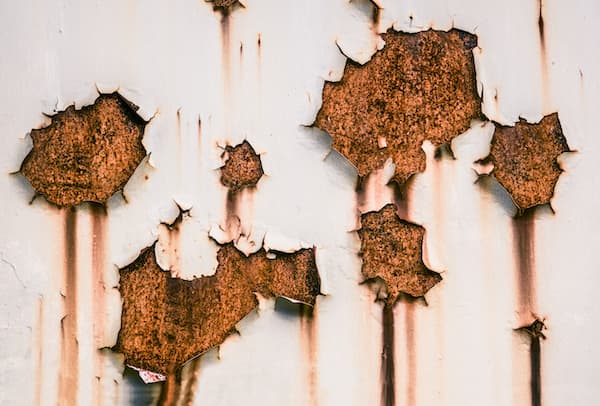
| Light surface oxidation | Powdery orange film, no pitting | Wire brush + converter + topcoat | 7–10 years dry climate |
| Moderate flaky rust | Scale lifts under thumbnail | Wire wheel + converter (2 coats) + urethane | 5–7 years mixed climate |
| Heavy scale with pitting | Pits 1–3 mm deep, sound base | Needle scaler + converter + epoxy + urethane | 3–5 years salt belt |
| Perforated metal | Light visible through panel | Cut, patch, weld, then converter on adjacent areas | N/A — structural repair |
| Aluminum or galvanized | White powder, not orange | Skip converter. Use aluminum-specific etch. | N/A — wrong chemistry |
Salt wins every time. Inland projects in dry climates can stretch the upper end of these ranges. Coastal and salt-belt projects should plan for the lower end and budget for a touch-up coat every two seasons.
XionLab vs. Other Converters: Where Each One Wins
We have used most of them. POR-15. Corroseal. Ospho. Rust-Oleum Rust Reformer. Each has a sweet spot and a failure mode. Here is the honest read.
Corroseal works well for lighter surface rust on flat panels. The water-based formula brushes on cleanly and dries to a milky film. Where XionLab pulls ahead is on heavy scale and on jobs that need a primer in the same coat. We have seen Corroseal lift under aggressive sanding, where the XionLab 2-in-1 holds.
POR-15 is harder than a hockey puck once cured. Brutal UV resistance with their topcoat system. The downside is shelf life and surface sensitivity. Open a can twice and the rest skins over. XionLab's water-based formula lets you reseal and use the same can six months later.
Ospho is a single-acid phosphoric prep, not really a true converter. It chemically prepares the surface but offers no primer layer and no UV protection. Cheap, useful for a narrow use case. XionLab combines the prep step and the primer step.
NACE’s long-running corrosion-management studies report that targeted prevention practices in the automotive sector cut industry corrosion costs by roughly 52 percent between 1975 and 1999. The product category has only matured since.
Step-by-Step: Applying the Converter Right the First Time
Sequence is everything. Skip a step and you redo the job in a year. We follow the same six-step rhythm on every project, whether it is a tractor bucket or a rooftop railing.
- 1. Knock off loose scale. Wire wheel or needle scaler. Anything that flakes under a thumbnail needs to come off first.
- 2. Degrease. Wax-and-grease remover or acetone. Oil contamination is the number-one cause of premature failure.
- 3. Rinse and dry. Cool water, full evaporation. A damp surface dilutes the acids and weakens the bond.
- 4. Brush or roll the first coat. Thin. Not heavy. The acids need air contact to react properly.
- 5. Wait 24 hours. Then apply a second thin coat. One thick coat is worse than two thin ones, because the top skins over while the bottom stays liquid.
- 6. Topcoat after 72 hours. Urethane for outdoor service. Epoxy for marine immersion-adjacent service. Cheap latex for indoor decor only.
Two thin coats. 24 hours apart. That is the entire trick. Most failures we see trace back to a single heavy coat applied in a hurry. Full surface prep walkthrough is here.
A Real Project: The 1998 GMC Sierra Frame
One of our field testers picked up an old 1998 GMC Sierra in central Pennsylvania last fall. Frame rust was about a quarter-inch thick in places along the crossmembers, with scale flaking like pie crust over sound steel underneath. Classic salt-belt patient.
The workflow was straightforward, even if it took a full Saturday. He pressure-washed the frame, let it dry overnight in a heated garage, then went after the scale with a 4-inch wire cup on an angle grinder. He degreased with brake clean, rinsed with cool water, and waited about three hours for full evaporation. Two thin coats of XionLab 2-in-1, 24 hours apart, brushed on with a chip brush in the tight spots and rolled on the flat sections. He topped it with a single-stage automotive urethane after the converter cured for three days.
One coat. Done.
The truck went back into daily winter service on salted roads. We checked it again at twelve months. Surface still locked down, no pinholes, no bubbling. The body shop quoted him $3,400 for a strip-prime-paint job on the same frame. He spent under $90 in materials.
One honest caveat: he did not stop the rust. He arrested it. There is a difference. Once steel has lost mass to oxidation, it does not grow back. A converter freezes the damage at its current depth so the surface stays paintable.
Why the XionLab 2-in-1 Stands Apart
Most converters tackle one job. Either they react with rust or they prime the surface. The XionLab 2-in-1 does both in a single coat, which collapses the timeline and the material cost.
Tannate-Phosphate Chemistry
Dual-acid formulation locks ferric iron and lays a phosphate primer in one application, with stable conversion under field conditions.
Water-Based, Low VOC
Brushes, rolls, or sprays. Cleans up with soap and water. No respirator required for typical outdoor jobs.
Topcoat-Ready
Accepts urethane, epoxy, latex, and most automotive systems without an etching primer in between.
Tested in Salt Belts
Field-tested on Gulf Coast trailers, Atlantic boat docks, Pacific Northwest railings, and Northeast plow trucks.
Terra Care Seal
Certified safer-for-you, safer-for-the-environment formulation with documented non-toxic ingredient sourcing.
Long Shelf Life
Reseal and use the same can months later. Water-based chemistry resists skinning between projects.
Climate-Specific Application Notes
One product. Five wildly different climates. The application sequence stays the same, but the wait times and topcoat choice shift by region.
Gulf Coast and Florida humid coastal homes. Apply between 50 and 90 degrees Fahrenheit with relative humidity under 80 percent. Higher humidity slows full cure. Cover with a marine-grade urethane within five days.
Northeast and Midwest salt belt. Time your job for late spring or early fall. Brake-clean the surface twice if the part has seen winter salt. Plan for an annual touch-up coat on plow vehicles.
Pacific Northwest persistent damp. Long cure windows. Use a heated garage if available. The converter still works, just on a slower clock.
Desert Southwest dry heat. Best converter conditions on earth. Cure can finish in under 48 hours. UV is your enemy here, not moisture. Always topcoat.
Mountain freeze-thaw. Apply only when overnight lows stay above 40 degrees Fahrenheit until the second coat dries. Freezing during cure kills the bond.
Frequently Asked Questions
No. A converter needs iron oxide to react with. On bare steel it sits as a thin acid film, never converts, and peels off under any topcoat. Use a self-etching primer on bare metal instead.
Indoors, the bare converter film holds for years. Outdoors, plan on six to eighteen months before UV breakdown starts to show. Always topcoat for outdoor service.
Partially. The converter will react with the rust inside the pit, but it cannot replace lost metal. If pits exceed 50 percent of original wall thickness, weld a patch first.
Yes. The water-based, low-VOC formula carries a Terra Care Seal certification. Open a window for airflow, but no respirator is required for typical projects under 100 square feet.
Only where the paint has failed and rust shows through. Scuff the surrounding paint to feather the edge, then brush converter onto the exposed rust only. Old paint blocks the chemistry.
A thick puddle skins on top while the bottom stays liquid. The skin cracks within weeks and the whole film fails. Two thin coats always beat one heavy coat.
Mostly, yes. A clean shift from rust-red to dark gray or blue-black is the visual signal. Patchy spots mean either oily contamination or rust too thick for the acid to reach the active layer.
No. Chrome plating sits on top of steel and corrodes by chloride attack on the chrome layer itself. The chemistry differs entirely from iron oxide formation. Use a chrome-specific polish or replate.
Ospho is single-acid prep with no primer layer. Corroseal handles light surface rust well but lifts under aggressive sanding. The XionLab 2-in-1 combines conversion and priming in one coat and holds under topcoat sanding.
Stop Rust Before It Wins
One product. One coat. Ready for a topcoat in 72 hours. Field-tested on automotive frames, marine hardware, patio furniture, and industrial steel.