Rust converter
Rust Converter for Cars: Treat Automotive Rust Without a Body Shop

Quick answer: A rust converter for cars is an acid based liquid coating, usually tannic or phosphoric, and it reacts with iron oxide to form a stable dark film you can prime and paint. On light or moderate corrosion across panels, floor pans and frame rails, it stops the spread and saves the metal. On steel already perforated, it saves nothing.
The Problem
Where Car Rust Actually Begins
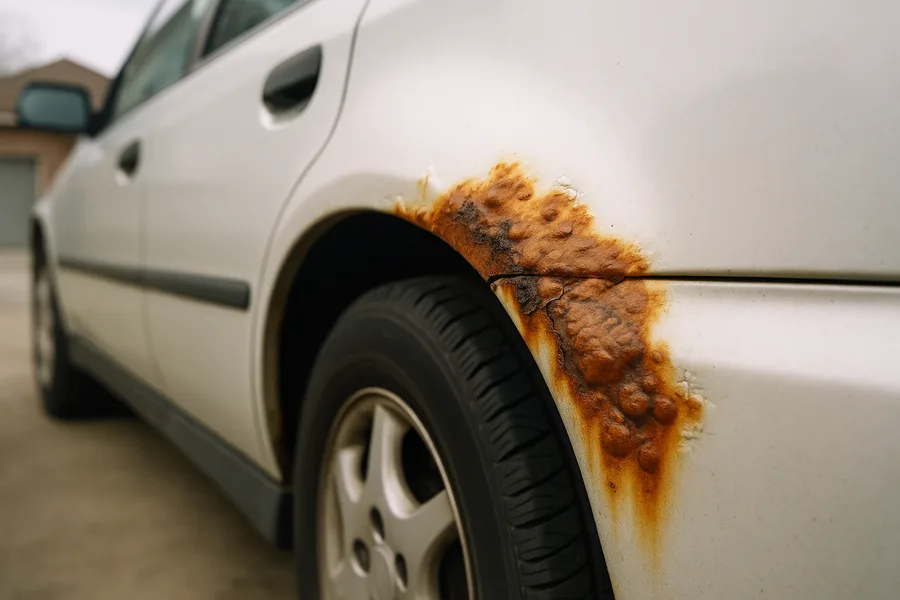
Rust rarely announces itself where it started. By the time a brown blister pushes through paint on a rear wheel arch, the steel behind it has been dissolving for a year or longer, usually working outward from the hidden face of the panel. What you see is the ending, not the beginning.
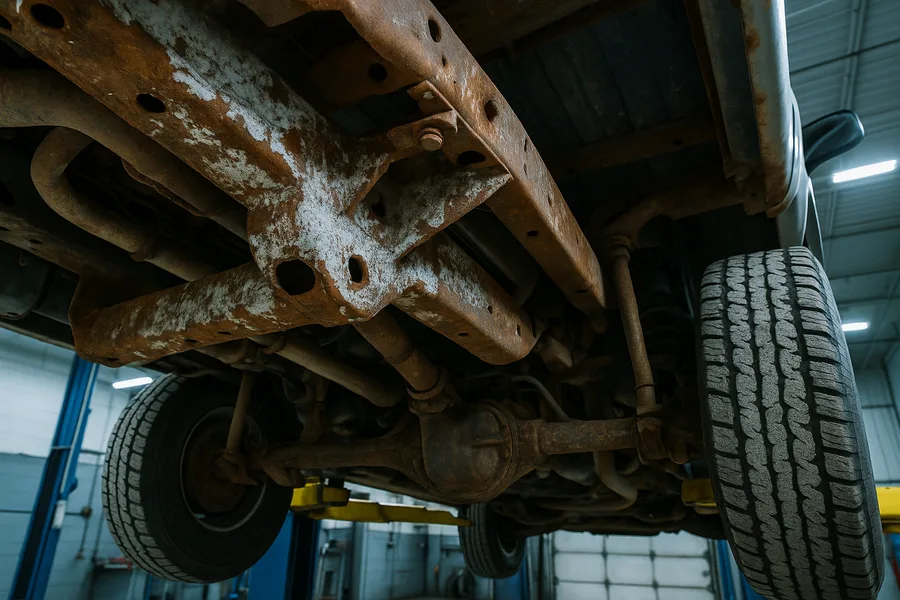
Vehicles corrode in depressingly predictable places. Wheel arches and rocker panels absorb every rock chip and every rope of slush thrown off the front tires. Lower door skins hold water because their drain holes pack solid with pine needles and road film. Floor pans rot beneath damp carpet, silently, for years. Frame rails and crossmembers suffer worst of all, since brine settles into the box sections and never quite dries out.
Geography decides how fast. Drivers across Michigan, Ohio, Pennsylvania and the rest of the salt belt watch winter brine chew through undercarriages between December and March. Gulf Coast owners face a slower enemy: year round humidity carrying airborne chloride, which corrodes gently but never takes a season off. Pacific Northwest cars collect moss in their seams and stay wet from October onward.
The national bill is staggering.
American drivers spent this much over five years repairing corrosion traced to road salt and liquid de-icers, averaging roughly $490 per vehicle. Source: AAA Newsroom.
Roughly 22 million drivers experienced that damage firsthand. And most of them paid a shop for repairs a bottle of converter and an afternoon could have prevented, had anyone caught the corrosion at the blister stage.
The Chemistry
What a Converter Does to Corroded Steel
Iron oxide is loose, porous and endlessly hungry for moisture. Left alone it wicks water down to clean metal underneath and keeps eating. A converter interrupts that cycle chemically rather than mechanically.
Tannic acid formulas bond with the oxide and produce iron tannate, a dense blue black compound with no appetite for oxygen. Phosphoric acid versions build iron phosphate instead, grayer in tone, equally inert. Either way the loose orange powder becomes a tight adherent film bonded to the panel, and most formulas leave a polymer layer on top ready to accept primer. The color shift from rust orange to near black is your visual receipt that the reaction happened.
Confusion between product categories costs people a lot of wasted weekends. A remover strips oxide away with acid or chelation and hands you bare reactive steel, which flash rusts within hours unless you coat it immediately. A converter leaves the oxide in place and neutralizes it. Our breakdown of rust converter versus rust remover covers where each belongs, and the deeper explanation of converter chemistry walks through the reaction itself.
One more distinction worth keeping straight. Encapsulators seal rust under a thick barrier coating without changing it, betting the moisture stays out. Converters change the chemistry. Both approaches have defenders among restoration shops, though converters tend to win on thin automotive sheet metal where an extra 12 mils of coating creates fitment headaches.
Diagnosis First
Which Rust Stage a Converter Can Fix
Grab a screwdriver and a flashlight before you grab a brush. Press firmly on the corroded area. Solid metal pushes back. Soft metal gives, and metal with a hole behind the paint will simply cave in, which tells you everything. So the treatment question is really a diagnosis question.
| Rust Stage | What It Looks Like | Screwdriver Test | Does a Converter Help? |
|---|---|---|---|
| Surface | Orange haze or speckling, paint intact or lightly chipped | Firm, no give | Yes. Ideal candidate, one application usually settles it |
| Scale | Flaking layers, bubbled paint, brown crust about a sixteenth of an inch thick | Firm but rough | Yes, after knocking off loose scale with a wire wheel |
| Penetrating | Pitting visible in bare steel, metal thinned but unbroken | Slight flex under pressure | Partially. Stops progression, cannot restore lost thickness |
| Perforation | Holes, crumbling edges, daylight through the panel | Punches through | No. Cut and weld, or replace the panel |
Fair warning — and this is the part product pages quietly skip — a converter is a chemical treatment, not a structural repair. It has no tensile strength. Spreading it across a frame rail with a hole in it produces a black painted hole, nothing more. If you are unsure how far the corrosion has traveled, our guide on stopping rust before it spreads explains how to trace the perimeter.
The Process
Treating Automotive Rust in Your Driveway
Budget an afternoon, plus overnight curing. The work itself is unglamorous and mostly involves a wire brush.
Knock off everything loose
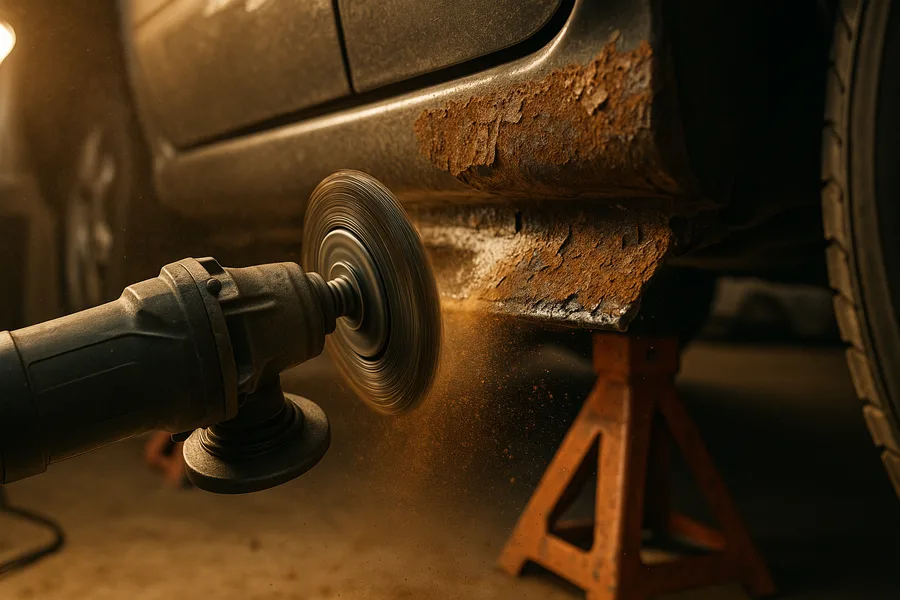
A wire wheel on an angle grinder handles scale fast. For tight spots around seams and bolt heads, a hand brush and coarse sandpaper get the job done without gouging good sheet metal. Stop when the surface reads tight and matte. Chasing every last speck of oxide defeats the purpose, since the oxide is precisely what the chemistry needs to react with.
Degrease, then degrease again
Undercarriage steel carries decades of oil mist, wax coating and road film. Acid cannot penetrate any of it. Wax and grease remover on a lint free rag, worked until the rag comes away clean, is the single most skipped step in driveway rust work and the leading cause of a converter simply peeling off two weeks later.
Watch the weather
Most formulas want 50 to 90 degrees Fahrenheit and relative humidity under about 85 percent. Cold slows the reaction to a crawl. Direct sun on dark metal flashes the carrier off before the acid finishes working, so an overcast morning in a shaded driveway beats a bright afternoon every time.
Apply thin, apply twice
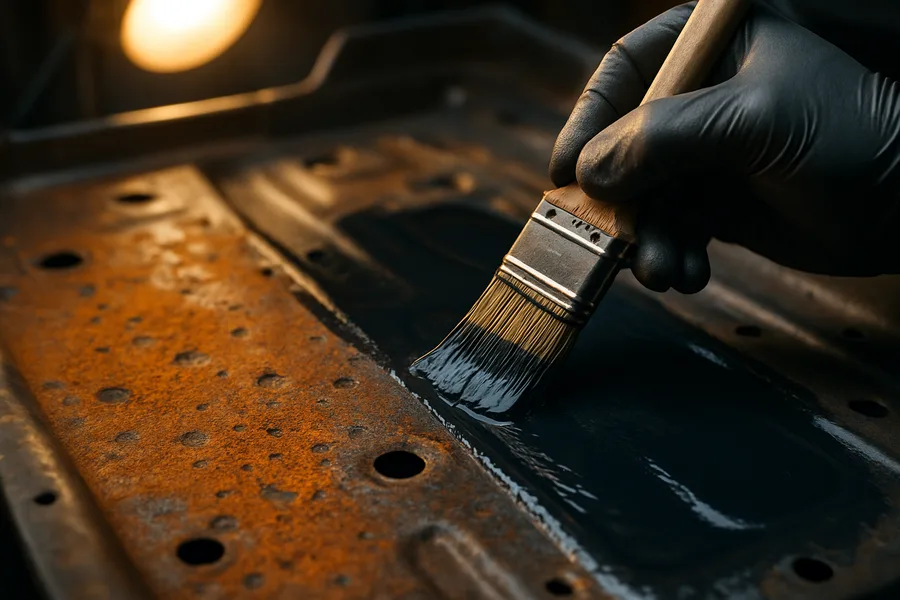
Brush or roll a thin even film. Thick coats trap solvent, skin over, and cure into something rubbery underneath. Let coat one dry to the touch, usually 20 to 40 minutes, then lay down a second. Full cure takes 24 hours, sometimes 48 in cool weather.
Seal it
The converted film is stable but not waterproof on its own, and it is not UV resistant. Oil based enamel, epoxy primer, or a dedicated chassis coating all work. Latex does not, because water borne paint reactivates the surface and lifts. There is more detail on topcoat sequencing in our article about painting over rusted metal.
Avoid These
Mistakes That Ruin a Good Job
Nearly every failure traces back to one of six habits, and none of them are exotic.
- Coating over grease or wax. The acid never touches oxide and the film delaminates in sheets.
- Going too thick. One heavy pass looks productive and cures badly. Two thin passes outperform it by a wide margin.
- Treating only the visible side. Rust on an outer fender almost always started inside the cavity. Treat what you can reach through drain holes, or accept the repair is cosmetic.
- Skipping the topcoat. Bare converted film chalks under sunlight and eventually lets moisture back through.
- Latex paint on top. Water based coatings and acid films are chemically incompatible. Oil based only.
- Ignoring the edges. Corrosion creeps outward under sound paint. Feather your treatment two inches past visible damage.

Worth mentioning too — the dark cured film is a primer surface, never a finish. Owners sometimes love the flat black look on a chassis and leave it. Six months later it looks chalky and gray.
Know the Limits
When a Body Shop Is the Right Call
Some corrosion belongs to professionals with a welder and a lift. Frame rails, unibody rails, subframe mounting points, suspension pickup points, seatbelt anchors, brake line brackets and fuel tank straps all carry load or carry your ability to stop. Softness in any of them is a structural finding, and no chemical fixes a structural finding.
Federal safety recalls covering frame corrosion have hit multiple truck platforms over the past two decades, which is a reasonable reminder that manufacturers themselves treat this as a safety matter rather than a cosmetic one. Checking your VIN against open campaigns at NHTSA takes about a minute and occasionally saves thousands. Owners of older salt belt pickups can start with our writeup on F-150 frame corrosion, where the problem areas are well documented.
Corrosion engineering standards published by AMPP, the organization formed from NACE International and SSPC, define surface preparation grades used throughout industry. Shop quality work follows them. Driveway work approximates them, and honestly that approximation is fine for a rocker panel and completely inadequate for a suspension mount.
The Math
Driveway Cost Versus Shop Cost
Here is where the argument for handling it yourself becomes hard to ignore. A quart of converter runs somewhere around 25 to 40 dollars and covers 50 to 75 square feet, which is both rear wheel arches, a rocker panel and a good stretch of floor pan. Add a wire wheel, a can of degreaser, gloves, a respirator and a quart of enamel topcoat, and a first project lands near 80 dollars. Every project afterward costs less, because you already own the tools.
Compare that against the AAA figure of roughly $490 per rust repair, and against the 1,200 to 2,500 dollars a body shop quotes to cut out and replace a rotted quarter panel section. The gap is the whole argument.
But there is a tradeoff, and pretending otherwise would be dishonest. Driveway work will not match a shop finish. Color match on a treated fender is difficult without spray equipment. Cavity wax injection needs a wand and a compressor. If the vehicle is a show car or a lease return, professional work pays for itself. If the vehicle is a nine year old commuter you intend to drive until the wheels fall off, an afternoon and 80 dollars is an obviously good trade.
Prevention beats both numbers. Washing the undercarriage after salt exposure, keeping drain holes clear, and treating small chips before they blister costs almost nothing. Our overview of rust prevention products covers the proactive side.
Common Questions
Frequently Asked Questions
Can I apply a rust converter for cars directly over old paint?
No, and it wastes product. The chemistry reacts with iron oxide only. Sound paint blocks contact entirely, so the film sits on top and peels. Scuff back to rust and bare metal in the treatment zone, then feather the edges.
How long does a treated panel last?
With a proper oil based topcoat and no fresh damage, five to ten years is realistic on a body panel. Undercarriage surfaces exposed to winter brine and stone impact need inspection every couple of seasons. Bare converted film with no topcoat degrades within a year.
Will it work on my brake lines or fuel lines?
Skip it. Corroded brake and fuel lines are replacement items, full stop. A line that has rusted enough to look treatable has already lost wall thickness, and a failure there is catastrophic rather than inconvenient.
What if the converted surface stays sticky?
Sticky means the coat went on too thick or humidity was too high during curing. Give it another 24 hours in dry conditions. Still tacky? Scuff it lightly and reapply thinner. Sticky film will never accept a topcoat properly.
Does a converter work on aluminum or galvanized parts?
Aluminum does not produce iron oxide, so there is nothing for the acid to convert. Galvanized steel poses a different problem, since the zinc coating reacts unpredictably. Both surfaces call for a self etching primer instead.
How much surface can one quart cover?
Roughly 50 to 75 square feet per quart across two coats, depending on how pitted the metal is. Heavily scaled steel drinks noticeably more. Buy a little extra rather than stopping partway through a panel.
Can I treat rust in winter?
Only in a heated space. Below 50 degrees the reaction slows badly and the film may never fully cure. A garage held at 60 degrees for the full 24 hour window works fine, which is why many owners schedule this work for early autumn.
Keep Reading
Dozens of detailed guides on treating, preventing and understanding corrosion across vehicles, equipment and structural metal.
Safer For You, Safer For The Environment